
Corn Head Smut
Sporisorium reilianum (J.G. Kühn) Langdon & Full.; maize-adapted form traditionally cited as S. reilianum f. sp. zeaeCorn Head Smut overview
Corn head smut is a systemic fungal disease caused by Sporisorium reilianum f. sp. zeae. Infection usually occurs while corn seedlings are emerging, but symptoms may remain hidden until tassels and ears develop. Affected inflorescences are replaced by large, dark, powdery spore masses, often with leafy or malformed growth. Resistant hybrids and clean field practices are the main management tools.
Typical conditions
Overview
Corn head smut is caused by the maize-adapted form of the basidiomycete fungus Sporisorium reilianum. Unlike common corn smut, which commonly produces localized galls on several aboveground tissues, head smut develops systemically and becomes most conspicuous when the tassel or ear is forming.
The pathogen has a narrow grass-host relationship, but host specialization is important: S. reilianum populations associated with maize and sorghum are treated as host-adapted forms with different disease behavior. In the United States, diagnosis should be based on the characteristic replacement of the inflorescence and, where needed, laboratory confirmation.
Symptoms and identification
- Plants may be stunted, excessively tillered, weak, or show loss of normal apical dominance.
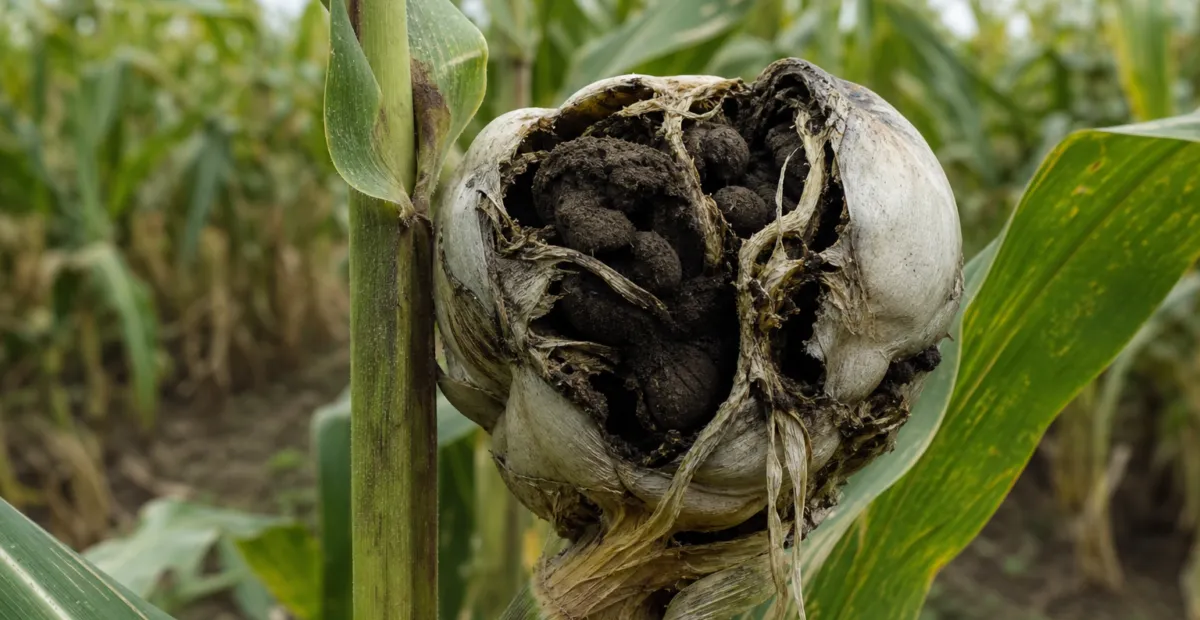
- Tassels or ears are partly or completely replaced by a large, swollen smut sorus covered initially by a pale membrane.
- The membrane ruptures to expose dark brown to black, powdery teliospores mixed with persistent strands of vascular tissue.
- Inflorescences may show leafy growth, phyllody, abnormal branching, or multiple small malformed ears.
- An infected plant often produces little or no usable grain; an affected ear may be completely lost.
- Early infections are usually difficult to see because the fungus can grow inside the plant without obvious external symptoms until flowering.
Do not confuse head smut with common corn smut, which more often forms separate gray-white or black galls on leaves, stalks, ears, or tassels.
Causes and spread
The primary inoculum is made up of durable, soil-borne teliospores released from ruptured smut heads and infected plant debris. Spores can be moved locally by wind, rain splash, cultivation equipment, contaminated soil, animals, and handling of infected plants. Spores may also adhere to the outside of seed, although the disease is primarily regarded as soil-borne rather than an internal seed infection.
After germination, compatible fungal cells mate and produce infectious hyphae. The fungus enters very young corn plants, grows with the developing tissues, and eventually reaches the floral meristems. Once the tassel or ear is invaded, normal reproductive tissue is replaced by a sorus containing new teliospores.
Infection risk is greatest during the seedling stage. Disease severity is strongly influenced by hybrid susceptibility, local pathogen populations, soil conditions, planting depth, and environmental conditions during emergence.
Life cycle and persistence
- Teliospores remain in infested soil or crop debris between crops and may survive for several years.
- With suitable moisture and temperature, teliospores germinate and produce haploid sporidia of compatible mating types.
- Compatible sporidia fuse, forming dikaryotic infectious hyphae.
- The hyphae infect emerging corn seedlings and grow systemically, often without visible symptoms.
- The pathogen moves through young tissues toward the shoot apex and floral meristems.
- At tassel or ear development, reproductive tissue is transformed into a smut sorus.
- The sorus ruptures and releases teliospores, completing the cycle and contaminating soil and debris.
Treatment and control
There is no practical curative treatment for a corn plant after systemic infection has occurred. Once a tassel or ear is replaced by a smut sorus, remove the plant or affected head promptly and contain the material before the membrane ruptures and spores disperse.
For future plantings, the most effective approach is integrated prevention: choose resistant genetics, use clean seed, reduce movement of infested soil and debris, improve seedling establishment, and avoid planting highly susceptible corn repeatedly in the same contaminated ground. In commercial production, local extension or seed-company resistance information is more useful than a universal treatment recommendation because pathogen populations and hybrid reactions vary.
Fungicide seed treatments may reduce infection under some tested conditions, but performance is product-, crop-, pathogen- and application-specific. They should not be considered a substitute for resistant varieties and sanitation.
Low-impact and biological control
- Remove smutted plants or inflorescences before spore release and dispose of them in sealed bags or through an appropriate waste pathway.
- Do not save seed from affected plants or knowingly plant seed heavily contaminated with smut spores.
- Wash soil and plant residue from tools, boots, tillers, and harvest equipment before moving between fields or garden beds.
- Use resistant corn genetics, crop rotation, and clean planting material as the primary nonchemical controls.
- Keep records of affected cultivars and locations so susceptible varieties can be avoided in subsequent seasons.
- No widely reliable home-garden biological control has been established for systemic corn head smut; products marketed for soil or seed use should be evaluated only when they have evidence for this disease and are legally permitted for the crop.
Prevention
- Plant corn hybrids or open-pollinated varieties with documented resistance to head smut for the relevant production region.
- Use certified, clean seed and avoid moving soil, debris, or machinery from heavily infested areas into clean beds or fields.
- Scout fields and gardens from seedling emergence through tasseling, especially where the disease has occurred previously.
- Remove and destroy infected plants before the sori rupture whenever practical. Bag or otherwise contain them; do not compost visibly spore-filled heads unless the composting system reliably reaches pathogen-destroying temperatures.
- Clean soil from tillage, gardening, and harvesting equipment before it leaves an infested area.
- Use crop rotation to reduce repeated exposure, recognizing that rotation alone may not eliminate long-lived teliospores.
- Control volunteer corn and manage susceptible maize relatives where they could maintain local inoculum; do not assume every grass is a host.
- Maintain uniform emergence with appropriate planting depth, soil preparation, and irrigation, because healthy seedlings are better able to withstand infection pressure.
Interesting facts
- The disease is also called head smut of maize or corn.
- The black powder is composed largely of teliospores, the survival and dispersal stage of the fungus.
- Infected plants may look normal for much of the season because the pathogen grows internally before flowering.
- Maize- and sorghum-associated populations are host-adapted; a sorghum isolate is not automatically equivalent to a maize head-smut isolate.
- Head smut can cause total harvest loss on an individual infected corn plant because the ear or tassel is replaced rather than merely blemished.
- Resistance is quantitative and varies among corn germplasm, pathogen populations, and environments.
Use only pesticide or fungicide products legally authorized for corn, sweet corn, or the specific crop and disease in the United States and in your state. Read and follow the current label, including crop, disease, rate, timing, personal protective equipment, reentry, disposal, and preharvest requirements. Do not apply a product solely because it is labeled for another smut disease. For commercial decisions, consult your state extension plant pathologist or crop adviser.