
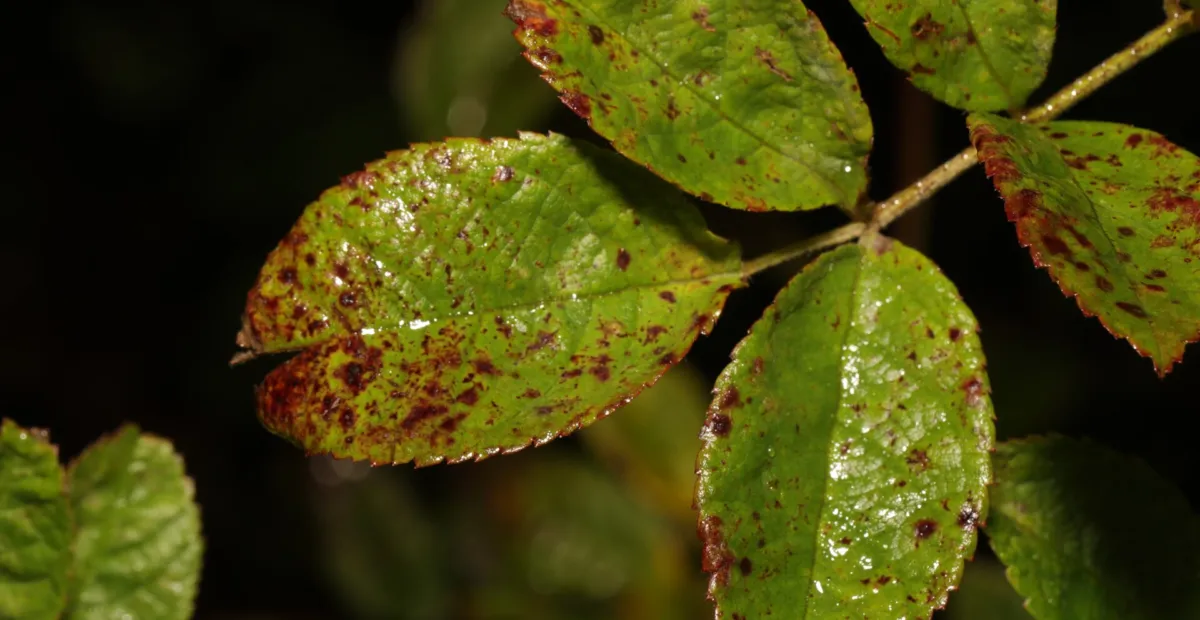
Rose black spot
Diplocarpon rosaeRose black spot overview
Rose black spot is a fungal disease caused by Diplocarpon rosae, affecting cultivated and wild roses throughout humid or frequently wet growing conditions. It produces dark, fringed leaf spots surrounded by yellowing, followed by premature defoliation. The disease is rarely fatal by itself, but repeated leaf loss weakens plants, reduces flowering and increases winter injury risk.
Typical conditions
Overview
Rose black spot is one of the most important foliar diseases of garden roses in humid climates and during wet growing seasons. It is caused by the ascomycete fungus Diplocarpon rosae, formerly associated with the name Marssonina rosae.
Symptoms usually begin on the upper surfaces of leaves as dark brown to black, round or irregular spots with feathery or radiating margins. Yellowing develops around older lesions, and affected leaves may drop early. Young stems and succulent canes can also develop purplish to black lesions.
Severity varies with rose cultivar, pathogen strain, weather and irrigation practices. Modern hybrid teas, grandifloras and many miniature roses may be especially vulnerable, while resistance is cultivar-dependent rather than guaranteed by rose type alone.
Symptoms and identification
- Dark brown, black or purplish spots on leaflets, often with fringed, fibrous or feathery margins.
- Yellow halos or broad areas of chlorosis surrounding older lesions.
- Premature yellowing and drop of leaves, sometimes beginning from lower foliage and progressing upward.
- Small purplish, brown or black lesions on young canes and stems.
- Severe recurring infections cause sparse foliage, reduced flowering, weak late-season growth and increased susceptibility to winter injury.
Black spot can resemble other rose leaf-spot diseases. Confirmation is more reliable when the characteristic fringed lesions, yellowing and premature defoliation occur together under persistently wet conditions.
Causes and spread
The pathogen survives in infected living or fallen leaves and in diseased stem tissue. Spores are moved primarily by splashing rain, irrigation water, and contact with wet foliage. New infections are favored when rose leaves remain continuously wet for roughly seven hours or longer.
Dense plantings, poor air movement, evening overhead irrigation, frequent rainfall, fog, heavy dew and shaded sites prolong leaf wetness. Inoculum left in fallen leaves or infected canes can initiate disease in the following growing season. Disease intensity also differs among pathogen populations and rose genotypes.
Life cycle and persistence
Diplocarpon rosae persists between active disease periods in infected leaves and stems. During wet weather, the fungus produces spores in dark fruiting structures within lesions and on overwintered tissue. Splashing water carries spores to susceptible rose foliage.
After a spore lands on a wet leaf, it can germinate and penetrate the tissue. New lesions develop after an incubation period that varies with temperature, cultivar and pathogen strain. Repeated cycles of spore production and splash dispersal can rapidly increase disease during rainy or humid weather.
When infected leaves fall, the pathogen may remain capable of producing inoculum. Removing diseased foliage reduces, but does not necessarily eliminate, the local source of infection.
Treatment and control
Begin with sanitation and moisture management. Remove severely spotted leaves and collect fallen foliage, especially when disease is increasing. Prune congested or infected canes during suitable dry weather and discard diseased material in household trash where permitted; do not add it to a slow or cool compost pile.
Fungicides protect healthy new foliage; they do not restore leaves already damaged or shed. If disease recurs annually, applications generally need to begin as new leaves emerge and continue according to the product label during periods favorable for infection. Rotate products with different modes of action when repeated applications are necessary, and combine chemical protection with resistant cultivars, sanitation and dry-foliage practices.
Low levels of leaf spotting may be tolerated on established plants. If a rose repeatedly defoliates despite cultural improvements, replacement with a better-adapted resistant cultivar is often more effective than an intensive spray program.
Low-impact and biological control
- Remove and dispose of infected leaves and fallen debris promptly.
- Improve air circulation by thinning crowded growth without creating excessive pruning wounds.
- Use morning soil-level irrigation and avoid routine overhead watering.
- Where legally labeled for roses and black spot in the United States, products based on potassium bicarbonate, sulfur or certain horticultural oils may reduce disease when used preventively and according to the label.
- Test any oil, bicarbonate or sulfur product on a small portion of the cultivar first; avoid treating heat- or drought-stressed plants and follow all cautions about mixing or applying oils near sulfur treatments.
- Biological and low-impact products should be viewed as components of an integrated program, not substitutes for sanitation and resistant plant material.
Prevention
- Choose rose cultivars described by reliable US nursery or extension sources as resistant or highly resistant to black spot; resistance may vary by region and pathogen strain.
- Plant roses where they receive at least 6 hours of direct sun, preferably with good air movement.
- Space plants to allow foliage to dry quickly and prune crowded growth selectively.
- Water the soil at the base of plants in the morning rather than wetting leaves late in the day.
- Remove fallen rose leaves and badly infected leaves during the season; clean up remaining debris during dormant-season pruning.
- Prune out visibly infected canes when practical and disinfect tools between plants when moving from diseased to healthy specimens.
- Avoid excessive nitrogen fertilization, which can promote lush, disease-prone growth.
Interesting facts
- The disease name refers to the conspicuous black leaf spots, but the surrounding yellowing and premature leaf fall are often more damaging aesthetically than the spots themselves.
- Rose black spot is principally a disease of the genus Rosa; susceptibility differs widely among species, hybrids and cultivars.
- Different pathogen populations, commonly called races or pathotypes in research, can overcome resistance in some rose genotypes, so no single resistance claim is universally reliable.
- Leaves do not need to be visibly dripping for infection risk to be high: long periods of dew, fog or humid wetness can be sufficient.
- Keeping foliage dry and removing inoculum are often more valuable in home landscapes than attempting to eradicate the fungus after extensive defoliation has occurred.
Use only fungicides legally authorized and currently labeled for roses and rose black spot in your state and country. Follow the current label exactly, including crop/site, rate, personal protective equipment, reentry interval, application interval, weather restrictions and disposal instructions. Product registrations and available active ingredients can change; do not use a product solely because it is recommended for another crop or disease.
Affected plants
The plants below are linked to this problem by structured host-plant data. The list updates automatically as new plant profiles are added.
 Bodinier’s Beautyberry (Callicarpa bodinieri) care guideCallicarpa bodinieri
 Urnip rape (Brassica rapa) care guideBrassica rapa
 Collard greens (Brassica oleracea) care guideBrassica oleracea
 Multiceps Group (Brassica juncea Multiceps Group)Brassica juncea Multiceps Group
 Moth orchid (Phalaenopsis ‘Harlequin’)Phalaenopsis 'Harlequin'
 Orchid (Phalaenopsis violacea) care guidePhalaenopsis violacea
 Musa ‘Dwarf Cavendish’Musa 'Dwarf Cavendish'
 Delphinium ‘Blue Bird’Delphinium 'Blue Bird'
 Delphinium elatum care guideDelphinium elatum
 Elkhorn Fern (Platycerium bifurcatum) care guidePlatycerium bifurcatum