
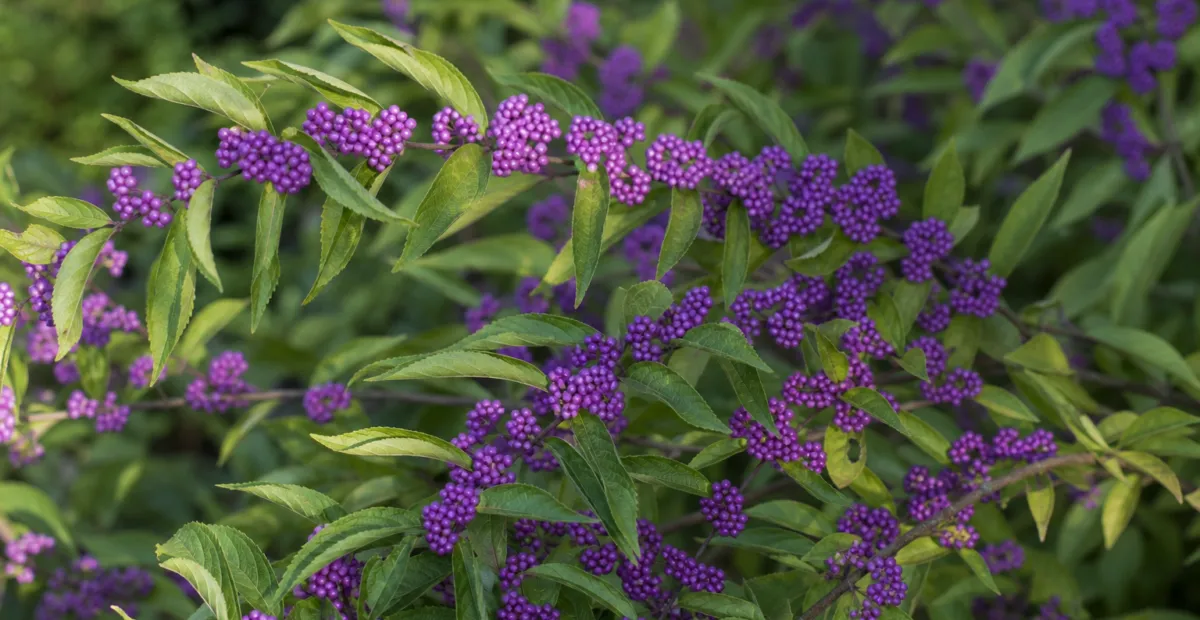
 AI-generated illustration
Bodinier’s Beautyberry (Callicarpa bodinieri) short overview
Bodinier's beautyberry is a deciduous Chinese shrub grown in the United States for its summer sprays of small lilac flowers and vivid violet-purple berries. The rounded, upright plant develops best in full sun, where flowering and fruiting are strongest, but it tolerates partial shade. Its toothed, downy leaves turn yellow in fall, while berry clusters often remain after the foliage drops. A rounded, deciduous shrub from central and western China, valued primarily for lilac summer flowers followed by glossy violet-purple berry clusters in fall.
Taxonomic classification
Bodinier’s Beautyberry (Callicarpa bodinieri) care guide
Light and placement
Place in full sun for the heaviest flowering and most abundant berry display; an east-, south-, or west-facing site is suitable. Partial shade is tolerated, especially with bright afternoon or filtered light, but deep shade can produce lanky stems and fewer flowers and fruits. Excessive heat combined with reflected light may increase leaf scorch if the root zone dries.
Watering and humidity
Water deeply when the upper few inches of soil begin to dry during the first growing season. Established shrubs prefer even, moderate moisture but should not stand in saturated soil. Reduce watering after leaf drop and during cool weather, while continuing occasional irrigation during prolonged autumn or winter drought when the ground is workable. Average garden humidity is adequate.
Soil and growing medium
Use ordinary garden soil amended only when drainage or structure is poor. A loam or sandy loam that drains freely yet retains some moisture is ideal; clay is acceptable if it is not chronically waterlogged. Incorporate organic matter into compact soil, keep the root flare at soil level, and mulch without covering the stems. A slightly acidic to neutral pH is a practical target.
Feeding
Apply a thin layer of compost or a label-rate, balanced slow-release shrub fertilizer in early spring as growth begins. Feed only when the plant shows weak growth or when soil fertility is low; excessive nitrogen can encourage soft, leafy growth at the expense of flowering and fruiting. Do not fertilize during drought, immediately before hard freezes, or after late-summer growth has begun to harden.
Growth and habit
This is a medium-growing, upright-to-rounded shrub with slender branching and new flowers produced on the current season's growth. It can become open or leggy in insufficient light. Group planting improves cross-pollination and fruit set, while renewal pruning helps maintain a denser framework. Winter dieback may occur in colder sites without necessarily preventing the next season's display.
Planting and repotting
Choose a sunny, protected site with reliable drainage. Dig a hole no deeper than the root ball and two to three times its width. Loosen circling roots, set the shrub with the root flare level, backfill with native soil, water thoroughly, and apply a 2–3 inch mulch layer away from the stems. Water consistently through the first growing season. Planting multiple shrubs together can improve fruit set.
For container plants, repot in early spring just as growth resumes, moving to a container only modestly larger than the root ball. Use a free-draining woody-plant mix and ensure generous drainage holes. Root-prune lightly only when necessary. Container shrubs dry and freeze more quickly than plants in the ground, so monitor moisture and winter exposure carefully.
Propagation and pruning
Propagation
Stem cuttings are the most practical method for named plants and are commonly taken from softwood or semiripe growth during the active growing season. Use clean material, a sterile, well-drained rooting medium, rooting hormone, and high humidity with good ventilation. Seed is also possible from ripe berries, but seedlings may vary and germination can be slower or less uniform.
Pruning
Prune in late winter or very early spring before new growth begins. Remove dead, damaged, crossing, or weak stems first. To maintain a dense shrub, thin selected older branches at the base or cut the whole plant back to roughly 6 inches in colder areas where stems routinely die back. Avoid heavy late-summer pruning, which can remove next season's framework and reduce fruit display.
Overwintering
In Zones 6–8, mulch the root zone and avoid late-season fertilizer that could stimulate tender growth. In colder Zone 5 sites, choose a sheltered location and expect possible above-ground dieback; stems can be cut back in late winter and allowed to regrow. Container plants need protection from repeated deep freezing, with roots insulated or the container moved to an unheated, sheltered space.
Uses
Use as a specimen, informal hedge, mixed shrub border, woodland-edge planting, or fall-interest grouping. Fruit-bearing branches can be cut for seasonal arrangements. The berries are ornamental and should not be treated as a food crop simply because some sources describe beautyberries as non-poisonous; avoid eating unidentified berries and supervise children and pets around fruiting plants.
Appearance
Leaves are opposite, elliptic to ovate-elliptic, toothed, pointed, and often softly hairy on both surfaces. Young stems are slender and hairy, and the species may show reddish glands on stems, leaves, and flowers. Small lilac flowers occur in dense axillary cymes. The most distinctive feature is the compact display of glossy violet-purple berries along the stems, followed by yellow fall foliage.
Flowering
Flowers are produced on new wood in dense clusters arising from the leaf axils along the current season's stems. Bloom typically extends through early to midsummer, with timing shifting by region and spring temperatures. Flowering is modest at close range but contributes to the later berry display, especially when several compatible shrubs grow nearby.
Pollination and visitors
Extension horticulture references describe the flowers as attracting bees and butterflies. The small, tubular, clustered flowers provide access to insect visitors, while the later berries offer ornamental wildlife value and may be used by birds. Documentation for a single principal pollinating species is insufficient, so no species-level Latin name is assigned.
Callicarpa bodinieri photos
Click any photo for a larger view. Source, author and license are shown separately.
Diseases and pests
Diseases
Leaf spot, stem diseases, and black mold are reported occasional problems. Improve air circulation by avoiding dense overcrowding, water at the soil line rather than wetting foliage, remove fallen diseased leaves, and prune out affected stems with sanitized tools. Avoid routine fungicide use unless the diagnosis is clear and the product is labeled for the crop and disease.
Pests
Serious pest problems are not usually emphasized for this species. Inspect new growth and leaf undersides for aphids, scale, mites, or chewing damage. Support plant vigor with correct watering and light, remove light infestations by hand or with a strong water spray, and use horticultural oil or insecticidal soap only when the target pest is confirmed and the label permits use.
Related diseases and pests
Only Plant Doctor profiles whose host data indicate this plant may be affected are shown here.

Toxicity and pollen
North Carolina Extension describes the plant as not poisonous but notes a bitter taste. Other horticultural guidance cautions that the absence of a listing in major toxic-plant references does not establish that the fruit is safe or edible in quantity. Treat the berries as ornamental, do not encourage eating, avoid unidentified plant material, and seek poison-control or medical advice after significant ingestion or symptoms.
- Typical season
- Typically June–August in much of the United States
- Pollination / pollen
- Insect-carried pollen from small summer flowers
This is an insect-pollinated flowering shrub, so its pollen is not generally dispersed like wind-pollinated tree or grass pollen. However, insect-pollinated plants are not automatically allergy-free, and reliable species-specific airborne-pollen or clinical-allergy data were not located. People with strong pollen sensitivity should avoid handling flowers when symptomatic and monitor individual reactions.
Native habitat
In its native range, this shrub occurs in central and western China, including mountainous and warm-temperate regions. It grows in open woodland margins, thickets, and disturbed or cultivated settings with seasonal moisture. In gardens it prefers fertile, well-drained soil and sun, but can tolerate partial shade. It is cultivated in the United States rather than being native there.
Interesting fact
The genus name Callicarpa refers to beautiful fruit. The species is named for French missionary and botanist Émile Marie Bodinier. Its berry color becomes most conspicuous after the leaves fall. Pruning in late winter can restore a compact framework because flowers form on new growth. Group planting generally improves fruit production.
Frequently asked questions (FAQ)
The most relevant questions about this plant, with short and direct answers.
🌱Quick care
What is Bodinier's Beautyberry?⌄
Bodinier's Beautyberry is a deciduous flowering shrub, Callicarpa bodinieri, grown for its clusters of glossy violet-purple berries in fall. It belongs to the mint family, Lamiaceae, and typically reaches 6–10 feet tall and wide.
How much sun does Bodinier's Beautyberry need?⌄
Bodinier's Beautyberry grows best in full sun, although it tolerates partial shade. At least 6 hours of direct sunlight generally produces better flowering and heavier berry displays.
How often should I water Bodinier's Beautyberry?⌄
Water Bodinier's Beautyberry to maintain moderate, even moisture, especially during its first growing season and during extended summer drought. Once established, it tolerates short dry periods but performs best when the soil does not remain parched.
Is Bodinier's Beautyberry easy to grow?⌄
Yes, Bodinier's Beautyberry is generally an easy-care shrub when planted in well-drained soil with adequate sunlight. Its main maintenance tasks are watering during establishment, occasional renewal pruning, and removing damaged wood.
🌤️Environment and placement
What USDA hardiness zones are suitable for Bodinier's Beautyberry?⌄
Bodinier's Beautyberry is usually hardy in USDA Zones 6–8, while some selections may tolerate Zone 5. In colder Zone 5 locations, stems may die back during winter and the plant may need to be treated like a herbaceous perennial.
Can Bodinier's Beautyberry grow in partial shade?⌄
Bodinier's Beautyberry can grow in partial shade, but it may become leggier and produce fewer flowers and berries. Choose a site with morning sun or several hours of direct light for the best ornamental performance.
What type of soil does Bodinier's Beautyberry prefer?⌄
Bodinier's Beautyberry prefers moderately moist, well-drained soil, including loam, clay, or sandy loam. Improve very compact or poorly drained ground before planting because persistently wet roots can cause problems.
How much space does Bodinier's Beautyberry need?⌄
Allow roughly 6–10 feet of space for a mature Bodinier's Beautyberry, depending on the cultivar and growing conditions. Give it enough room for its rounded, open branching habit rather than planting it tightly against buildings or paths.
Is Bodinier's Beautyberry drought tolerant?⌄
Bodinier's Beautyberry has some drought tolerance after establishment but is not a strongly drought-proof shrub. Water deeply during prolonged hot, dry weather, especially when the plant is young or growing in sandy soil.
Does Bodinier's Beautyberry attract birds and pollinators?⌄
Bodinier's Beautyberry attracts bees and butterflies to its flowers and can provide fall cover and fruit for birds. Wildlife may leave the bitter berries untouched until other food sources become scarce.
💧Care and problems
Why is my Bodinier's Beautyberry not producing berries?⌄
Poor sunlight, young age, drought stress, or severe winter damage can reduce berry production in Bodinier's Beautyberry. Full sun usually improves flowering and fruiting, and planting more than one shrub may support better pollination.
Why does Bodinier's Beautyberry have flowers but no berries?⌄
A Bodinier's Beautyberry with flowers but few berries may be affected by insufficient pollination, low sunlight, drought, or weather during flowering. Planting small groupings and keeping the shrubs adequately watered can improve fruit set, although results vary by cultivar and site.
Why is my Bodinier's Beautyberry becoming leggy?⌄
Bodinier's Beautyberry often becomes leggy when it receives too much shade or is not periodically renewed through pruning. Move or thin surrounding vegetation if possible, then remove some of the oldest stems in late winter or early spring.
Does Bodinier's Beautyberry need fertilizer?⌄
Bodinier's Beautyberry usually does not need regular fertilizer when grown in reasonably fertile soil. If growth is weak, test the soil first and apply a suitable slow-release fertilizer only according to the test or product directions.
Should I mulch Bodinier's Beautyberry?⌄
Yes, apply a 2–3-inch layer of organic mulch around Bodinier's Beautyberry to conserve moisture and moderate soil temperature. Keep the mulch a few inches away from the stems to reduce the risk of rot and pest problems.
🪴Planting and repotting
When is the best time to plant Bodinier's Beautyberry?⌄
The best time to plant Bodinier's Beautyberry is spring or fall, when temperatures are moderate and soil moisture is easier to maintain. In colder areas, spring planting gives the shrub more time to establish before winter.
How do I plant Bodinier's Beautyberry?⌄
Plant Bodinier's Beautyberry in a hole about twice as wide as the root ball and no deeper than it was growing in its container. Backfill with the native soil, water thoroughly, and maintain even moisture while the roots establish.
Can Bodinier's Beautyberry be grown in a container?⌄
Bodinier's Beautyberry can be grown in a large container while young, but its mature 6–10-foot size makes long-term container culture challenging. Use a pot with drainage holes, a well-drained potting mix, and provide winter protection in cold climates.
✂️Propagation and pruning
How do you propagate Bodinier's Beautyberry?⌄
Bodinier's Beautyberry is commonly propagated from stem cuttings, particularly semi-ripe or softwood cuttings taken during the growing season. Keep the cuttings in a sterile, evenly moist medium with bright, indirect light until roots develop.
Can you grow Bodinier's Beautyberry from seed?⌄
Bodinier's Beautyberry can be grown from seed, but germination may be slower and less predictable than propagation from cuttings. Clean ripe seeds, use a well-drained seed-starting mix, and expect young plants to take time to reach flowering size.
When should Bodinier's Beautyberry be pruned?⌄
Prune Bodinier's Beautyberry in late winter or early spring before new growth begins. Because its flowers and berries develop on new wood, this timing reduces the risk of removing the season's flower-producing stems.
How hard can you prune Bodinier's Beautyberry?⌄
Bodinier's Beautyberry tolerates substantial renewal pruning, including cutting stems back to about 6 inches in cold Zone 5 locations where winter dieback is common. In Zones 6–8, selectively remove the oldest or weakest stems to preserve a natural shape.
Should Bodinier's Beautyberry be cut back every year?⌄
Bodinier's Beautyberry does not always need to be cut back every year, but annual late-winter pruning can control size and encourage vigorous new stems. Avoid severe pruning if the shrub already has a good shape and adequate flowering.
⚠️Toxicity and safety
Are Bodinier's Beautyberry berries poisonous?⌄
Bodinier's Beautyberry is generally regarded as non-poisonous, but its berries are bitter and are not recommended as food. Do not encourage children or pets to eat the berries, and contact a medical professional or veterinarian if a large amount is consumed.
Can people eat Bodinier's Beautyberry berries?⌄
Bodinier's Beautyberry berries should not be eaten as a food crop because they are bitter and their culinary safety is not well established. The berries are best treated as ornamental fruit for wildlife and seasonal display.
Is Bodinier's Beautyberry safe for dogs and cats?⌄
Bodinier's Beautyberry is generally considered non-poisonous, but the berries are not intended as pet food and may cause digestive upset if eaten in quantity. Prevent pets from consuming large amounts and seek veterinary advice if symptoms develop.
🌸Flowering and special interest
When does Bodinier's Beautyberry bloom?⌄
Bodinier's Beautyberry typically blooms from early to late summer, often between June and August. Its small lilac or pale pink flowers appear in clusters along the stems and are followed by ornamental berries.
When do Bodinier's Beautyberry berries appear?⌄
Bodinier's Beautyberry berries usually develop in late summer and ripen into their strongest display from September through October. The glossy violet-purple fruits can remain attractive into early winter, depending on weather and wildlife activity.
What color are Bodinier's Beautyberry berries?⌄
Bodinier's Beautyberry produces glossy violet-purple to pale lilac berries. The fruits occur in conspicuous clusters around the stems and provide the shrub's main ornamental feature in fall.
Does Bodinier's Beautyberry need another plant to produce berries?⌄
Bodinier's Beautyberry may produce berries as a single plant, but planting it in a small grouping can improve pollination and fruit production. Adequate sunlight and moisture are also important for a heavy berry display.
What is Callicarpa bodinieri 'Profusion'?⌄
Callicarpa bodinieri 'Profusion' is a widely grown selection of Bodinier's Beautyberry valued for its abundant violet-purple fruit. It can reach about 10 feet tall and may show bronze spring foliage and attractive fall color.
Similar plants
 Azure Monkshood (Aconitum carmichaelii) care guideAconitum carmichaelii
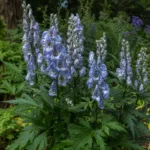 Monkshood (Aconitum ‘Stainless Steel’)Aconitum 'Stainless Steel'
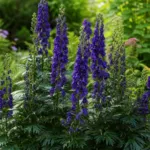 Monkshood (Aconitum ‘Bressingham Spire’)Aconitum 'Bressingham Spire'
 Golden full moon maple (Acer shirasawanum ‘Aureum’)Acer shirasawanum 'Aureum'
 Globosum (Acer platanoides ‘Globosum’)Acer platanoides 'Globosum'
 Striped maple (Acer pensylvanicum) care guideAcer pensylvanicum