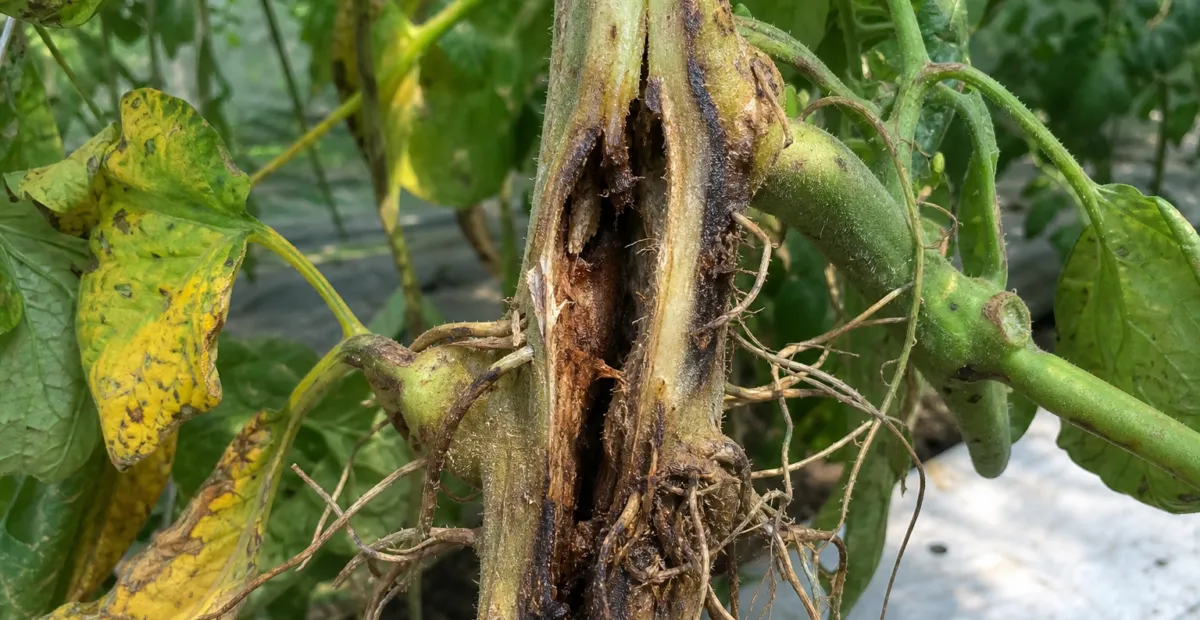
Tomato pith necrosis
Pseudomonas corrugataTomato pith necrosis overview
Tomato pith necrosis is a bacterial disease most strongly associated with Pseudomonas corrugata, although similar symptoms can be caused by several other soilborne bacteria. It usually appears as the first fruit cluster approaches mature green: leaves yellow and wilt, stems develop dark lesions and splits, and the pith turns brown, hollow or chambered. Cool nights, high humidity, wet foliage and excess nitrogen increase risk.
Typical conditions
Overview
Tomato pith necrosis is an opportunistic bacterial disease of mature tomato plants. The characteristic damage is internal: the stem pith becomes brown, necrotic and sometimes hollow or chambered. External signs may include dark stem streaks, cracking, swelling and prolific adventitious roots.
In US production, the problem is especially associated with greenhouses and high tunnels, but it can also occur in field-grown tomatoes. Because several bacteria can cause the same syndrome, a confirmed identification of P. corrugata requires laboratory testing rather than visual diagnosis alone.
Symptoms and identification
- Symptoms commonly become noticeable when the first fruit cluster reaches the mature-green stage.
- Lower, middle or younger leaves may turn pale green or yellow; upper shoots can wilt.
- Dark brown to black external lesions, streaks, swelling or splits may develop on the stem.
- Many adventitious roots can emerge from the stem near affected pith.
- Cutting the stem lengthwise may reveal brown, gray-brown or blackened pith with hollow, collapsed or chambered areas.
- Severe internal damage can weaken the stem and reduce water movement, but the pattern can resemble bacterial canker, bacterial wilt or other stem disorders.
Causes and spread
The bacterium may be introduced or redistributed in contaminated soil, infected residue, seed or transplants. Spread is favored by irrigation splash, wet greenhouse surfaces, handling, pruning and staking equipment, and wounds created during cultivation or transplanting. Dense canopies, poor ventilation, high humidity, excessive irrigation and high nitrogen fertility increase disease expression. Similar symptoms can arise from other soilborne bacteria, so apparent spread does not by itself prove that P. corrugata is the cause.
Life cycle and persistence
Pseudomonas corrugata can persist in soil, the rhizosphere and infected plant residue, and may be associated with contaminated seed or transplants. The bacterium is generally opportunistic and enters through wounds or natural openings, including injuries caused by handling, pruning, staking, root disturbance or cracking.
After colonizing internal stem tissues, it causes pith necrosis under favorable conditions. Disease expression is often associated with cool nights, cloudy or humid weather, free water and vigorous nitrogen-driven growth. Splashing water, contaminated tools, hands, containers, media and plant debris can move bacteria between plants. The epidemiology of seed transmission is possible but not fully resolved.
Treatment and control
There is no dependable curative treatment that restores necrotic tomato pith. Remove plants with severe stem collapse, extensive internal discoloration or progressive wilt, taking care not to shake contaminated soil or splash water onto neighboring plants. If disease is limited and the stem remains structurally sound, improve ventilation, reduce leaf and stem wetness, correct excessive irrigation and stop unnecessary nitrogen applications; some plants may remain productive if environmental conditions improve.
Do not diagnose or treat solely from yellow leaves or stem darkening. Confirm the cause when possible, because bacterial canker, bacterial wilt, Pectobacterium-associated soft rot and noninfectious stem disorders can require different management.
Low-impact and biological control
No curative organic treatment has been demonstrated reliably. Use an integrated sanitation and environment-management approach:
- Remove and discard severely affected plants promptly; do not compost diseased tomato stems unless the composting system reliably reaches pathogen-killing temperatures.
- Work in healthy blocks before affected areas, and disinfect pruners, knives, stakes, trays and other reusable equipment between plants or blocks.
- Keep foliage and stems dry when possible. Use drip irrigation, improve airflow and avoid overhead watering, especially late in the day.
- Do not move contaminated soil, residue, water, tools or hands from affected plants to healthy plants.
- Use clean, reputable seed and disease-free transplants. Inspect transplants for stem wounds, unusual swelling and early pith discoloration.
- Maintain balanced fertility and avoid high nitrogen rates that produce soft, excessively vigorous tissue.
- Biological products should be considered only when they are labeled for the crop and use, and expectations should remain modest because no biological treatment is a dependable cure for established internal pith necrosis.
Prevention
- Start with clean seed, transplants, containers, growing media and greenhouse surfaces.
- Sanitize tools, stakes, clips, benches and hands before working with healthy plants.
- Prevent standing water and reduce humidity with appropriate spacing, ventilation and irrigation timing.
- Prefer drip irrigation or carefully directed watering rather than routine overhead irrigation.
- Avoid excessive nitrogen and avoid forcing very rapid early-season growth, particularly during cool nights.
- Minimize wounds during transplanting, pruning, tying and cultivation.
- Remove diseased plants and residue at the end of the crop, and rotate away from tomato and pepper where practical.
- When symptoms are unusual or widespread, submit representative samples through a local county Extension office or plant diagnostic laboratory.
Interesting facts
- The disease name describes the damaged tissue rather than a unique symptom visible from outside: the pith is the central tissue inside the stem.
- Adventitious roots on the stem are a useful diagnostic clue, but they are not exclusive to this disease.
- P. corrugata is also known from soil and plant-associated environments where it may not cause disease.
- Tomato pith necrosis is a syndrome: several bacterial species can produce nearly identical symptoms, so the name of the syndrome and the name of the confirmed bacterium are not always interchangeable.
- Plants may stop worsening or partially recover when humidity, wetness and excessive vegetative growth are reduced, although damaged pith does not become healthy again.
No reliable, broadly effective chemical treatment is established for tomato pith necrosis in the United States. Use pesticides only when a product is legally authorized for the specific crop and problem in your state, and follow the current label exactly. Do not use off-label antibiotics or disinfectants on living plants.
Affected plants
The plants below are linked to this problem by structured host-plant data. The list updates automatically as new plant profiles are added.