
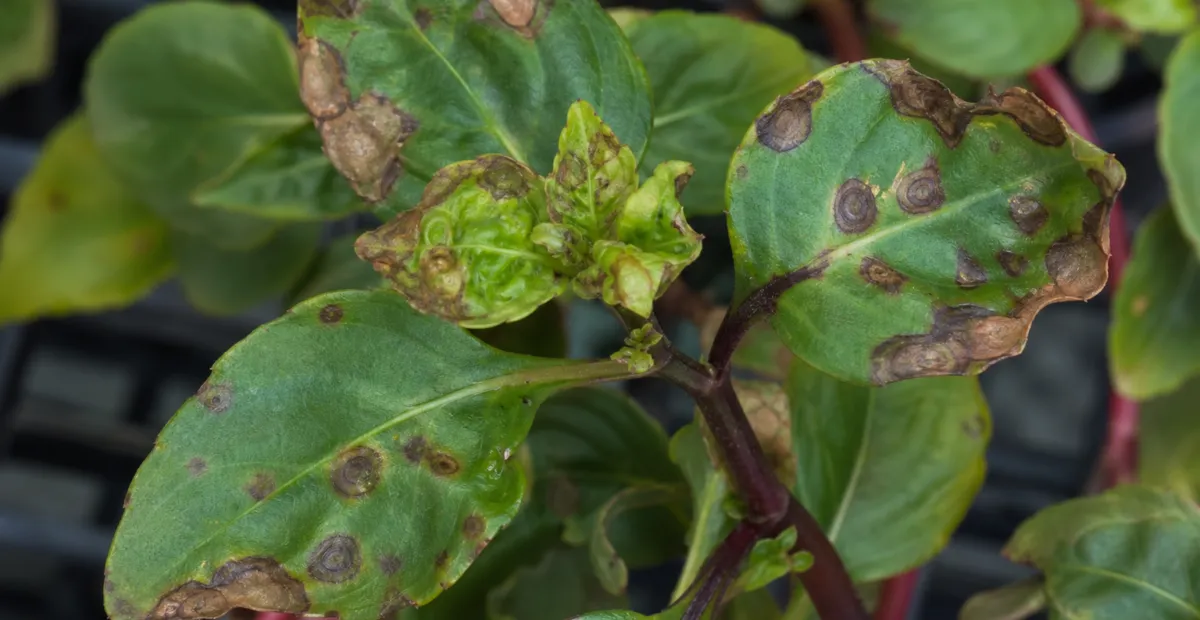
Impatiens necrotic spot virus disease
Impatiens necrotic spot orthotospovirusImpatiens necrotic spot virus disease overview
Impatiens necrotic spot virus (INSV) is a serious, thrips-transmitted disease of greenhouse and garden ornamentals in the United States. Symptoms vary widely by host and may include circular or ring-shaped leaf spots, necrotic veins and stems, distorted new growth, wilting, stunting, flower color break, and plant collapse. Because symptoms overlap with other diseases and disorders, laboratory confirmation is often needed.
Typical conditions
Overview
INSV is a systemic virus disease with highly variable symptoms. It is common in greenhouse crops, but infected plants may also occur in garden centers, landscapes, and outdoor beds. Impatiens, coleus, cyclamen, cineraria, gloxinia, lobelia, penstemon, torenia, and numerous other ornamentals can be affected.
Visual diagnosis is unreliable because symptoms depend on plant species, cultivar, plant age, virus strain, and growing conditions. Similar symptoms may result from tomato spotted wilt virus, other viruses, fungal or bacterial diseases, herbicide injury, insect feeding, or nutrient and environmental stress. Confirm suspected cases with a university plant diagnostic laboratory or another qualified laboratory.
Symptoms and identification
Symptoms may appear on leaves, stems, petioles, growing points, flowers, and occasionally fruit or vegetable-transplant foliage.
- Small brown, black, tan, purple, or chlorotic spots, sometimes with concentric rings or a zonate pattern.
- Sunken, pinprick-like or “chicken-pox-like” lesions on leaves.
- Vein, petiole, stem, or shoot-tip necrosis; darkened stems and dying growing points.
- Mosaic, mottling, yellow blotches, line patterns, leaf distortion, curling, or downward cupping.
- Stunting, wilting, poor flowering, flower color break, premature leaf drop, and plant collapse.
- Some infected plants remain symptomless while still serving as sources for thrips-mediated spread.
Causes and spread
The primary vector in U.S. production systems is the western flower thrips, Frankliniella occidentalis. Larvae acquire INSV while feeding on infected tissue; after the virus multiplies within the thrips, adults can transmit it while feeding on susceptible plants for the remainder of their lives.
Spread is favored by infested incoming plugs, cuttings, finished plants, weeds, volunteer plants, and crop residues. Vegetative propagation from infected stock can reproduce the disease directly. Thrips are difficult to detect because larvae feed in flowers and concealed plant tissue, while adults move readily between plants.
Life cycle and persistence
INSV replicates inside infected plant cells and moves systemically through susceptible plants. The virus does not have an independent soil or airborne cycle. Its important epidemiological cycle is infected plant tissue → feeding thrips larvae → viruliferous adult thrips → new plant infections.
Western flower thrips lay eggs inside plant tissue. Larvae feed on foliage, flowers, and pollen, then develop through nonfeeding pupal stages in protected sites such as growing media, leaf litter, benches, or other sheltered surfaces before emerging as adults. Development is faster in warm greenhouse conditions, so overlapping generations can sustain transmission throughout a crop.
Treatment and control
There is no curative treatment that eliminates INSV from an infected plant. Remove and discard symptomatic plants promptly, especially in greenhouses and propagation areas. Do not compost suspected infected material unless the composting process is demonstrably adequate for destroying plant material and local practice permits it.
Inspect neighboring plants and the entire crop, because symptoms may be delayed or absent. Submit representative symptomatic tissue for laboratory testing when practical; testing is particularly important before destroying a valuable collection or making major production decisions. Manage western flower thrips at the same time, because removing infected plants without suppressing the vector can allow rapid reinfection.
Low-impact and biological control
Organic and biological measures are most useful before INSV is detected or as part of a preventive IPM program. Combine exclusion, sanitation, sticky-card monitoring, removal of infected plants, weed control, and careful inspection of flowers and growing points.
- Use commercially available biological-control agents such as predatory mites, minute pirate bugs, or entomopathogenic fungi where they are compatible with the crop and production system.
- Introduce natural enemies preventively and monitor their establishment; biological control alone is unlikely to contain an active INSV outbreak if infected plants remain.
- Use insect-exclusion screening where feasible and keep greenhouse doors closed.
- Remove flowers and plant debris that shelter thrips, while avoiding practices that scatter adults through the crop.
- For home gardeners, discard severely symptomatic plants, clean containers and tools, and avoid overwintering suspect cuttings indoors with other ornamentals.
Prevention
- Purchase plugs, cuttings, and finished plants from suppliers using documented virus-exclusion and thrips-monitoring programs.
- Quarantine and inspect incoming material before placing it near established crops. Check flowers, growing points, leaf undersides, and shipping containers.
- Use yellow, blue, or white sticky cards at crop height and near entrances; record counts and inspect flowers directly.
- Remove weeds, volunteer plants, spent flowers, and crop debris that can harbor thrips or virus.
- Do not take cuttings from symptomatic plants or from lots with unexplained viral symptoms.
- Isolate suspect plants promptly. Bag and remove them without shaking foliage across the crop, then clean benches, tools, carts, and work areas.
- Schedule crop breaks and clean propagation areas between crops. Avoid carrying plants, tools, clothing, or thrips from older houses into clean propagation areas.
- Use indicator petunias only as an early-warning aid, not as a substitute for laboratory testing or crop inspection.
Interesting facts
- INSV was historically treated as an impatiens-associated strain of tomato spotted wilt virus but is now recognized as a separate orthotospovirus.
- Symptoms can differ dramatically between hosts: one plant may show ringspots, another may show shoot-tip death, and another may remain symptomless.
- Only a small number of viruliferous western flower thrips can spread INSV rapidly through a greenhouse crop.
- Petunia cultivars such as ‘Summer Madness’, ‘Super Magic Coral’, and ‘Red Cloud’ can be used as indicator plants for thrips-transmitted tospoviruses, although indicator responses should be confirmed diagnostically.
- INSV can affect vegetable transplants, including tomato and pepper, even though it is especially associated with ornamental production.
Chemical products cannot cure an INSV-infected plant. If insecticides are considered for western flower thrips, use only products legally authorized for the specific crop, site, and pest in the United States, and follow the current product label. Rotate effective modes of action according to the label and local Extension guidance, protect biological-control agents where possible, and do not rely on pesticide applications as a substitute for sanitation, exclusion, monitoring, and removal of infected plants.