
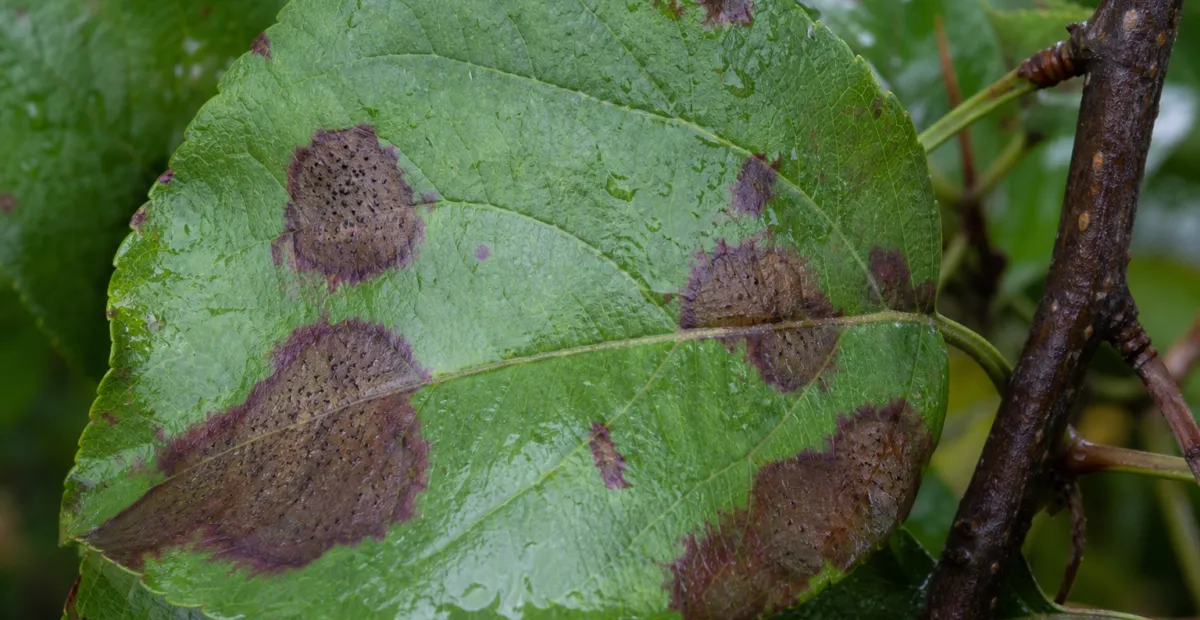
Apple blotch (Marssonina blotch)
Diplocarpon mali Harada & Sawamura; commonly treated as a synonym or earlier name of Diplocarpon coronariae (Ellis & J.J. Davis) Wöhner & Rossman. Marssonina coronaria is the former anamorph name.Apple blotch (Marssonina blotch) overview
Apple blotch, also called Marssonina blotch, is a fungal disease of apple caused by Diplocarpon mali, currently treated taxonomically in many references as Diplocarpon coronariae. It mainly affects mature leaves, producing gray-brown to black blotches that enlarge, yellow surrounding tissue and may trigger severe premature defoliation. Wet, humid summer weather and infected leaf litter favor outbreaks, especially where fungicide coverage is reduced.
Typical conditions
Overview
Apple blotch is a fungal leaf and occasional fruit disease of apple. It is also called Marssonina blotch or Marssonina leaf blotch. The disease is often most conspicuous in mid- to late summer, when dark lesions expand and affected trees begin losing leaves prematurely.
In the United States, the disease has been documented in northeastern and Mid-Atlantic orchards, including Pennsylvania and New York. Diagnosis should be confirmed when practical because apple blotch can resemble Alternaria blotch, frogeye leaf spot, apple scab, necrotic leaf blotch, chemical injury and other causes of summer defoliation.
Symptoms and identification
Initial lesions are usually small, round to irregular gray-brown, olive, maroon or nearly black spots on mature leaves. Some lesions have a darker or purplish margin, and tiny black acervuli may become visible as spore-producing structures.
As spots enlarge and merge, surrounding tissue turns yellow. Leaves may drop prematurely, often beginning in the lower or interior canopy and progressing upward. Severe outbreaks can cause striking late-summer defoliation while fruit remains attached.
Fruit infection is uncommon in many U.S. observations. When present, lesions may be clear brown at first, then become oval, depressed and dark brown to almost black; small black acervuli can occur in the lesion. Fruit symptoms may remain inconspicuous until storage.
Causes and spread
Apple blotch spreads when spores from infected leaves or lesions reach wet, susceptible apple foliage. Rain splash, wind-driven rain, prolonged dew and overhead irrigation are the principal dispersal mechanisms.
Risk increases in dense, poorly ventilated trees; orchards with heavy leaf litter; plantings exposed to repeated summer storms; and situations where spray coverage is interrupted by rainfall or extended intervals. Infected nursery material bearing leaves may provide a pathway for long-distance introduction, but fruit is generally considered a less important pathway.
Life cycle and persistence
The fungus survives between seasons mainly in infected fallen apple leaves, where overwintering structures and/or mycelium can remain. In regions where the sexual stage develops, ascospores released from overwintered leaves provide primary inoculum; conidia produced in black acervuli provide repeated secondary spread. The relative importance of sexual and asexual overwintering varies by region and is not fully resolved for every U.S. production area.
Spores are moved principally by rain splash, wind-driven rain and wet canopy contact; no insect vector is required. Conidia germinate on wet foliage, penetrate the leaf surface and produce expanding blotches. New acervuli form in lesions, allowing repeated infection cycles during prolonged humid weather. Symptoms may become obvious weeks after infection, so visible late-summer disease can reflect earlier wet periods.
Treatment and control
Remove heavily infected leaves from small trees when feasible and reduce continued wetting of the canopy. Correct drainage, irrigation and pruning problems that are maintaining humidity. Avoid handling wet foliage because contact can spread spores locally.
Once extensive defoliation is visible, recovery depends mainly on preventing additional infection and preserving tree reserves; removed leaves cannot be restored. Maintain adequate but not excessive water and nutrition, protect the tree from additional stress and avoid stimulating late flushes with heavy nitrogen.
In commercial plantings, consult current state extension recommendations and a licensed crop adviser for a preventive, labeled fungicide program. Products and registrations change, and efficacy data do not by themselves establish legal use. Rotate fungicide modes of action and follow the label and FRAC resistance-management guidance.
Low-impact and biological control
In home orchards and organic systems, prioritize inoculum reduction and canopy drying rather than relying on a single product.
- Collect, shred, mow or otherwise rapidly decompose fallen apple leaves in autumn and again before spring infection periods where practical.
- Remove badly infected leaves and dropped fruit from small trees; do not leave diseased debris beneath the canopy.
- Prune selectively during dormancy to open the canopy, improve light penetration and shorten drying time. Avoid excessive pruning that stimulates lush, susceptible growth.
- Use drip irrigation or water at the soil surface rather than wetting foliage. Irrigate early enough for leaves to dry before night.
- Maintain balanced nutrition and avoid excessive nitrogen, which can produce dense, soft growth and a humid canopy.
- Choose locally tested cultivars with lower observed susceptibility when establishing new plantings, recognizing that cultivar responses vary by region and disease pressure.
Organic fungicides or biopesticides should be considered only when they are certified or permitted for the intended production system and currently labeled for apples and the target disease. Their performance may be limited under persistent wet weather.
Prevention
Begin with sanitation and canopy management. Remove or thoroughly shred fallen apple leaves after leaf drop, maintain good drainage, prune for airflow and avoid prolonged leaf wetness. Keep grass and weeds managed so air can move through the lower canopy, and avoid overhead irrigation whenever possible.
Scout mature leaves regularly from late spring through summer, especially after repeated rain. Inspect interior and lower-canopy foliage as well as exposed leaves. Record cultivar, weather, irrigation and disease location so recurring hot spots can be managed more precisely.
For commercial orchards, integrate sanitation, weather-based disease-risk monitoring, timely coverage and resistance management. Do not extend spray intervals automatically during unusually wet periods. Resistant or less-susceptible cultivars may reduce risk, but cultivar performance is regional and should be verified locally.
Interesting facts
- Diplocarpon mali, Diplocarpon coronariae and Marssonina coronaria are names encountered for the same apple-blotch pathogen complex in different taxonomic and applied references.
- The disease is unusual among many apple foliar diseases because severe late-season infections can cause dramatic defoliation while fruit infection remains relatively uncommon.
- Some apple cultivars selected for apple-scab resistance may still be susceptible to apple blotch; scab resistance should not be assumed to provide protection.
- Early diagnosis matters because the most visible symptoms may appear after the primary infection period and after secondary cycles are already underway.
Use only fungicides legally authorized and currently labeled for apples and this disease in your state and country. Follow the current product label exactly, including crop, disease, rate, re-entry interval, preharvest interval, worker-protection requirements and resistance-management instructions. Do not assume that a product effective in research trials or labeled for apple scab is legally labeled for apple blotch.