
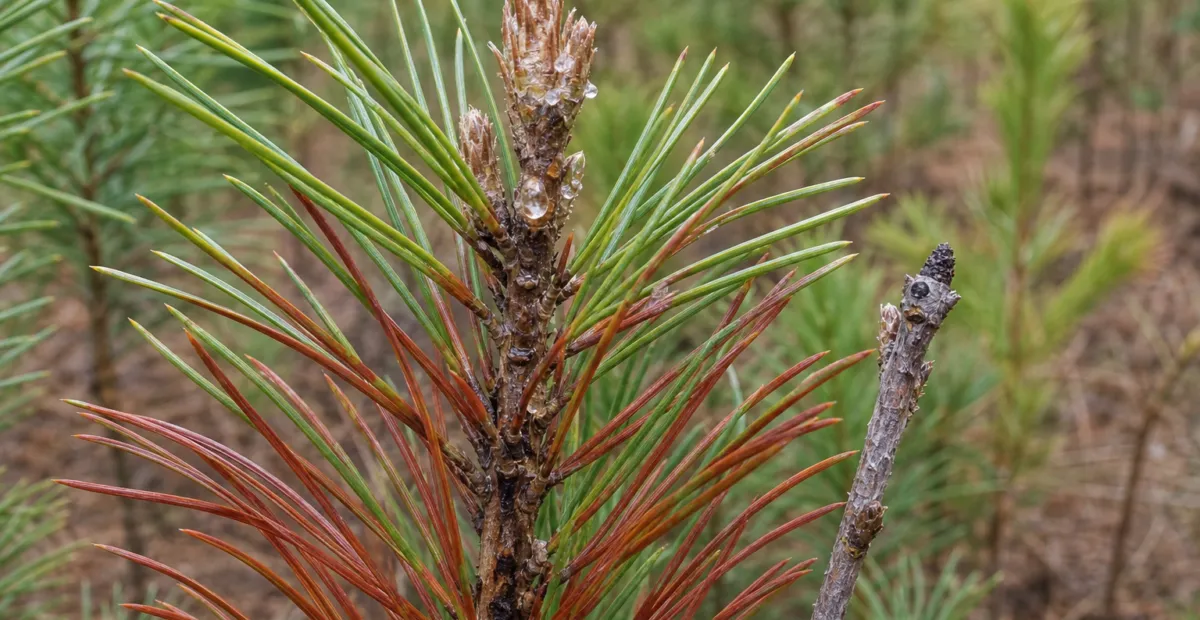
Scleroderris Canker
Gremmeniella abietina (Lagerberg) MoreletScleroderris Canker overview
Scleroderris canker is a serious fungal disease of pines and several other conifers, caused by Gremmeniella abietina. In the United States it is most important in the Northeast and Lake States, especially on young red, jack, and lodgepole pines growing in cool, wet, snowy sites. Infected buds and shoots die back, needles turn reddish brown from the base, and branch or stem cankers may develop.
Typical conditions
Overview
Gremmeniella abietina infects developing buds and shoots, then advances into needle bases and woody tissues. The disease is called Scleroderris canker in the United States and is most damaging where spring weather is cool and wet, snow remains around lower branches, or trees are stressed by frost, poor aeration, or unsuitable planting sites.
Young nursery stock, seedlings, and saplings are particularly vulnerable. The North American race often concentrates damage on lower branches covered by snow, whereas the European race may cause extensive crown dieback and cankers on larger trees. Because the fungus can remain latent in apparently healthy shoots, visual inspection alone may not always confirm infection.
Symptoms and identification
- Needle bases turn orange, reddish brown, or brown while tips may remain green initially.
- Needles later dry, bend downward, and drop readily when affected shoots are disturbed.
- Terminal buds fail to open, shoots die from the tip, and new growth may become distorted or form short, irregular replacement shoots.
- Resin droplets or resinous necrotic lesions may occur around buds and young shoots.
- Small black pycnidia may appear at dead needle bases or on dead shoot tips; light-brown cup-shaped apothecia can develop later on dead tissues.
- Elongated resinous branch or stem cankers may form, sometimes with yellow-green discoloration beneath the bark.
Symptoms are easiest to notice in spring, before or during shoot elongation, although crown dieback and fruiting structures may remain visible into summer and early fall.
Causes and spread
The causal fungus produces conidia in pycnidia and ascospores in apothecia. Conidia spread mainly by rain splash and surface water, while ascospores can move through the air. Infection is favored by prolonged wetness during spring shoot development, cool temperatures, lingering snow, frost injury, dense stands, poor air circulation, and wounds on needles, buds, or shoots.
Long-distance movement can occur in infected nursery stock, Christmas trees, or other planting material, including symptomless shoots carrying latent fungus. Local spread may increase from infected branches, dead shoots, nearby diseased trees, and retained slash. Disease severity also varies substantially with host species, pathogen race or biotype, tree age, snow cover, and site conditions.
Life cycle and persistence
Infection commonly begins in developing buds and current-season shoots during spring or early summer. The fungus may remain inconspicuous in shoots while host tissues are dormant. During winter or the following spring, it expands through cortical tissues, needle bases, buds, and shoots, producing resinous lesions and killing the growing point.
Pycnidia may form during the first or second year of visible disease and release conidia during wet weather. Apothecia generally develop on dead needles and twigs about one to two years after shoot death and release airborne ascospores. The complete sexual cycle commonly takes about two years, and latent mycelium may persist for several years in symptomless shoots.
Treatment and control
There is no dependable curative treatment for established cankers in landscape or forest trees. If infection is limited to a few branches, prune during dry weather into healthy wood and destroy the cut material. Disinfect pruning tools between cuts and avoid pruning during wet conditions that favor spread.
Remove trees with extensive crown infection, repeated dieback, or structurally important stem cankers when safety or plantation health is at stake. In nurseries and Christmas-tree operations, consult a state plant pathologist, extension specialist, or diagnostic laboratory because race, host, and regulatory status affect management. Confirm unusual or high-impact cases before moving planting material.
Low-impact and biological control
- Use exclusion, sanitation, resistant or tolerant planting material, and site selection as the primary nonchemical controls.
- Improve spacing and airflow, reduce prolonged snow retention where feasible, and avoid unnecessary wounds during cultivation or pruning.
- Rogue and destroy infected nursery plants promptly; do not compost diseased conifer shoots or branches unless a validated high-temperature process is used.
- Biological control products and antagonistic fungi remain research-oriented or situation-dependent for this disease; use them only when specifically registered and supported for the crop and site.
Organic production does not eliminate the need for diagnosis, sanitation, and careful sourcing of planting stock.
Prevention
- Purchase disease-free, inspected nursery stock and isolate or reject plants with suspicious shoot or needle-base symptoms.
- Choose species and seed sources suited to the site; avoid planting highly susceptible pines in cold frost pockets, wet depressions, or locations where snow routinely persists around lower crowns.
- Maintain adequate spacing and thin dense stands to improve airflow and reduce prolonged canopy humidity.
- Prune and destroy localized infected branches during dry weather, cutting well below visible cankers and disinfecting tools between trees.
- Remove severely diseased seedlings, saplings, and trees rather than retaining them as inoculum sources.
- Remove or properly dispose of infected slash where practical, and avoid moving suspect nursery stock, Christmas trees, or branches from affected areas.
- Monitor young pines in early spring for orange-brown needle bases, dead buds, resin, and easily shed needles.
Interesting facts
- Gremmeniella abietina is a species complex containing geographically and biologically distinct races or biotypes; the North American and European races cannot be reliably separated by symptoms alone.
- The disease has also been called Brunchorstia disease or pine shoot blight in European references.
- Needles may become discolored from the base upward because infection and tissue death interrupt transport near the short shoot.
- Latent infection can allow apparently healthy planting material to carry the fungus over long distances.
- In the United States, the disease has been especially important on red pine plantations and young conifers in northern states.
Use fungicides only when a product is legally authorized in the United States for the specific crop, site, and disease, and follow the current EPA-approved label exactly. Do not assume that a fungicide registered elsewhere, listed in older forestry literature, or labeled for a different conifer disease is legal or effective for Scleroderris canker. Preventive applications, where locally recommended for nurseries or plantations, should be based on a confirmed diagnosis, disease-risk monitoring, crop value, resistance-management principles, and advice from the state extension service or a licensed pesticide professional.
Affected plants
The plants below are linked to this problem by structured host-plant data. The list updates automatically as new plant profiles are added.
 Field maple (Acer campestre) care guideAcer campestre
 Downy Japanese Maple (Acer japonicum) care guideAcer japonicum
 Boxelder (Acer negundo) care guideAcer negundo
 Sycamore maple (Acer pseudoplatanus) care guideAcer pseudoplatanus
 Red maple (Acer rubrum) care guideAcer rubrum
 Tatar Maple (Acer tataricum) care guideAcer tataricum
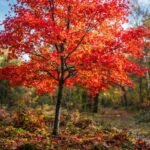 Amur Maple (Acer tataricum ginnala) care guideAcer tataricum ginnala
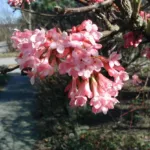 Fragrant viburnum (Viburnum farreri) care guideViburnum farreri
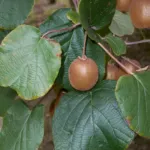 Kiwifruit (Actinidia chinensis deliciosa) care guideActinidia chinensis deliciosa
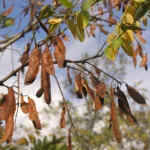 False Acacia (Robinia pseudoacacia) care guideRobinia pseudoacacia
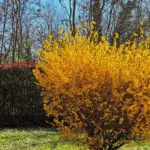 Border Forsythia (Forsythia intermedia) care guideForsythia intermedia
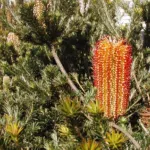 Banksia ericifolia care guideBanksia ericifolia