Hessian Fly
Mayetiola destructorHessian Fly overview
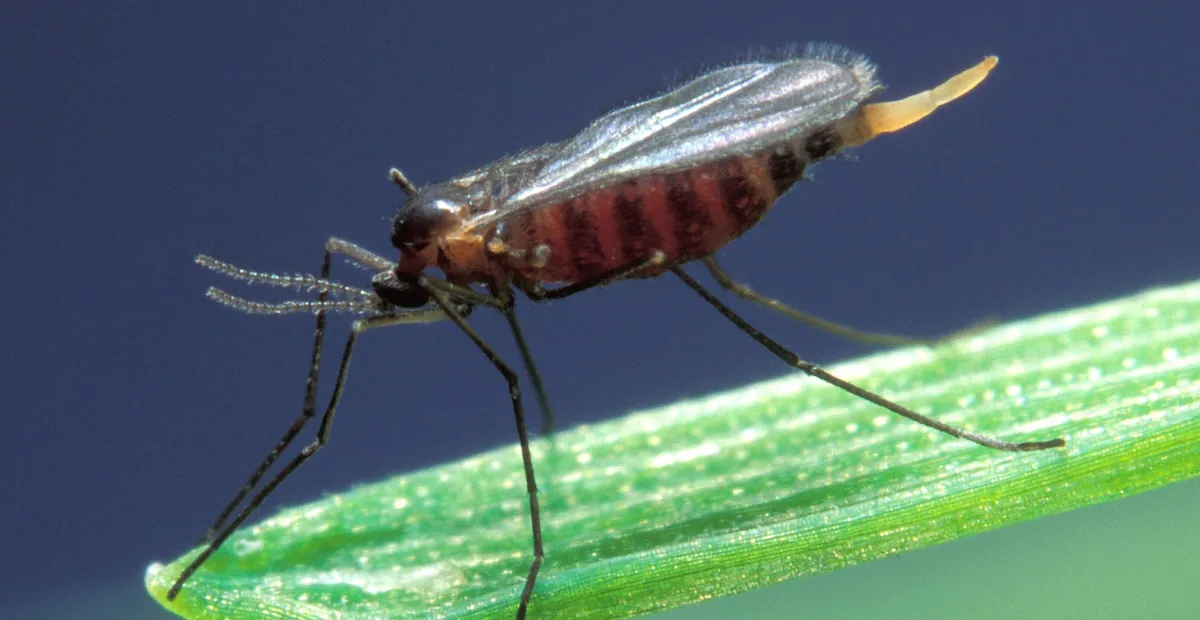
The Hessian fly, Mayetiola destructor, is a small midge-like insect and an important pest of wheat in many U.S. grain-growing regions. Its larvae feed at the crown or lower stem beneath leaf sheaths, causing stunting, weakened tillers, lodging, and sometimes premature white heads. Wheat is preferred, while barley, rye, triticale, and selected grasses may also support development.
Typical conditions
Overview
The Hessian fly is a small, mosquito-like fly in the family Cecidomyiidae. Wheat is its principal and most economically important host in the United States, although barley, rye, triticale, and some closely related grasses may also be attacked. The damaging stage is the legless larva, often called a maggot, which settles between the leaf sheath and stem near the crown or lower nodes.
Feeding can stunt or kill tillers, reduce stand establishment, weaken stems, and increase lodging. Risk varies substantially by region, planting date, cultivar resistance, local fly biotypes, weather, and the presence of volunteer or cover-crop cereals.
Symptoms and identification
Symptoms depend on plant age and the timing of infestation.
- Seedlings may become dark green, stunted, swollen, or noticeably shorter than healthy plants.
- Infested tillers may yellow, wilt, die, or fail to produce a normal head.
- Older wheat can develop weakened lower stems, lodging, and premature white heads when the stem is damaged below the head.
- Larvae and brown, seed-like puparia are usually concealed beneath leaf sheaths near the crown or lower stem. The puparia are commonly called the “flaxseed” stage.
- Eggs are tiny, reddish-orange and may occur in rows or grooves on the upper surface of leaves.
White heads are not diagnostic by themselves; drought, root and crown rots, stem-boring insects, and other disorders can produce similar symptoms. Pull affected plants and inspect the stem base for larvae or flaxseed puparia.
Causes and spread
Adults emerge from puparia in cereal stubble or living host plants and lay eggs on newly emerged small grains. After hatching, larvae move down the leaf groove and establish feeding sites at the plant crown or lower stem. Infestations spread locally through adult flight and are favored when susceptible cereals overlap in time and space.
The most important cultural source is a “green bridge”: volunteer wheat, early-sown winter wheat, winter rye, barley, or susceptible cereal cover crops that remain green between crop seasons. Infested stubble can also retain puparia. Local fly-free dates are regional guidelines intended to place crop emergence after the main adult flight; they differ across the United States and should be obtained from the relevant state extension service.
Life cycle and persistence
Hessian fly commonly has two generations annually in much of the northern United States, although additional generations may occur in warmer regions. Adults are small, dark, and short-lived. Females lay eggs on leaves, usually of young cereal plants. Eggs generally hatch within several days, and the young larvae move toward the base of the plant.
Larvae feed for roughly three to four weeks, depending on temperature and host conditions. They then form a hardened brown puparium, the flaxseed stage, beneath the leaf sheath or near the crown. The insect may pass summer or winter in this stage. Adults emerge when conditions favor development, mate, and begin the next generation. Development time can be much shorter under warm conditions, while diapause or unfavorable weather can extend the cycle.
Treatment and control
There is no dependable rescue treatment for larvae already feeding beneath leaf sheaths. Scout young and established wheat by examining stunted tillers, lodged plants, and premature white heads. Pull plants and inspect the crown and lower stem for larvae or flaxseed puparia before deciding whether the problem is Hessian fly.
In an infested field, prioritize removal of volunteer hosts, timely termination of susceptible cereal cover crops, and future use of resistant varieties and appropriate planting dates. Where damage is extensive, harvest and rotation decisions may be more useful than attempting late-season insecticide treatment.
Low-impact and biological control
For organically managed or low-input systems, rely on exclusion and cultural IPM: select resistant cultivars when available, plant after the locally appropriate fly-free date, destroy volunteer wheat and other host cereals, avoid susceptible cereal cover crops during risk periods, and rotate with nonhost crops. Remove or thoroughly incorporate infested cereal residue where permitted and compatible with soil-conservation goals.
Predators and parasitoids attack Hessian fly, but biological control alone is generally unreliable when susceptible wheat emerges during a large adult flight. Preserve beneficial arthropods by avoiding unnecessary broad-spectrum insecticide use and by maintaining diverse field margins where appropriate.
Prevention
Prevention is more reliable than rescue treatment because larvae are protected beneath leaf sheaths and established infestations are difficult to suppress.
- Plant Hessian fly-resistant cultivars recommended for the local region and known biotypes.
- Use the current state or regional Hessian fly-free planting date when growing winter wheat, rye, barley, or cereal cover crops. These dates are not identical across the United States.
- Destroy volunteer wheat and other documented host cereals before adult emergence and before planting the next susceptible cereal.
- Avoid planting susceptible wheat or rye immediately beside heavily infested volunteer cereal or infested stubble when practical.
- Rotate with nonhost broadleaf crops where agronomically feasible.
- Use clean, certified seed and inspect fields during establishment and early tillering.
- Choose oats as a cover crop where appropriate; oats generally do not support Hessian fly larval development.
Interesting facts
The common name is linked to the insect’s historical association with straw bedding used by Hessian troops during the American Revolutionary War, although the species has a much older Eurasian history. The brown puparium is called “flaxseed” because it resembles a small flax seed. Multiple Hessian fly biotypes occur, and resistance genes effective against one biotype may not provide complete protection against another. The insect is a true fly, not a disease-causing organism, despite the old common name “Hessian fly.”
No routine chemical rescue program is recommended for established Hessian fly infestations because larvae are concealed and control is inconsistent. Use only products legally authorized for Hessian fly on the specific crop in your country and state, and follow the current product label, including crop, timing, rate, worker-protection, rotational, grazing, and preharvest requirements. Check the current label and consult your state extension service before any application.
Affected plants
The plants below are linked to this problem by structured host-plant data. The list updates automatically as new plant profiles are added.