
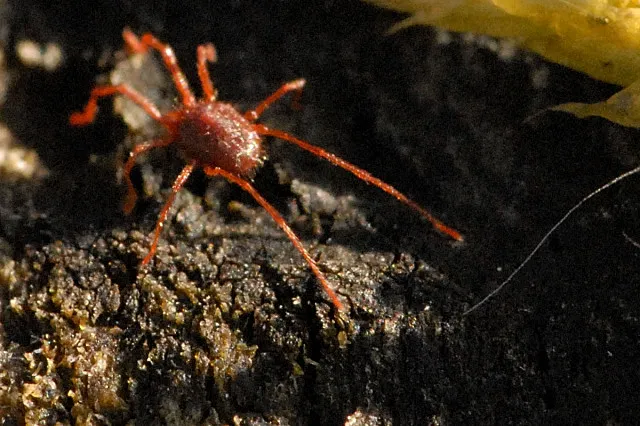
Clover mite
Bryobia praetiosaClover mite overview
Clover mite, Bryobia praetiosa, is a tiny reddish-brown plant-feeding mite most often associated with cool-season turfgrass, clover and weeds in the United States. Feeding can produce silvery streaks, stippling or bronzed turf, but the larger nuisance is often seasonal migration onto sunny foundations, windows and indoors. These mites do not bite people or pets, reproduce indoors, or damage buildings.
Typical conditions
Overview
Clover mites are true mites, not insects. Adults are about 1/32 inch long, reddish to reddish-brown, flattened and oval, with eight legs. The first pair of legs is conspicuously long, approximately as long as the body. A hand lens is useful, but field identification of very small mites can be unreliable; an extension diagnostician or qualified entomologist should confirm unusual specimens.
They feed by piercing plant tissue and sucking cell contents. Low populations are usually inconsequential, while heavy populations in turf or groundcovers may cause visible silvering or bronzing. Around homes, their nuisance status generally exceeds their direct plant-damage importance.
Symptoms and identification
- Fine silvery streaks, specks or stippling on grass blades and broadleaf foliage.
- Loss of green color, bronzing or a pale cast in heavily infested turf, especially near buildings.
- Small reddish mites visible on leaves, stems, walls, windows or foundations, often concentrated on sunny exposures.
- Red or rusty smears when mites are crushed on light-colored surfaces.
- Plant injury is commonly minor; extensive symptoms should also be checked for drought, nutrient imbalance, other mites or disease.
Causes and spread
Populations increase where susceptible grasses, clover and weeds form dense, succulent growth, particularly in heavily fertilized or newly established lawns. Mites are often most abundant on sunny south- or west-facing sides of buildings. Grass and groundcovers touching the foundation provide a continuous route indoors.
Migration is encouraged when vegetation dries, is mowed closely, becomes crowded, or otherwise becomes less suitable. Wind, movement of infested plant material and crawling along connected vegetation can spread mites locally. Indoor sightings do not mean that the mites are feeding or reproducing inside the building.
Life cycle and persistence
Clover mites reproduce primarily by parthenogenesis, so females can produce viable offspring without mating. Eggs are laid outdoors in protected locations, including vegetation, soil crevices and structural edges. In cooler seasons, eggs hatch and the six-legged larvae begin feeding; later nymphal stages have eight legs and pass through molts before adulthood.
Populations are most active during cool periods, commonly spring and fall in much of the United States. As temperatures rise, females lay heat-induced dormant eggs that remain inactive until cooler conditions return. Hot, dry weather, host-plant removal or other unfavorable changes can drive mites away from vegetation and toward buildings. They do not establish breeding populations indoors.
Treatment and control
When plant injury is light, treatment is usually unnecessary. Improve turf and landscape conditions, reduce host vegetation at foundation edges and monitor with a hand lens. If mites are concentrated on individual plants, a firm water spray can reduce exposed populations, provided the plant tolerates the pressure and foliage is allowed to dry.
For recurring building invasions, prioritize exclusion and the vegetation-free barrier. Vacuum or wipe indoor mites carefully to prevent staining. If an outdoor treatment is judged necessary, obtain local Cooperative Extension or licensed pest-management advice and select only a currently labeled product for the exact site and use. Do not treat indoor surfaces with a garden pesticide unless the label specifically permits that use.
Low-impact and biological control
For small indoor incursions, remove mites with a vacuum or lift them with a damp cloth rather than crushing them. Dispose of the vacuum contents promptly. Avoid sweeping or smearing large numbers across walls, carpets or fabrics.
Outdoors, reduce favorable habitat next to the building: mow turf regularly, remove dense weeds and clover from foundation edges, correct excessive fertilization and avoid creating lush vegetation against walls. A continuous plant-free strip about 18–24 inches wide can deter many invasions; maintain it as bare soil, coarse sand or another surface that does not bridge into the lawn. Keep windows, doors and foundation cracks well sealed.
Preserve predatory mites and other natural enemies by avoiding unnecessary broad-spectrum insecticides. Strong water sprays may dislodge mites from accessible foliage, but repeated treatment can be needed and should not create runoff or plant stress.
Prevention
- Keep turf, clover and weeds trimmed back from foundations, windows and doors.
- Maintain an approximately 18–24-inch vegetation-free band around frequently affected foundations, especially on sunny exposures.
- Seal cracks around windows, doors, siding, utility penetrations and foundations; repair damaged screens and weather stripping.
- Avoid excessive nitrogen fertilization that produces dense, succulent turf.
- Monitor lawn edges and foundation walls during spring and fall, before large migrations occur.
- Confirm the mite before treatment; red spider mites, clover mites and other small arthropods can be confused in the field.
Interesting facts
- Clover mites are arachnids related to spiders and ticks, not insects.
- Their common name reflects frequent association with clover, but grasses are often the most important hosts in US landscapes.
- They are non-webspinning mites, unlike many spider mites.
- They do not bite, transmit disease to people or pets, or reproduce inside homes.
- The species has a very broad recorded host range, but local host preference differs substantially by climate and region.
Use pesticides only when necessary and only products legally authorized and labeled in the United States for the specific crop, site and pest. Follow the current product label exactly; the label is the law. Avoid routine broad-spectrum treatments that may disrupt predatory mites and other beneficial organisms. For building invasions, pesticide use may fall under structural-pest regulations and is often best handled by a licensed professional.