
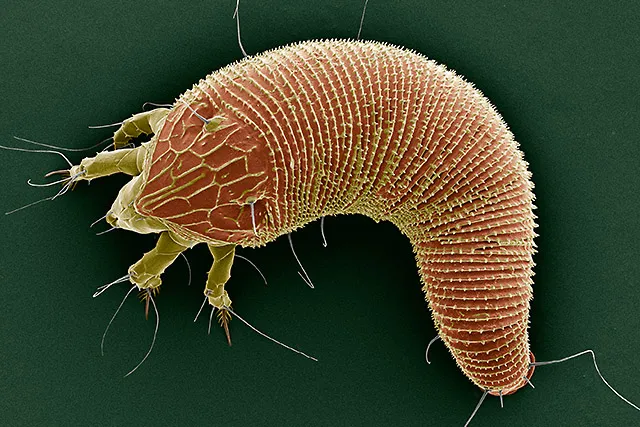
Rose bud mite
Phyllocoptes fructiphilus KeiferRose bud mite overview
The rose bud mite, Phyllocoptes fructiphilus, is a microscopic eriophyid mite associated mainly with roses in the United States. Its greatest importance is as the primary vector of rose rosette emaravirus, the cause of rose rosette disease. Mites hide in developing buds, leaf bases and sepals, making direct detection difficult and management dependent on clean plants, sanitation and integrated prevention.
Typical conditions
Overview
Phyllocoptes fructiphilus is a very small, wingless eriophyid mite associated with Rosa species. It is difficult to see without magnification and is usually found in developing flower buds, leaf bases, sepals, shoot tips and other protected crevices.
The mite is best known as the primary documented vector of rose rosette emaravirus in the United States. The mite itself may cause little obvious injury, but virus transmission can lead to the progressive and usually fatal rose rosette disease. Finding mites does not by itself prove that a rose has the virus, because populations may occur on asymptomatic plants and other eriophyid mites can also occur on roses.
Symptoms and identification
Direct feeding symptoms from the mite are often subtle or absent and cannot be reliably diagnosed in the field. When the mite transmits rose rosette emaravirus, affected roses may develop:
- Dense clusters of short shoots resembling witches’ brooms or rosettes.
- Abnormally red, elongated or distorted new growth.
- Excessive, enlarged or flexible thorns.
- Malformed leaves, shortened internodes and unusual leaf coloration or mosaic patterns.
- Deformed flower buds and flowers, followed by declining vigor and eventual plant death.
These symptoms are caused by the virus, not necessarily by mite feeding alone. Laboratory confirmation may be needed because herbicide injury, genetic growth abnormalities and other disorders can resemble rose rosette disease.
Causes and spread
The mite acquires rose rosette emaravirus while feeding on an infected rose and can transmit it when it moves to a healthy rose. Mites are readily dispersed on air currents and may also be moved on clothing, pruning tools, plant material or possibly by attachment to other insects.
Nearby infected roses, especially invasive multiflora rose (Rosa multiflora), can provide a continuing source of virus and mites. Grafting and infected propagation material can also spread rose rosette disease independently of mite movement. The pest is host-specific to roses in the available literature; reports outside Rosa should be treated cautiously.
Life cycle and persistence
The life cycle begins with eggs laid in protected sites such as flower buds, leaf bases, sepals and young shoots. Immature stages pass through several active feeding stages before reaching adulthood. Because the mites remain sheltered within buds and crevices, they are difficult to detect and contact with sprays is limited.
In the United States, activity has been documented during much of the growing season. In central Georgia, eriophyid mite activity, including P. fructiphilus, was recorded from April through December, with higher populations generally observed in summer. Seasonal timing varies with latitude, temperature, host growth and local weather. Wind-assisted movement can bring mites from infected or infested roses into nearby plantings.
Treatment and control
There is no curative treatment for a rose already infected with rose rosette emaravirus. If symptoms are limited to one shoot and another cause has not been ruled out, remove the symptomatic growth well below the affected area and monitor subsequent growth closely. If symptoms recur, spread through the plant or are strongly characteristic of rose rosette disease, remove the entire rose, including as much of the root system as practical.
Place removed plants and prunings in sealed bags for disposal according to local requirements. Do not compost, chip for mulch or leave infected material beside healthy roses. Removing adjacent multiflora roses can reduce local inoculum, but complete eradication may require repeated cutting, mowing or a legally appropriate invasive-plant control program over multiple seasons.
Mite suppression alone is difficult because the mites are protected in buds and because virus transmission may occur before control is achieved. Treating a rose without confirming the diagnosis is unlikely to solve the problem.
Low-impact and biological control
Use an integrated, low-risk approach rather than relying on a single spray. Promptly prune suspicious shoots, clean tools between plants and dispose of cut material in sealed bags. Remove infected roses and nearby multiflora rose where legally allowed. Maintain plant vigor through appropriate watering, mulching, nutrition and pruning without stimulating excessively lush growth.
Insecticidal soap, horticultural oils, kaolin clay and other reduced-risk products may suppress exposed eriophyid mites in some situations, but effectiveness is inconsistent because mites occupy protected buds. Avoid spraying open flowers or harming pollinators and predatory mites. Follow the product label and test any treatment on a small portion of the cultivar first.
Prevention
Prevention is more dependable than trying to eradicate mites after they have entered a rose planting.
- Buy roses from reputable US nurseries and inspect new plants for abnormal shoots, excessive thorns and distorted growth.
- Do not propagate or graft from roses showing suspicious symptoms.
- Survey the surrounding property and remove nearby multiflora rose where permitted and practical; follow local invasive-plant rules.
- Space roses to reduce direct contact between plants and maintain good air movement.
- Disinfect pruning tools between plants when working around symptomatic roses.
- Monitor new growth from spring through fall, especially near wild or abandoned roses.
- Consider cultivars described by current university or breeding programs as having improved resistance, while recognizing that resistance is not universal or permanent.
Interesting facts
- The mite is about half the size of a grain of salt and is generally invisible without magnification.
- It often hides deep within rose flower buds, which helps explain why detection and spray coverage are difficult.
- Rosa multiflora, an invasive rose in much of the eastern United States, is highly susceptible and can act as an important reservoir for rose rosette disease.
- The mite and rose rosette disease have been documented across much of the United States, but distribution and seasonal abundance vary by region.
- Several eriophyid mite species occur on roses and can be difficult to distinguish by appearance alone; positive identification may require specialist examination.
Use only products legally authorized and currently labeled in the United States for eriophyid mites on the specific rose crop or landscape use. Follow the current label exactly, including rate, timing, personal protective equipment, re-entry interval and pollinator precautions. Products labeled for spider mites are not automatically effective or legally appropriate for rose bud mites. Chemical control cannot cure rose rosette virus and should not replace sanitation, removal of infected plants and management of nearby multiflora rose.