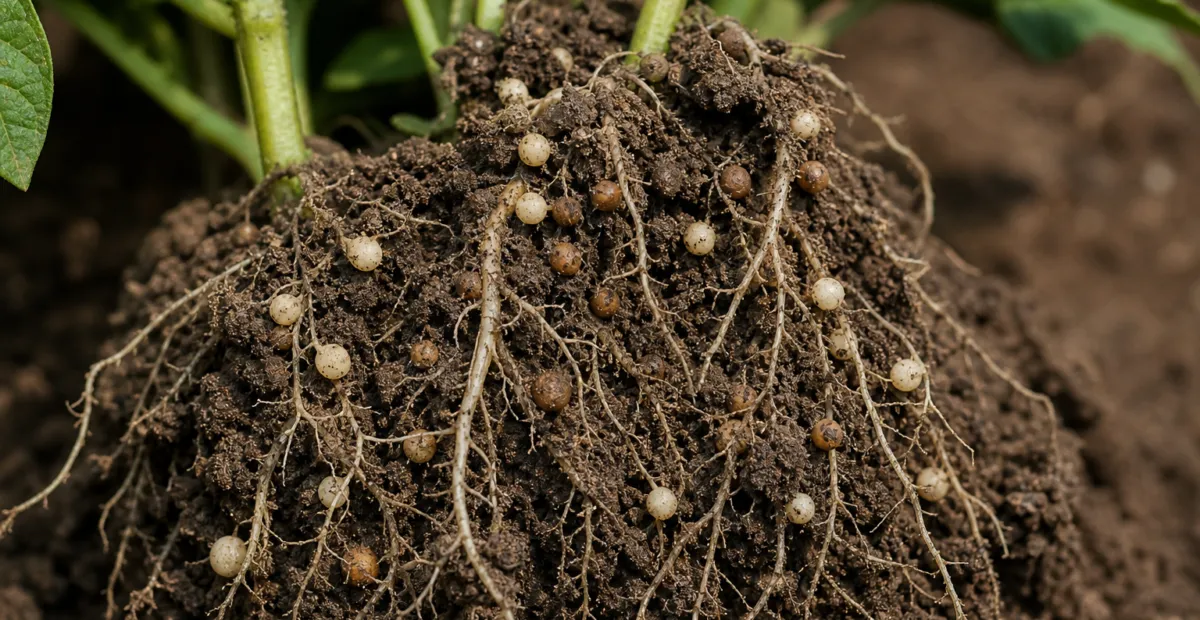
Pale potato cyst nematode
Globodera pallidaPale potato cyst nematode overview
Globodera pallida is a regulated, soil-borne nematode pest of potato and other solanaceous hosts. It attacks roots, causing patchy poor growth, chlorosis, wilting during heat or drought, early senescence and reduced tuber size. The most diagnostic evidence is the presence of tiny white-to-brown cysts attached to roots or recovered from soil. Suspected detections in the United States should be reported to state plant-health authorities or USDA APHIS.
Typical conditions
Overview
Globodera pallida, commonly called the pale potato cyst nematode or pale cyst nematode, is a soil-dwelling pest primarily associated with potato production. It is not a foliar disease: the nematode invades roots, establishes a permanent feeding site and reduces the plant’s effective root system.
Aboveground symptoms are often irregular and may resemble drought, poor fertility, compaction, vascular disease or other root problems. Confirmation requires laboratory identification of cysts or juveniles from a properly collected soil or root sample. In the United States, a suspected finding should be handled through state plant-health officials or USDA APHIS because regulated-area, sampling and movement requirements may apply.
Symptoms and identification
Symptoms usually appear in patches rather than uniformly across a field.
- Uneven, stunted or weak potato growth
- Light-green to yellow foliage, premature senescence and wilting during heat or water stress
- Reduced root development, sometimes with excessive short root growth around feeding sites
- Fewer, smaller or unevenly sized tubers; severe infestations may cause tuber pitting or necrotic areas
- Small spherical females or cysts attached to roots, changing from pale or white to yellowish and then brown as they mature
Cysts are usually too small for reliable diagnosis in casual inspection, and their appearance can overlap with the related golden potato cyst nematode, Globodera rostochiensis. Species confirmation requires specialist examination and, where necessary, molecular testing.
Causes and spread
The pest is introduced or dispersed mainly in infested soil and plant material. Important pathways include soil adhering to tillage, planting and harvesting equipment; footwear, tools and vehicles; seed potatoes and other rooted planting material; and soil or cull waste moved from potato grading or storage areas.
Free-living juveniles hatch when stimulated by root exudates from a suitable host, especially potato. Repeated potato or other susceptible solanaceous crops allow populations to increase. Wind and clean water are not usually the primary long-distance pathways, although erosion, flooding and runoff can redistribute infested soil locally.
Life cycle and persistence
Eggs remain protected inside a durable cyst, which is the dead, hardened body of a mature female. Under suitable soil conditions, second-stage juveniles hatch in response to host-root compounds, move through soil and enter young roots.
Juveniles establish specialized feeding cells inside the root and pass through several molts. Males become vermiform and leave roots; females enlarge, remain associated with the root and become filled with eggs. The female body eventually hardens into a cyst containing hundreds of eggs. Cysts can remain viable in soil for many years—reported survival may reach about 30 years—until favorable conditions and host roots stimulate hatching. Population increase depends on host presence, temperature, soil conditions, cultivar resistance and the nematode population’s pathotype.
Treatment and control
There is no practical home-garden treatment that reliably eradicates G. pallida from soil. If cysts or a suspicious pattern are found, stop moving soil or plant material from the area, keep samples and equipment contained, and contact the state department of agriculture or USDA APHIS for diagnosis and regulatory guidance.
For confirmed production fields, management is an integrated program based on official survey results, crop rotation, resistant or tolerant cultivars, sanitation, host-weed control and carefully selected legal treatments where appropriate. Long rotations and resistant cultivars are generally more sustainable than relying on fumigation alone. Avoid spreading contaminated soil during digging, harvesting, tilling or disposal.
Low-impact and biological control
Organic and low-input management should emphasize exclusion and population reduction rather than unverified curative products.
- Use clean, certified planting stock and sanitize tools and equipment.
- Exclude potato, tomato, eggplant and susceptible solanaceous weeds from the rotation during the nonhost period.
- Use a long rotation with documented nonhost crops suited to the site.
- Remove volunteer potatoes and manage nightshade weeds before they produce roots capable of sustaining the nematode.
- Use resistant or partially resistant potato cultivars approved for the production system and suited to the detected population.
- Consider locally validated biofumigant or cover-crop approaches only where extension or regulatory guidance supports them; performance is site-, cultivar- and population-dependent.
Do not assume that compost, organic amendments, solarization or biological products will eliminate cysts. Their effects can be inconsistent, especially in field soil and at the depths occupied by cysts.
Prevention
- Use certified, regulated seed potatoes and obtain planting material from reputable sources.
- Do not move soil, culls, manure containing soil, containers or uncleaned equipment from suspect or infested ground.
- Remove soil from tractors, planters, harvesters, bins, tools and footwear before moving between fields; pay special attention to hard-to-reach machinery areas.
- Maintain documented field histories and follow state and USDA APHIS restrictions if a regulated field or associated field is identified.
- Use soil testing before planting potatoes where risk is known or suspected; sampling should follow the applicable state or federal protocol.
- Rotate away from potato and other documented solanaceous hosts for as long as practical. Rotation alone may reduce populations but does not prove eradication.
- Select cultivars with resistance or tolerance appropriate for the identified G. pallida population, because resistance is not universal across pathotypes.
- Control volunteer potatoes and susceptible solanaceous weeds, including nightshade relatives, where they could maintain the pest.
Interesting facts
- Globodera pallida and the golden potato cyst nematode, G. rostochiensis, are closely related but distinct regulated pests.
- The species was first reported in the United States in Idaho in 2006.
- A mature cyst is the hardened body of a dead female and may protect hundreds of eggs.
- Damage is often concentrated in expanding patches because soil movement and repeated host cropping redistribute and amplify infestations.
- Pathotypes differ in their ability to reproduce on particular potato cultivars, so a cultivar described as resistant is not necessarily resistant to every population.
Use only products legally authorized for pale potato cyst nematode, the crop and the application site in the United States, and follow the current EPA-approved label and all state requirements. Product registrations, permitted uses and quarantine conditions can change. Chemical nematicides or soil fumigants should be considered only within a documented, professional IPM and regulatory plan; they do not replace sanitation, rotation, resistant cultivars or official testing.
Affected plants
The plants below are linked to this problem by structured host-plant data. The list updates automatically as new plant profiles are added.