Codling moth
Cydia pomonellaCodling moth overview
Codling moth (Cydia pomonella) is a major internal fruit-feeding pest of apples, pears and English walnuts in the United States. Newly hatched caterpillars quickly tunnel into developing fruit, leaving a small entry wound, reddish-brown frass and a feeding gallery that reaches the seed chamber. Effective control depends on sanitation, pheromone monitoring, seasonal timing and integrated measures directed at eggs and newly hatched larvae.
Typical conditions
Overview
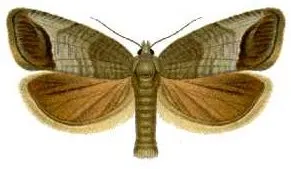
Codling moth is one of the most important internal fruit pests of apple and pear plantings in the United States and also damages English walnut. Adults are small gray-brown moths with a distinctive coppery-brown patch near the wing tip. Females lay single, disk-shaped eggs on leaves or fruit. After hatching, larvae usually enter fruit rapidly and feed toward the seed chamber.
Damage can range from shallow entries to complete loss of marketable fruit. Population pressure and the number of generations vary with climate, elevation, host availability and season length; many US regions have two generations, while warmer areas may support a partial or third generation.
Symptoms and identification
- Small entry hole on developing or mature fruit, often surrounded by reddish-brown granular frass.
- Tunnels through the flesh, commonly leading toward the seed chamber; larvae or darkened feeding galleries may be visible when fruit is cut open.
- Premature fruit drop, internal browning, spoiled seed chambers and fruit unsuitable for fresh eating or storage.
- On walnut, injury may occur through the husk and can cause staining or premature drop.
- Adults are not the damaging stage; similar fruit injury can also be caused by other internal fruit-feeding insects.
Causes and spread
Damage is caused by larvae of Cydia pomonella. Adults fly at dusk and night, mate, and lay eggs singly on foliage or fruit. Newly hatched larvae crawl to a suitable fruit and bore inside, where contact insecticides are less effective. Spread is favored by nearby untreated apple, pear or walnut trees, abandoned orchards, infested dropped fruit, and unmanaged orchard edges that provide breeding sites.
Life cycle and persistence
In much of the United States, mature larvae overwinter in silken cocoons under loose bark, in branch crotches, in orchard debris or sheltered soil locations. Adults emerge in spring; the first flight and egg-laying period is best detected with pheromone traps rather than calendar dates alone. Eggs hatch after temperature-dependent development, and larvae enter fruit soon afterward. Mature larvae leave fruit to pupate, producing later flights where the growing season is long enough. Degree-day models can improve timing, but local trap captures and field observations should confirm the model.
Treatment and control
Use an IPM sequence rather than routine calendar spraying. Install species-specific pheromone traps and use the first sustained captures, local extension guidance and temperature-based development information to identify egg-laying and hatch periods. Management is most effective against eggs and newly hatched larvae before they enter fruit.
For small plantings, combine sanitation, removal of infested fruit, fruit bagging and targeted interventions. In commercial orchards or high-pressure sites, mating disruption, granulovirus products, selective insecticides and other registered tools may be integrated according to monitoring results, resistance-management guidance and crop timing. Reinspect fruit after each generation and adjust the program to local pressure.
Low-impact and biological control
- Sanitation: remove infested and fallen fruit promptly and eliminate nearby unmanaged host reservoirs.
- Physical exclusion: bag individual fruit or use suitable orchard covers where feasible.
- Mating disruption: pheromone dispensers can reduce successful mating, especially in sufficiently large, relatively isolated blocks with manageable moth pressure.
- Biological control: codling moth granulovirus can kill young larvae when correctly timed and repeatedly applied according to its label; conserve predators and parasitoids by avoiding unnecessary broad-spectrum treatments.
- Monitoring: use pheromone traps to determine whether treatment is needed and to identify flight periods.
Organic production does not mean risk-free control: sanitation, coverage, timing and repeated monitoring remain essential.
Prevention
- Inspect fruit regularly from petal fall through harvest and remove fruit with fresh entry holes or frass.
- Pick up and destroy dropped or visibly infested fruit; do not leave cull fruit beneath trees.
- Prune and thin trees so fruit is accessible for inspection, bagging and treatment.
- Remove or manage abandoned apple, pear and walnut trees near the planting when legally and practically possible.
- Use pheromone traps before spring flight and continue monitoring through the season; record captures and local fruit injury.
- Where practical, protect individual backyard fruit with paper or reusable fruit bags after fruit thinning and before egg-laying pressure increases.
Interesting facts
- The familiar “worm in the apple” is a caterpillar, not an adult moth.
- A newly hatched larva may enter fruit within a short time, making post-entry control difficult.
- The coppery wing-tip patch is a useful adult identification feature, although field confirmation with traps and host damage is important.
- USDA APHIS recognizes codling moth as a pest of quarantine significance in certain fruit-movement and treatment contexts; regulatory requirements can vary with the commodity and origin.
- Degree-day models are useful for forecasting egg hatch and larval risk, but local validation is important because climate and moth populations differ among regions.
Use only pesticide products legally authorized and currently labeled for codling moth on the specific crop in your US state. Follow the current label for crop, rate, timing, application interval, personal protective equipment, preharvest interval, pollinator precautions and resistance-management requirements. Do not apply an off-label product or assume that a product registered on apple is registered on pear or walnut.
Affected plants
The plants below are linked to this problem by structured host-plant data. The list updates automatically as new plant profiles are added.