
 Source:
 Phytophthora root and crown rot
Phytophthora nicotianaePhytophthora root and crown rot overview
Phytophthora nicotianae is a soilborne water mold with a broad but host- and isolate-dependent host range. It commonly causes root, crown, stem, tuber, fruit, and occasional foliar disease in tobacco, vegetables, citrus, ornamentals, and greenhouse crops. Warm, saturated soil, poor drainage, contaminated irrigation water, and infested plant debris favor rapid spread and severe losses.
Typical conditions
Overview
Phytophthora nicotianae attacks plants through roots, crowns, stem bases, wounds, or low foliage contacting infested soil or water. Disease expression varies by host. Tobacco is affected by black shank, while tomato, potato, pepper, eggplant, citrus, annual vinca, petunia, pothos, and other crops may develop root or crown rot, damping-off, fruit or tuber rot, or aerial blight.
Diagnosis should be confirmed by a plant diagnostic laboratory using isolation, microscopy, and/or molecular testing, especially when management depends on distinguishing P. nicotianae from other Phytophthora species.
Symptoms and identification
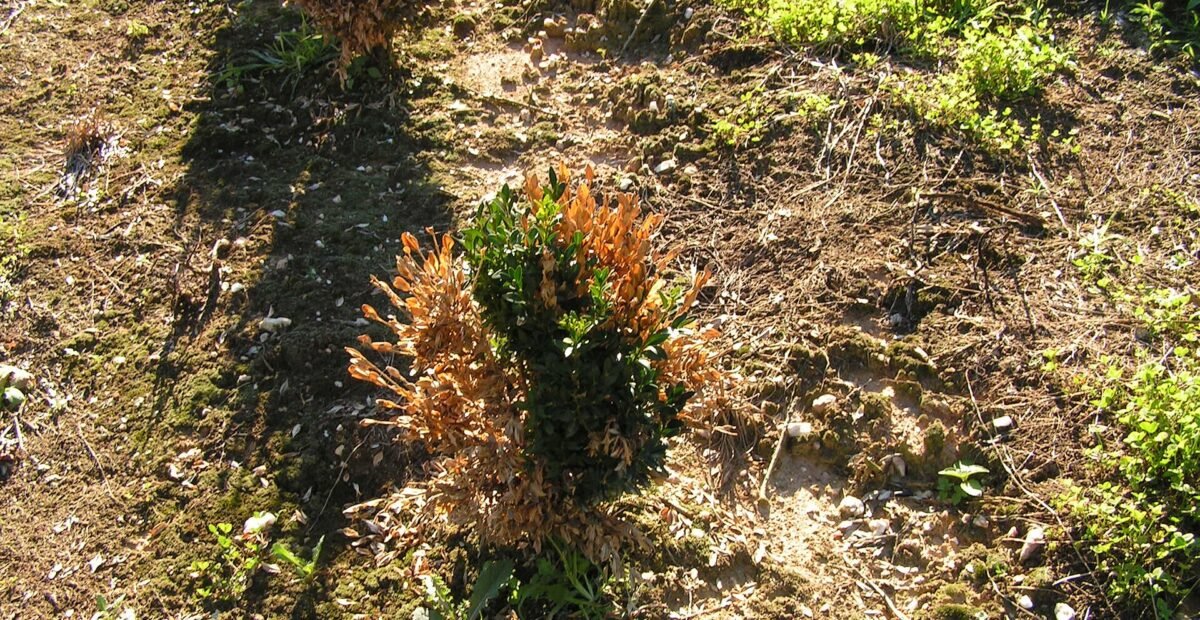
- Roots become water-soaked, dark brown to black, and may lose their outer cortex.
- Crowns and lower stems develop brown, water-soaked lesions that may girdle the plant.
- Aboveground symptoms include wilting, stunting, yellowing, poor new growth, leaf drop, and rapid collapse.
- Tobacco black shank may show dark lower-stem lesions, pith necrosis, and brown-to-black discolored pith disks.
- Seedlings may damp off, while fruits and tubers can develop depressed, water-soaked or dark rots.
- On susceptible ornamentals such as annual vinca, dark water-soaked leaf and petiole lesions may progress into stem girdling and plant death.
These symptoms are not species-specific. Healthy-looking roots do not exclude aerial infection on some hosts.
Causes and spread
The pathogen survives in infested soil, plant debris, roots, potting media, and water. It produces swimming zoospores when soil or irrigation water is saturated, allowing infection to move through wet root zones. Sporangia, chlamydospores, and oospores can contribute to persistence and secondary disease cycles.
Spread occurs through runoff, flooding, overhead irrigation, rain splash, contaminated tools, containers, footwear, machinery, transplants, and reused growing media. In greenhouses, recirculated or contaminated irrigation water can rapidly distribute inoculum between containers or benches.
Life cycle and persistence
Phytophthora nicotianae persists between crops as thick-walled survival structures, including chlamydospores and, where compatible mating types occur, oospores. Under warm, wet conditions it produces sporangia. These release motile zoospores that swim short distances through saturated soil or water films and encyst on susceptible plant tissue.
After infection, the pathogen colonizes roots, crowns, stems, fruits, tubers, or foliage depending on the host and isolate. New sporangia and zoospores can produce repeated infection cycles during a wet growing period. The disease may progress very quickly in warm saturated media.
Treatment and control
There is no reliable curative treatment for plants with extensive root or crown destruction. Remove and discard badly affected plants, roots, and contaminated container media. Isolate disease foci and improve drainage immediately. Reduce irrigation frequency and duration while preventing drought stress, and avoid moving water from diseased to healthy areas.
For valuable perennial plants, prune only dead tissue when appropriate and correct the underlying drainage problem. In commercial, greenhouse, and nursery systems, use a crop-specific integrated program based on resistant material, sanitation, water management, and products legally registered for the exact crop and disease. Fungicides are generally most effective preventively or very early in disease development and should not substitute for sanitation and moisture control.
Low-impact and biological control
Organic and low-input management depends primarily on exclusion and cultural control: clean propagation material, new or properly sanitized media, disinfected containers, careful irrigation, raised beds, removal of infected plants, and avoidance of contaminated runoff.
Products containing biological control organisms or microbial amendments may help suppress Phytophthora in some crops and production systems, but performance is variable and they do not reliably rescue plants with advanced rot. Use only products approved for organic production when that status is required, and follow the product label and crop-specific extension guidance.
Prevention
- Plant certified, symptom-free material in clean, pathogen-free commercial media.
- Use raised beds, well-drained sites, clean containers, and sanitized benches; correct drainage before planting.
- Water deeply but only as needed, avoid standing water, and favor drip or subirrigation that limits splash.
- Do not move soil, runoff, tools, pots, or plant debris from infested areas to clean areas.
- Remove severely diseased plants with surrounding roots and media; do not compost infected material unless the process is validated to destroy the pathogen.
- Use resistant or tolerant cultivars and rootstocks when documented for the specific crop and local pathogen population.
- Rotate susceptible annual crops with nonhost or less-susceptible crops where practical, recognizing that broad host range and survival structures can limit rotation effectiveness.
- Have representative samples tested before establishing a long-term management plan.
Interesting facts
- Phytophthora nicotianae was historically referred to in much of the plant pathology literature as Phytophthora parasitica.
- The pathogen is not a true fungus; it is an oomycete, or water mold.
- Its reported host range includes plants in many families, but isolates can be host-specific and a record from one host does not guarantee pathogenicity on every related plant.
- It differs from late blight pathogen Phytophthora infestans in having an important soilborne phase and survival structures such as chlamydospores and oospores.
- Swimming zoospores explain why flooding, runoff, overhead irrigation, and recirculated greenhouse water can cause rapid local spread.
- Black shank of tobacco is one of the best-known diseases caused by this pathogen.
Use only fungicides or other pesticides legally authorized in the United States for the specific crop, site, and Phytophthora disease. Always follow the current product label, including crop restrictions, application method, personal protective equipment, reentry and harvest intervals, and resistance-management requirements. Mefenoxam resistance has been reported in some P. nicotianae populations, so do not assume a product will work without local evidence or label-supported guidance.
Affected plants
The plants below are linked to this problem by structured host-plant data. The list updates automatically as new plant profiles are added.
 Onion (Allium cepa) care guideAllium cepa
 Allium christophii care guideAllium christophii
 Bunching onion (Allium fistulosum) care guideAllium fistulosum
 Giant Allium (Allium giganteum) care guideAllium giganteum
 Ornamental onion (Allium) care guideAllium
 Garlic (Allium sativum) care guideAllium sativum
 Chives (Allium schoenoprasum) care guideAllium schoenoprasum
 Ransoms (Allium ursinum) care guideAllium ursinum