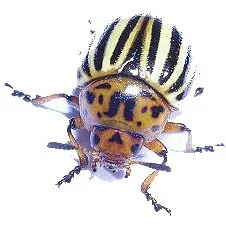
Colorado Potato Beetle
Leptinotarsa decemlineataColorado Potato Beetle overview
The Colorado potato beetle, Leptinotarsa decemlineata, is a highly destructive leaf-feeding pest of potatoes and other nightshade-family crops in the United States. Striped adults and orange-red larvae chew foliage, sometimes causing complete defoliation and substantial yield loss. Early detection, crop rotation, physical exclusion, hand removal, biological conservation and insecticide-resistance management work best when used together.
Typical conditions
Overview
The Colorado potato beetle (Leptinotarsa decemlineata) is one of the most important insect pests of potato in North America. Adults are oval, about 3/8 inch long, with yellowish wing covers marked by 10 black stripes. Larvae are hump-backed, orange to salmon-colored, black-headed and marked with two rows of dark spots.
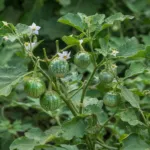
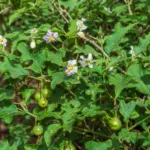
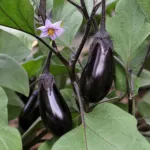
In the United States, potato is the principal crop host, but eggplant and, in some regions, tomato may also be seriously damaged. The beetle is not a plant disease and does not cause infection; injury results from direct chewing by adults and larvae.
Symptoms and identification
Adults and larvae chew irregular holes in leaves, often leaving only veins or stems when populations are high. Young larvae may remain clustered near egg masses, while older larvae spread across the plant and account for much of the feeding injury.
- Bright yellow-orange egg clusters on leaf undersides.
- Orange, pink or salmon larvae with black heads and dark lateral spots.
- Shot-hole to extensive skeletonized foliage.
- Reduced plant vigor, premature senescence and, in severe cases, complete defoliation.
- Lower potato yield when defoliation occurs during tuber initiation and bulking.
Causes and spread
Damage is caused by feeding adults and larvae, not by a pathogen. Adults overwinter in soil and emerge in spring near potato fields, gardens, field margins, windbreaks and other sheltered areas. They may walk into newly emerged plants and later disperse by flight, especially in warm weather.
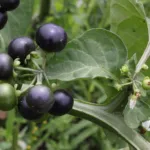
Nearby volunteer potatoes and nightshade weeds, including horsenettle and other Solanum species, can provide food and breeding sites. Moving potatoes into a different location, removing host weeds and maintaining separation from the previous infested planting can delay colonization, although beetles may arrive from surrounding properties.
Life cycle and persistence
Adults overwinter approximately 5–10 inches underground. After emerging in spring, they feed briefly, mate and females lay clusters of roughly 10–30 yellow-orange eggs on the undersides of leaves. A female may lay up to about 350 eggs over several weeks.
Eggs commonly hatch in about two weeks, depending on temperature. Larvae pass through four instars; development can take about 10 days in warm conditions near the mid-80s °F but more than a month near 60 °F. Mature fourth-instar larvae drop to the soil, burrow down and pupate. The number of generations varies by region, temperature, photoperiod and host quality; one or more generations may occur in the United States.
Treatment and control
Base treatment on monitoring rather than calendar spraying. In small plantings, hand-pick adults and larvae into soapy water and crush or remove egg masses from leaf undersides. Pay particular attention when adults first emerge and when plants approach flowering and tuber initiation.
For commercial or larger plantings, use local extension thresholds and consider treatment when defoliation approaches economically important levels. Potatoes generally tolerate more foliage loss before flowering than during tuber initiation, when even comparatively modest defoliation can reduce yield. Combine cultural and physical tactics with any chemical intervention, and rotate insecticide modes of action according to resistance-management guidance. Do not increase rates or repeat ineffective products.
Low-impact and biological control
Hand removal, early planting, crop rotation, row covers, straw mulch and removal of host weeds are the most practical nonchemical measures for home gardens. Preserve predatory stink bugs, lady beetles, ground beetles and other naturally occurring enemies; they may consume eggs or larvae but usually do not provide dependable control alone.
Beauveria bassiana-based products may kill larvae and adults under suitable conditions, but performance depends on formulation, coverage, humidity, timing and local registration. Use only products allowed for the crop and production system, and follow the current label. Do not assume that every biological product provides reliable field control.
Prevention
- Rotate potatoes and other susceptible nightshades to a location at least 1/4 mile from the previous infested planting when practical; greater separation is more protective.
- Remove volunteer potatoes and nearby nightshade weeds that can sustain beetles.
- Plant early-maturing potato varieties where appropriate to reduce exposure to later-season populations.
- Use row cover before beetles emerge and only where the planting is rotated; remove it when heat and humidity could encourage plant disease.
- Use straw mulch between rows to make movement and soil access more difficult.
- Inspect plants every few days from emergence through tuber initiation, recording adults, egg masses, larval size and percent defoliation.
- Clean up crop debris after harvest to reduce favorable overwintering conditions, while recognizing that adults may overwinter outside the garden.
Interesting facts
The species was originally associated with native North American nightshades and shifted strongly onto cultivated potato during its nineteenth-century expansion. It is widely studied because it can evolve resistance to insecticides unusually rapidly.
Adults may remain dormant underground through winter, and some populations show substantial variation in emergence, dispersal and generation number. The beetle's flexibility is why rotation, physical barriers, biological conservation and resistance-aware chemical use are more durable than any single control method.
Use only insecticides legally authorized in the United States for Colorado potato beetle on the specific crop and site. Follow the current product label for crop, rate, timing, preharvest interval, protective equipment, pollinator precautions and resistance-management requirements. Colorado potato beetle has developed resistance to many active ingredients across multiple insecticide groups; never rely on repeated applications of one mode of action, and do not use a product that has already failed in the local population.
Affected plants
The plants below are linked to this problem by structured host-plant data. The list updates automatically as new plant profiles are added.