
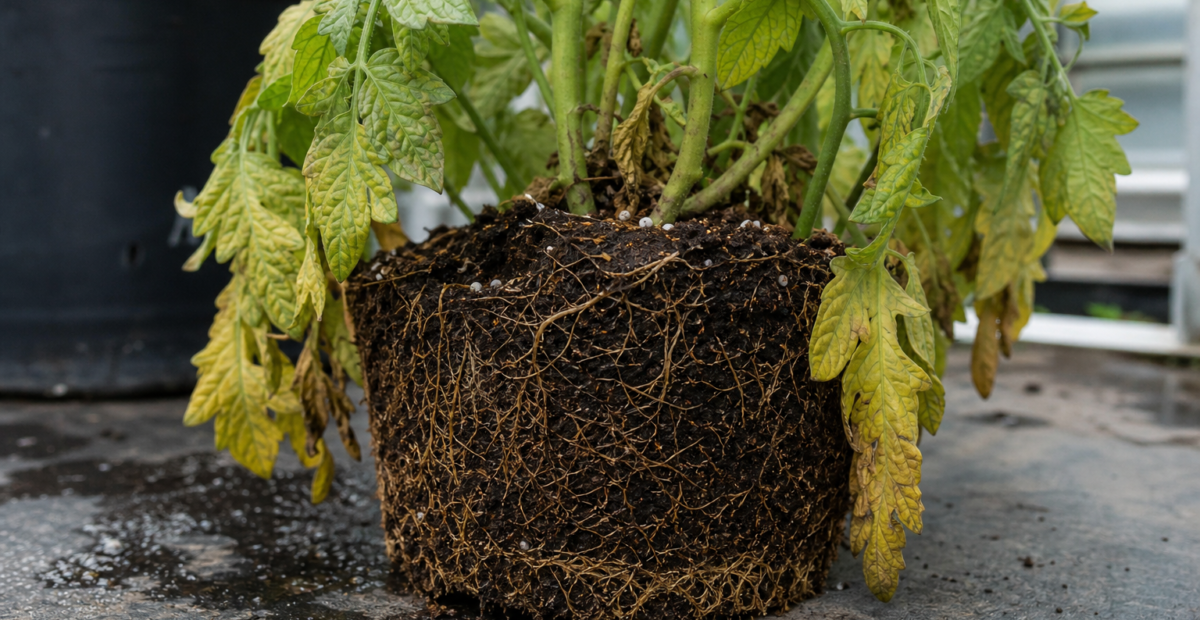
Root Anoxia
Root Anoxia overview
Root anoxia is a noninfectious environmental disorder caused by critically low oxygen in saturated, compacted, or poorly drained root zones. Affected plants may wilt even when soil is wet, develop yellow or prematurely dropping leaves, stop growing, and lose fine roots. Damage is often worsened by secondary root-rotting organisms, but the initiating problem is inadequate aeration around the roots.
Typical conditions
Overview
Roots require oxygen for respiration, growth, water uptake, and mineral acquisition. When water fills the large air-filled pores in soil, oxygen moves too slowly to replace what roots and microorganisms consume. The resulting oxygen shortage may be described as hypoxia when oxygen is reduced or anoxia when it is nearly absent.
Root anoxia can occur in gardens, landscapes, nurseries, containers, orchards, and field crops. Short-term saturation may cause temporary wilting or leaf drop, while prolonged saturation can kill fine roots and lead to chronic decline. Wet conditions also increase the risk of secondary infections by organisms such as Phytophthora and Pythium, so anoxic injury and root disease may occur together.
Symptoms and identification
- Wilting, leaf curling, epinasty, premature yellowing, browning, or leaf drop despite wet soil.
- Slow growth, short shoots, small leaves, poor flowering, reduced fruit development, or shoot dieback.
- Roots that are brown, gray, blackened, water-soaked, soft, or easily pulled apart; healthy feeder roots are generally firm and pale.
- Soggy soil, standing water, slow drainage, or a rotten-egg odor may be present.
- Some woody plants may develop basal adventitious roots, enlarged lenticels, bark cracking, gumming, or cankers after chronic stress.
Symptoms overlap with drought, nutrient disorders, vascular disease, and root rot. Inspect the root zone and drainage pattern before making a diagnosis.
Causes and spread
Common causes include overwatering, frequent irrigation, heavy rainfall, flooding, high-clay or fine-textured soil, compaction, hardpan, a shallow water table, buried planting depth, impermeable surfaces, blocked container drainage, and poorly designed landscape grades. Fresh organic material incorporated into warm, wet soil can also temporarily increase microbial oxygen consumption.
Root anoxia itself does not spread from plant to plant. However, saturated conditions can move waterborne root pathogens and favor their infection of stressed roots. Runoff, flooding, contaminated irrigation water, and movement of wet soil may therefore increase secondary disease problems.
Life cycle and persistence
This disorder has no biological lifecycle because it is caused by an environmental condition. After soil pores become saturated, oxygen may be depleted within hours to days, especially in warm, compacted, fine-textured soil. Root respiration and elongation decline, and the root tips and fine feeder roots may die first.
If the soil is rapidly aerated, surviving roots may resume function and new roots can develop. Flood-tolerant plants may form adventitious roots or internal air spaces called aerenchyma, whereas flood-sensitive plants often fail to regenerate roots and continue to decline. Secondary root rots may progress after the original waterlogging event.
Treatment and control
First stop unnecessary irrigation and remove or channel standing water. Improve the cause of poor drainage rather than simply adding fertilizer. In containers, move the plant to a protected, well-drained location, confirm that drainage holes are open, and repot only when the medium remains saturated or roots are extensively damaged.
After drainage improves, inspect the root system. Remove only clearly dead, mushy roots with clean tools, avoid aggressive root pruning, and replant at the original depth in well-drained soil. Reduce transplant shock by providing moderate light and consistent—not excessive—moisture. Delay routine fertilization until new root or shoot growth resumes, because stressed roots may be injured by concentrated salts.
For valuable trees, shrubs, greenhouse crops, or plants that continue to wilt after drainage is restored, obtain a diagnostic examination. Test roots for pathogens when appropriate; anoxia and Phytophthora or Pythium root rot can look similar and require different management.
Low-impact and biological control
- Use cultural correction as the primary control: drainage, irrigation adjustment, raised beds, appropriate plant selection, and compaction prevention.
- Incorporate finished compost before planting where soil-test and site conditions support it; do not bury fresh manure or large quantities of undecomposed material in a wet root zone.
- Use clean containers, fresh or properly managed potting media, and sanitary propagation practices to limit secondary root pathogens.
- Biological products may have a role against particular root pathogens, but they do not replace oxygen restoration and should be selected only for a confirmed or strongly suspected target problem.
Prevention
- Match plants to the site; reserve poorly drained locations for species adapted to wet soils.
- Correct grading and drainage before planting. Redirect downspouts, use swales or French drains where appropriate, and consider raised beds or planting berms.
- Do not irrigate by calendar alone. Water when the root zone needs it, and allow excess water to drain.
- Improve soil structure with mature organic matter incorporated before planting, but avoid creating a fine-textured amended pocket in heavy native soil.
- Prevent compaction, keep machinery off wet beds, and do not bury trunks, crowns, or root collars.
- Use containers with unobstructed drainage holes and a suitable, porous potting medium; do not place pots in standing saucers of water.
- After flooding, remove debris and inspect roots and crowns for secondary rot. Sanitize tools used on diseased roots.
Interesting facts
- Plants can wilt in waterlogged soil because damaged roots cannot absorb and transport enough water, producing a drought-like symptom under conditions of excess moisture.
- Oxygen deficiency can reduce nutrient uptake and contribute to yellowing that resembles nitrogen or iron deficiency.
- Flood-tolerant species may produce adventitious roots or internal air channels that help move oxygen toward submerged tissues.
- Root anoxia is an environmental disorder, not an infectious disease, but it can predispose plants to water-favored root pathogens.
- The duration of saturation, soil temperature, plant species, root age, and soil texture all influence severity; there is no universal safe flooding period.
No pesticide treats root anoxia itself. Use only products legally authorized for the specific crop and diagnosed problem in the United States, and follow the current product label. Fungicides or other pesticides should be considered only when a separate pathogen or pest has been confirmed or professionally diagnosed; never use a pesticide to compensate for poor drainage.
Affected plants
The plants below are linked to this problem by structured host-plant data. The list updates automatically as new plant profiles are added.
 Common juniper (Juniperus communis) care guideJuniperus communis
 Creeping juniper (Juniperus horizontalis) care guideJuniperus horizontalis
 Compressa (Juniperus communis ‘Compressa’)Juniperus communis 'Compressa'
 Dwarf Japanese garden juniper (Juniperus procumbens ‘Nana’)Juniperus procumbens 'Nana'
 Savin juniper (Juniperus sabina) care guideJuniperus sabina
 Rocky Mountain Juniper (Juniperus scopulorum) care guideJuniperus scopulorum
 Flaky juniper (Juniperus squamata) care guideJuniperus squamata
 Eastern redcedar (Juniperus virginiana) care guideJuniperus virginiana
 Juniperus × media ‘Gold Star’Juniperus × media 'Gold Star'
 Juniperus × media ‘Old Gold’Juniperus × media 'Old Gold'
 Pfitzer’s juniper (Juniperus pfitzeriana) care guideJuniperus pfitzeriana
 Magnolia ‘Star Wars’Magnolia 'Star Wars'