
 Source:
 Magnolia ‘Star Wars’ short overview
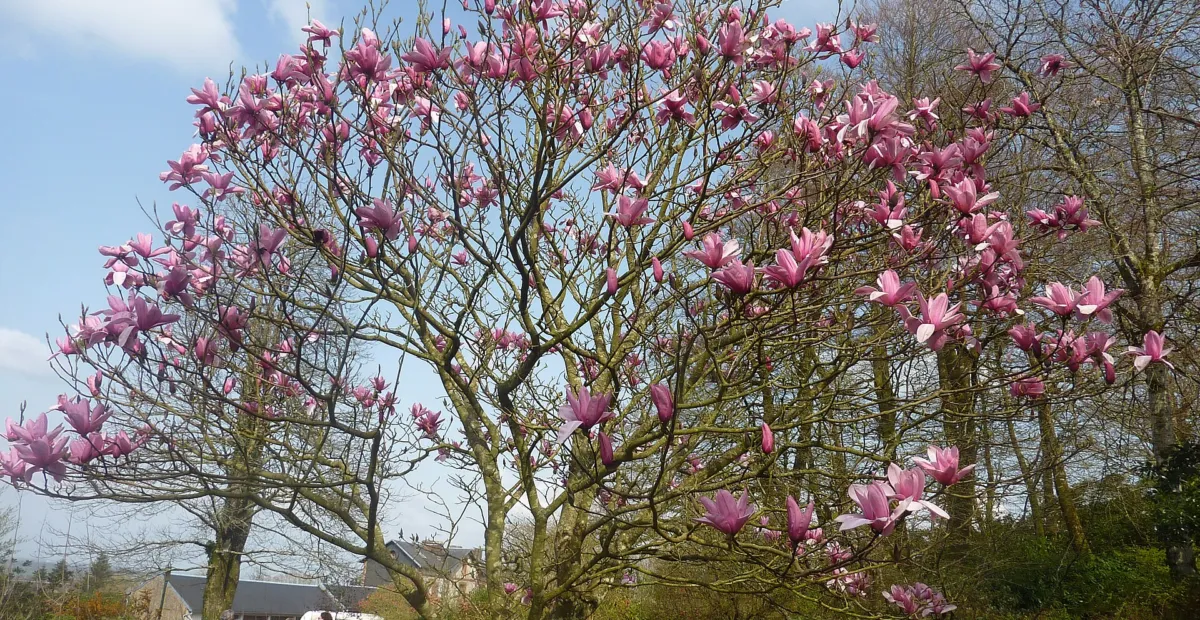
Magnolia 'Star Wars' is a distinctive deciduous hybrid magnolia raised in New Zealand from Magnolia campbellii and M. liliiflora. It forms an upright, medium-sized tree with dark green summer foliage and an impressive spring display of large, fragrant rosy-pink flowers. The outer tepals characteristically roll inward, giving each bloom a sculptural, starburst-like appearance. Plant it in rich, well-drained soil with shelter from strong winds and late frosts.
Taxonomic classification
Magnolia ‘Star Wars’ care guide
Light and placement
Grow in full sun for the heaviest flowering, or light partial shade where summers are hot. A site with morning sun and afternoon protection can reduce heat and drought stress. Shelter from strong prevailing winds, which can damage flowers and dry the foliage. Sparse flowering may indicate excessive shade; scorched leaves or premature wilting suggest excessive exposure combined with moisture stress.
Watering and humidity
Water deeply and slowly whenever the upper few inches of soil begin to dry, keeping the root zone evenly moist during the first two growing seasons. Reduce frequency after establishment but do not allow prolonged drought. Increase watering during hot, dry weather and pause when soil is saturated. Mulch helps moderate root temperature and moisture.
Soil and growing medium
Use rich, humus-amended soil that drains freely but does not dry rapidly. Loam is ideal; clay and sand can work when improved with organic matter and drainage is adequate. A slightly acidic to neutral reaction is preferred. Avoid compacted ground and chronically waterlogged sites.
Feeding
Apply compost or a thin organic mulch layer in spring, keeping it away from the trunk. If growth is weak, use a slow-release balanced tree fertilizer according to the label after establishment. Do not overfeed with high nitrogen, and avoid fertilizing during drought, immediately after planting or late in the growing season.
Growth and habit
This is an upright, strong-leader hybrid that develops into a medium-sized deciduous tree. It tends to flower young and can be highly floriferous. Maintain a clear, stable framework when young, but avoid unnecessary pruning because magnolias heal slowly and flower buds are often carried at shoot tips.
Planting and repotting
Plant in spring or fall while the soil is workable. Set the root flare level with or slightly above surrounding soil, never deeply buried. Mulch broadly without touching the trunk, water consistently during establishment, and allow enough room for the mature canopy. Shelter the site from drying winds and frost pockets.
Young container plants can be shifted into a larger container when roots circle the pot, preferably in early spring or fall. Use a structurally stable, moisture-retentive but well-drained mix. Plant out before the root ball becomes badly congested; magnolias dislike repeated root disturbance.
Propagation and pruning
Propagation
Cultivar plants are normally propagated vegetatively. Softwood cuttings in early summer and semi-hardwood cuttings in late summer are documented methods, but rooting can be inconsistent. Grafting is also used commercially for magnolia cultivars. Seed will not reliably reproduce the named cultivar.
Pruning
Prune only when necessary, preferably in midsummer after the tree is fully leafed out. Remove dead, damaged or crossing branches and make clean cuts at a suitable branch union. Avoid hard renovation pruning and unnecessary root disturbance; large wounds may heal slowly and reduce future flowering.
Overwintering
In Zone 6, choose a sheltered location and protect young trees from drying winter winds with appropriate mulch over the root zone. Avoid late-season nitrogen that can encourage tender growth. Flower buds may be lost to late freezes even when the tree itself survives. Container plants need extra root protection or planting out before severe winter.
Uses
Use as a specimen tree, lawn accent, woodland-edge feature or focal point in a large mixed border. Its fragrant spring flowers and unusual tepal form make it valuable for display gardens. It is not recommended as a culinary or medicinal plant, and fallen plant material should not be intentionally consumed.
Appearance
The tree has a strong central leader, upright branching and a generally pyramidal outline when young. Leaves are simple, mid- to dark green and deciduous. The most diagnostic feature is the large rosy-pink flower with outer tepals that roll inward into conspicuous tubes or spikes. Smooth gray-brown bark develops on mature branches.
Flowering
Large, fragrant flowers appear before or with the young leaves. Blooms are typically produced freely in spring, with individual flowers commonly about 6 inches across and sometimes larger. The tepals are rosy pink outside and paler inside; the outer tepals roll inward as the flower opens. Late frosts can damage developing buds.
Pollination and visitors
Magnolias are evolutionarily associated with beetle pollination, and their robust flowers provide pollen for beetle visitors. The flowers are insect-pollinated rather than wind-pollinated; evidence specific to this named cultivar is limited, so the visitor rating is conservative.
Magnolia 'Star Wars' photos
Click any photo for a larger view. Source, author and license are shown separately.
Diseases and pests
Diseases
Possible problems include fungal leaf spots, gray mold, Phytophthora in poorly drained soil, coral spot and honey fungus. Improve drainage, avoid trunk injury, water at the root zone rather than over the foliage, and remove heavily infected fallen leaves. Use fungicides only when diagnosis and local label directions justify treatment.
Pests
Watch for scale insects, including magnolia scale and horse chestnut scale, as well as capsid bugs. Inspect stems and leaf undersides, encourage natural enemies, avoid unnecessary broad-spectrum insecticides, and use horticultural oil or labeled treatments only when pests are confirmed and conditions are appropriate.
Toxicity and pollen
No cultivar-specific toxicity study was located. Magnolia is listed by ASPCA among plants regarded as non-toxic to dogs and cats, but any plant material can cause gastrointestinal upset if eaten in quantity. Do not treat the plant as edible, and contact a veterinarian or poison service if a pet develops symptoms after ingestion.
- Typical season
- Spring flowering period
- Pollination / pollen
- Heavy, sticky insect-dispersed pollen
Magnolia pollen is relatively heavy and sticky because the flowers are insect-pollinated, so it is generally less likely to become widely airborne than pollen from wind-pollinated trees. Sensitive individuals can still react to direct contact or local exposure during bloom.
Native habitat
This cultivated hybrid is not a wild native species. Its parentage combines Magnolia campbellii, associated with montane forests of the eastern Himalaya and southwestern China, and M. liliiflora, associated with China. In cultivation, it performs best in temperate climates with fertile, moist but well-drained soil and shelter.
Interesting fact
The cultivar was raised by Oswald Blumhardt in New Zealand in the 1970s from Magnolia campbellii × M. liliiflora. Its name refers to the many flowers whose rolled outer tepals point in different directions. It can flower at a relatively young age compared with some large-flowered magnolias. Magnolia flowers have tepals rather than clearly differentiated petals and sepals.
Frequently asked questions (FAQ)
The most relevant questions about this plant, with short and direct answers.
🌱Quick care
What is Magnolia 'Star Wars'?⌄
Magnolia 'Star Wars' is a deciduous hybrid magnolia bred from Magnolia campbellii and Magnolia liliiflora. It develops into a medium-sized tree with a strong central leader and large rosy-pink flowers.
How big does Magnolia 'Star Wars' get?⌄
Magnolia 'Star Wars' can reach about 30 feet tall and 15 feet wide at maturity. Give it enough room to develop its broad pyramidal form without crowding buildings, paths, or overhead utilities.
What USDA hardiness zone is Magnolia 'Star Wars'?⌄
Magnolia 'Star Wars' is generally suitable for USDA Zones 6 through 9, although cold exposure and local conditions can affect performance. Protect young plants and flower buds from severe or late frosts.
Is Magnolia 'Star Wars' evergreen or deciduous?⌄
Magnolia 'Star Wars' is deciduous, so it drops its leaves in fall and flowers on bare or partially bare branches in spring.
🌤️Environment and placement
How much sun does Magnolia 'Star Wars' need?⌄
Grow Magnolia 'Star Wars' in full sun to partial shade. More sun usually supports stronger flowering, while some afternoon shade can help in hot, dry climates.
Where should I plant Magnolia 'Star Wars'?⌄
Plant Magnolia 'Star Wars' in a sheltered location protected from strong, cold winds and late-frost pockets. A specimen position in a lawn, border, or spacious garden bed works well.
What type of soil does Magnolia 'Star Wars' prefer?⌄
Magnolia 'Star Wars' prefers rich, humus-rich, well-drained loam that stays evenly moist. It can tolerate improved clay or sandy soil, but poorly drained ground can encourage root problems.
Does Magnolia 'Star Wars' prefer acidic soil?⌄
Magnolia 'Star Wars' grows well in slightly acidic to neutral soil, although it can tolerate somewhat broader conditions if drainage and organic matter are good. Persistent yellowing leaves may indicate unsuitable soil chemistry or another nutrient issue.
Can Magnolia 'Star Wars' tolerate clay soil?⌄
Magnolia 'Star Wars' can grow in clay soil if it is amended with organic matter and drains adequately. Do not plant it where water remains stagnant after rain.
💧Care and problems
How often should I water Magnolia 'Star Wars'?⌄
Water Magnolia 'Star Wars' deeply whenever the top few inches of soil begin to dry, maintaining consistent moisture without waterlogging the roots. Newly planted trees need especially regular irrigation during their first growing season and during drought.
Should I mulch Magnolia 'Star Wars'?⌄
Yes, apply a 2- to 4-inch layer of organic mulch over the root zone to conserve moisture and moderate soil temperature. Keep mulch a few inches away from the trunk to reduce rot and pest problems.
Does Magnolia 'Star Wars' need fertilizer?⌄
Magnolia 'Star Wars' usually needs little fertilizer when planted in fertile soil. If growth is weak or a soil test identifies a deficiency, use a suitable slow-release fertilizer in spring rather than applying heavy doses.
Why is my Magnolia 'Star Wars' not flowering?⌄
Magnolia 'Star Wars' may fail to flower because of insufficient light, excessive nitrogen, drought stress, juvenile age, or flower-bud damage from late frost. Avoid heavy pruning and maintain even moisture while the tree establishes.
What pests affect Magnolia 'Star Wars'?⌄
Magnolia 'Star Wars' may occasionally be affected by scale insects, aphids, capsid-type insects, snails, or slugs. Inspect leaves, stems, and buds regularly and address infestations according to their severity.
What diseases can affect Magnolia 'Star Wars'?⌄
Potential problems include gray mold, leaf spots, coral spot, root or stem rots, and honey fungus in unsuitable conditions. Good drainage, adequate spacing, careful watering, and removal of damaged wood help reduce risk.
🪴Planting and repotting
When is the best time to plant Magnolia 'Star Wars'?⌄
Plant Magnolia 'Star Wars' while it is dormant, generally in late fall or winter in milder areas and early spring in colder areas. Avoid planting when the ground is frozen, waterlogged, or extremely dry.
Can Magnolia 'Star Wars' be grown in a container?⌄
Magnolia 'Star Wars' is best planted in the ground for long-term growth because it becomes a substantial tree. A large container may work temporarily for a young plant, but it will require careful watering, root-space management, and eventual planting out.
How far apart should Magnolia 'Star Wars' be planted from a house?⌄
Allow roughly 15 feet or more from a house or major structure, adjusting for the tree's mature spread and the available space. Also check for overhead wires, paving, drainage lines, and nearby trees before planting.
✂️Propagation and pruning
Can Magnolia 'Star Wars' be grown from seed?⌄
Seed is not the preferred way to reproduce Magnolia 'Star Wars' because seedlings may not retain the cultivar's exact characteristics. Named plants are generally propagated vegetatively, such as by cuttings or grafting.
How is Magnolia 'Star Wars' propagated?⌄
Magnolia 'Star Wars' can be propagated by softwood cuttings in early summer or semi-ripe cuttings in late summer, although successful rooting may require controlled humidity and specialized care. Commercial plants may also be grafted.
When should Magnolia 'Star Wars' be pruned?⌄
If pruning is necessary, prune Magnolia 'Star Wars' in midsummer after flowering, when it is in full leaf. Remove dead, damaged, crossing, or poorly positioned branches and avoid unnecessary heavy cuts.
Can Magnolia 'Star Wars' be hard-pruned?⌄
Avoid hard pruning Magnolia 'Star Wars' because magnolias can respond poorly to major cuts and may take years to regain a natural shape. Establish the desired structure while the tree is young and make only light corrective cuts later.
⚠️Toxicity and safety
Is Magnolia 'Star Wars' toxic to dogs and cats?⌄
Magnolia 'Star Wars' is generally regarded as non-toxic to dogs and cats. Pets can still experience stomach upset if they consume large amounts of plant material, so discourage heavy chewing.
🌸Flowering and special interest
When does Magnolia 'Star Wars' bloom?⌄
Magnolia 'Star Wars' usually blooms in mid to late spring, often before or as the leaves emerge. The exact timing varies with climate, weather, and the tree's exposure.
What do the flowers of Magnolia 'Star Wars' look like?⌄
The flowers are large, fragrant, and rosy pink, with paler inner surfaces and tepals that tend to roll or curl inward. Individual blooms can reach approximately 11 inches across under favorable conditions.
How long does Magnolia 'Star Wars' flower?⌄
The main flowering display can last several weeks, with the exact duration depending on temperature, wind, rainfall, and frost. Occasional later flowers may appear, but a second flush should not be expected every year.
Do late frosts damage Magnolia 'Star Wars' flowers?⌄
Yes, late frosts can brown or destroy open flowers and damage unopened flower buds. Planting in a sheltered site and protecting young trees during unusual cold snaps can help preserve the display.
Are Magnolia 'Star Wars' flowers fragrant?⌄
Yes, Magnolia 'Star Wars' is generally described as having fragrant flowers. Fragrance intensity can vary with temperature, flower age, and growing conditions.
Similar plants
 Crystal Palace (Lobelia erinus ‘Crystal Palace’)Lobelia erinus 'Crystal Palace'
 Blue Lobelia (Lobelia siphilitica) care guideLobelia siphilitica
 Lobelia ‘Techno Blue’Lobelia 'Techno Blue'
 Canary Island Lavender (Lavandula canariensis) care guideLavandula canariensis
 Fernleaf lavender and jagged lavender) is a species of flowering plant in the mint family (Lavandula pinnata) care guideLavandula pinnata
 Campbell’s Magnolia (Magnolia campbellii) care guideMagnolia campbellii