 Source:
 Mandevilla ‘Red Riding Hood’ short overview
Mandevilla ‘Red Riding Hood’ is a frost-tender tropical vine prized for glossy evergreen leaves and funnel-shaped flowers that range from rosy red to deep pink, often with a bright yellow throat. In the United States it is usually grown in a container, patio display, hanging basket, or seasonal bed. Give it strong light, regular moisture, excellent drainage, and a trellis or support; bring it indoors before frost in most regions.
Taxonomic classification
Mandevilla ‘Red Riding Hood’ care guide
Light and placement
Provide at least 6 hours of direct sun outdoors, preferably with morning sun and protection from intense reflected heat in the hottest climates. Indoors, use a bright south- or west-facing window or strong grow light. Too little light causes long, weak stems and fewer flowers; harsh heat through glass or sudden full sun can scorch leaves, so acclimate gradually.
Watering and humidity
Water thoroughly when the top inch of mix begins to dry, allowing excess water to drain completely. During hot summer growth, check containers frequently because flowering vines can dry quickly; reduce watering in fall and winter as light and growth decline. Do not leave the pot standing in water. Humidity is helpful indoors, but saturated soil and poor airflow encourage root problems.
Soil and growing medium
Use a fertile, porous potting mix that drains freely but does not dry immediately. A peat- or coir-based container mix amended with compost and perlite works well. Keep the root zone evenly moist rather than waterlogged. Slightly acidic to neutral conditions are suitable; avoid heavy, compacted soil and pots without drainage holes.
Feeding
Feed during active spring and summer growth with a balanced, water-soluble fertilizer diluted to about half strength every two to four weeks, or use a controlled-release product according to its label. Water the plant first if the mix is dry. Stop or greatly reduce feeding in low-light winter conditions.
Growth and habit
This cultivar develops twining or trailing stems and can be trained vertically, allowed to spill from a basket, or pinched for a fuller container display. Growth is fastest in warmth, bright light, and a long season. Pinching young shoots encourages branching; low light can produce elongated, less floriferous growth.
Planting and repotting
Set plants outdoors only after frost danger has passed and nights are reliably warm. Plant at the same depth as the nursery container, leaving about 3 to 4 feet between landscape plants where space permits. Establish with consistent moisture, then train young stems gently onto a trellis or support.
Repot in spring when roots fill the container or growth becomes weak. Move up only one pot size, use fresh well-drained mix, and keep the crown at its previous depth. After repotting, water thoroughly and return the plant to bright light while it re-establishes.
Propagation and pruning
Propagation
Use stem cuttings taken during active growth. Remove lower leaves, insert cuttings into a clean, lightly moist propagation medium, and provide warmth, bright indirect light, and high humidity until roots form. Cultivar characteristics are maintained vegetatively; seed is not recommended for preserving this named selection.
Pruning
Prune in late winter or early spring before vigorous new growth, or lightly pinch throughout the growing season to encourage branching. Remove weak, damaged, or overly long stems with clean shears and retrain remaining shoots. Avoid severe pruning while the plant is cold or drought-stressed; wear gloves because sap may irritate skin.
Overwintering
Move containers indoors before nighttime temperatures fall below about 45°F, and definitely before frost. Check for pests, prune lightly if needed, and place in the brightest available window or under grow lights. Keep the mix somewhat drier during low-light winter growth, avoid cold drafts, and return outdoors gradually in spring after frost danger has passed.
Uses
Use it as a patio container vine, trellised accent, hanging-basket specimen, conservatory plant, or seasonal flowering screen. In frost-free climates it can be planted near a pergola, fence, or wall with support. It is ornamental only; no culinary or medicinal use should be inferred.
Appearance
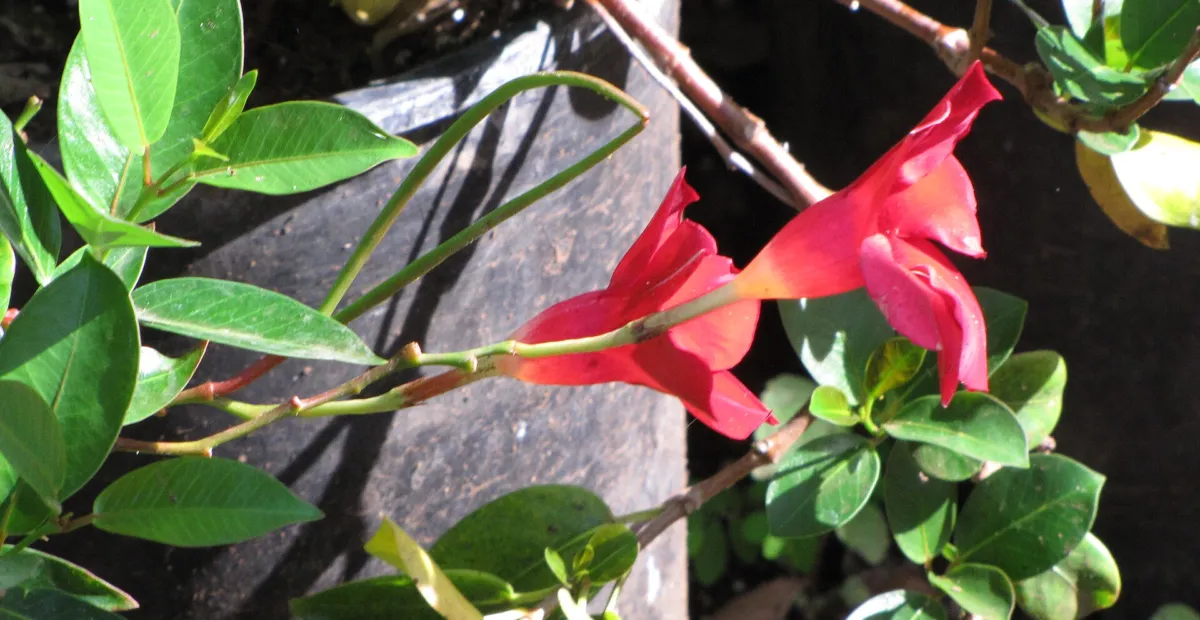
The plant has glossy, dark-green, opposite leaves with oval blades, pointed tips, rounded bases, and smooth margins. Stems are flexible and twining, with a woody base developing over time. The most distinctive feature is the contrast between saturated red-to-pink funnel flowers and their yellow throats.
Flowering
Flowers are produced freely during warm, bright growing conditions. The blooms are funnel-shaped, with five spreading lobes and a contrasting yellow throat; flowers may appear singly or in small clusters. Outdoor plants generally flower from late spring until cool weather, while well-lit indoor plants may bloom intermittently outside the main season.
Pollination and visitors
The showy tubular flowers are documented as butterfly-attracting. Their bright color and open funnel form may provide access to floral rewards, but a specific pollinating species is not reliably documented for this named cultivar. Pollinator evidence should not be confused with human allergy risk.
Mandevilla 'Red Riding Hood' photos
Click any photo for a larger view. Source, author and license are shown separately.
Diseases and pests
Diseases
Prevent disease by providing strong air circulation, avoiding wet foliage, and using a fast-draining medium. Root and stem problems are most likely in cold, saturated soil. Remove affected tissue, reduce watering during cool conditions, and discard severely rotted plants rather than reusing contaminated mix.
Pests
Inspect new growth and leaf undersides for aphids, mealybugs, whiteflies, spider mites, and thrips. Improve air movement, isolate infested containers, and wash pests off with water. Use insecticidal soap or horticultural oil only as directed and avoid treating plants during heat or drought stress.
Toxicity and pollen
No reliable cultivar-specific toxicity profile was found for 'Red Riding Hood'. Mandevilla is not listed in the consulted ASPCA plant database as a separately characterized toxic plant, but absence from a list is not proof of safety. The milky sap typical of Apocynaceae may irritate skin or eyes, and any plant material can cause gastrointestinal upset if eaten. Wear gloves when pruning and keep the plant away from children and pets that chew plants.
- Typical season
- Typically late spring through fall in the United States when grown outdoors
- Pollination / pollen
- Insect-dispersed pollen, not typically airborne in large amounts
Mandevilla flowers are generally insect-pollinated, so airborne pollen exposure is expected to be lower than for wind-pollinated plants. No cultivar-specific allergen studies were found, and low does not mean zero risk. People with plant allergies should avoid handling sap or flowers if irritation occurs.
Native habitat
The horticultural background is associated with tropical and subtropical Mandevilla from South America, especially Brazil. In cultivation it prefers warm conditions, bright light, fertile porous soils, and protection from cold. It is not hardy in freezing climates and is generally grown in containers or as a seasonal outdoor plant in the United States.
Interesting fact
‘Red Riding Hood’ is commonly associated with Mandevilla sanderi in horticultural references, although the requested name is the cultivar identity Mandevilla ‘Red Riding Hood’. The cultivar has also been sold under older Dipladenia terminology. Its flowers change in perceived color from red to pink or purple-pink depending on cultivar description, maturity, and growing conditions.
Frequently asked questions (FAQ)
The most relevant questions about this plant, with short and direct answers.
🌱Quick care
What is Mandevilla 'Red Riding Hood'?⌄
Mandevilla 'Red Riding Hood' is a frost-tender tropical vine cultivar grown for its red to rosy-pink, funnel-shaped flowers with yellow throats. It is commonly grown in containers, hanging baskets, and on trellises in the United States.
How much sunlight does Mandevilla 'Red Riding Hood' need?⌄
Give Mandevilla 'Red Riding Hood' full sun to bright filtered light, with about 6 or more hours of strong light for the best flowering. Provide some afternoon shade in very hot climates if the foliage shows heat stress.
How often should I water Mandevilla 'Red Riding Hood'?⌄
Water when the top inch of potting mix begins to dry, keeping the root zone evenly moist but never waterlogged. Containers may need frequent watering during hot summer weather and much less in winter.
What soil is best for Mandevilla 'Red Riding Hood'?⌄
Use a fertile, porous, well-drained potting mix, preferably one amended with materials such as perlite or fine bark. Poor drainage and constantly wet soil can cause root problems.
Is Mandevilla 'Red Riding Hood' a perennial?⌄
It is a tender perennial in frost-free climates but is usually grown as an annual or overwintered container plant in colder parts of the United States. Protect it before temperatures fall below about 45°F.
🌤️Environment and placement
Can Mandevilla 'Red Riding Hood' grow indoors?⌄
Yes, Mandevilla 'Red Riding Hood' can be overwintered indoors in a very bright window or under grow lights. Keep it away from cold drafts, reduce watering during low-light periods, and inspect regularly for pests.
Can Mandevilla 'Red Riding Hood' grow in a hanging basket?⌄
Yes, it performs well in a hanging basket when given bright light, regular moisture, and good drainage. Its trailing or twining growth can be allowed to spill over the container or guided onto a small support.
Does Mandevilla 'Red Riding Hood' need a trellis?⌄
A trellis or other support is useful because Mandevilla 'Red Riding Hood' produces twining growth and flowers best when its stems have room to climb. Pinching can keep the plant bushier if you prefer a compact container form.
What USDA hardiness zones can grow Mandevilla 'Red Riding Hood' outdoors?⌄
Mandevilla 'Red Riding Hood' is best treated as an outdoor perennial only in warm, frost-free areas, generally USDA Zones 10–11. In colder zones, grow it in a container and move it indoors before cold weather.
What temperature is too cold for Mandevilla 'Red Riding Hood'?⌄
Protect Mandevilla 'Red Riding Hood' when temperatures approach 45°F, because cool conditions can cause stress and temperatures near freezing can cause severe damage or death. Bring container plants indoors before the first frost.
💧Care and problems
Why are the leaves on my Mandevilla 'Red Riding Hood' turning yellow?⌄
Yellow leaves are often caused by overwatering, poor drainage, low light, or normal seasonal slowdown. Check that excess water drains freely, allow the surface to dry slightly between waterings, and provide brighter light.
Why is my Mandevilla 'Red Riding Hood' not blooming?⌄
Insufficient light, cool temperatures, drought stress, excessive nitrogen, or a plant that is still immature can all reduce flowering. Move it to brighter light, maintain even moisture, and avoid heavy nitrogen feeding.
How do I get Mandevilla 'Red Riding Hood' to bloom more?⌄
Provide strong light, consistent moisture, warm temperatures, and regular feeding with a balanced or bloom-supporting fertilizer during active growth. Removing faded flowers and pinching overly long shoots can also help maintain a productive shape.
How often should I fertilize Mandevilla 'Red Riding Hood'?⌄
Feed during active spring and summer growth according to the label directions for a flowering container plant, often every two to four weeks with a dilute liquid fertilizer. Stop or greatly reduce feeding during winter dormancy.
What pests attack Mandevilla 'Red Riding Hood'?⌄
Common pests include aphids, mealybugs, scale, whiteflies, and spider mites, especially on plants kept indoors. Inspect leaf undersides and stems, isolate affected plants, and use insecticidal soap or horticultural oil as directed.
Why are the leaves on my Mandevilla 'Red Riding Hood' curling or dropping?⌄
Curling or leaf drop can result from cold temperatures, sudden environmental changes, underwatering, overwatering, low light, or pest activity. Check the roots and soil moisture first, then move the plant to a warm, bright location.
🪴Planting and repotting
When should I plant Mandevilla 'Red Riding Hood' outside?⌄
Plant it outdoors after the danger of frost has passed and nighttime temperatures are consistently warm, ideally above 50°F. Harden indoor-grown plants gradually over about a week before placing them in full outdoor light.
Can Mandevilla 'Red Riding Hood' be planted in the ground?⌄
Yes, it can be planted in the ground in warm, frost-free regions with fertile, well-drained soil and a sturdy support. In colder regions, container growing is safer because the plant must be moved indoors for winter.
How do I repot Mandevilla 'Red Riding Hood'?⌄
Repot it in spring when active growth resumes, choosing a container only one size larger with drainage holes and fresh porous potting mix. Avoid burying the stem deeper than it was previously planted.
How large should a container be for Mandevilla 'Red Riding Hood'?⌄
Choose a container large enough to support the vine and its root system while still draining quickly, usually one size larger than the current root ball. Oversized containers can stay wet too long and increase the risk of root rot.
✂️Propagation and pruning
How can I propagate Mandevilla 'Red Riding Hood'?⌄
Mandevilla 'Red Riding Hood' is commonly propagated from stem cuttings, although success can vary by plant and conditions. Take healthy nonflowering cuttings during active growth and root them in a sterile, well-drained medium with warmth and bright indirect light.
Can Mandevilla 'Red Riding Hood' be grown from seed?⌄
It can produce seed in suitable conditions, but seed-grown plants may not reproduce the exact features of the named cultivar. Stem cuttings are generally preferred when you want plants matching the parent.
When should I prune Mandevilla 'Red Riding Hood'?⌄
Prune or pinch Mandevilla 'Red Riding Hood' in spring as new growth begins, or lightly trim it during the growing season to control size. Avoid severe pruning while the plant is cold or dormant unless removing dead or damaged growth.
How do I prune Mandevilla 'Red Riding Hood' for a bushier plant?⌄
Pinch the growing tips of young shoots to encourage branching and a fuller shape. Use clean pruners for larger cuts, and provide a support if the plant begins producing long twining stems.
⚠️Toxicity and safety
Is Mandevilla 'Red Riding Hood' poisonous to dogs and cats?⌄
Cultivar-specific toxicity information for Mandevilla 'Red Riding Hood' is limited, so treat the plant as potentially irritating or unsafe if chewed. Keep it away from pets and contact a veterinarian or poison-control service if ingestion occurs.
Is Mandevilla 'Red Riding Hood' poisonous to humans?⌄
Because the plant has sap and cultivar-specific toxicity information is limited, avoid eating any part and keep it away from children. Wear gloves when pruning and wash skin after contact, especially if irritation develops.
Does Mandevilla 'Red Riding Hood' have irritating sap?⌄
The milky sap of Mandevilla may irritate skin and eyes, so wear gloves and avoid touching your face while pruning or handling damaged stems. Rinse exposed skin promptly with soap and water.
🌸Flowering and special interest
What color are the flowers on Mandevilla 'Red Riding Hood'?⌄
The flowers are typically red, rosy pink, or pink-red with a contrasting yellow throat, and their color may deepen or lighten as they mature. Flower color can vary somewhat with light, temperature, and plant age.
When does Mandevilla 'Red Riding Hood' bloom?⌄
Mandevilla 'Red Riding Hood' generally blooms from late spring through summer and may continue into fall when temperatures remain warm. Flowering slows or stops in cool weather and during low-light winter conditions.
How large do the flowers of Mandevilla 'Red Riding Hood' get?⌄
The trumpet-shaped flowers are commonly about 2 to 3 inches across, though size can vary with growing conditions and the individual plant. Strong light, warmth, and adequate nutrition support better flowering.
Should I deadhead Mandevilla 'Red Riding Hood'?⌄
Deadheading is optional but can keep the plant tidy and encourage continued flowering. Remove spent flowers and developing seedpods with clean scissors without damaging nearby buds or new growth.