
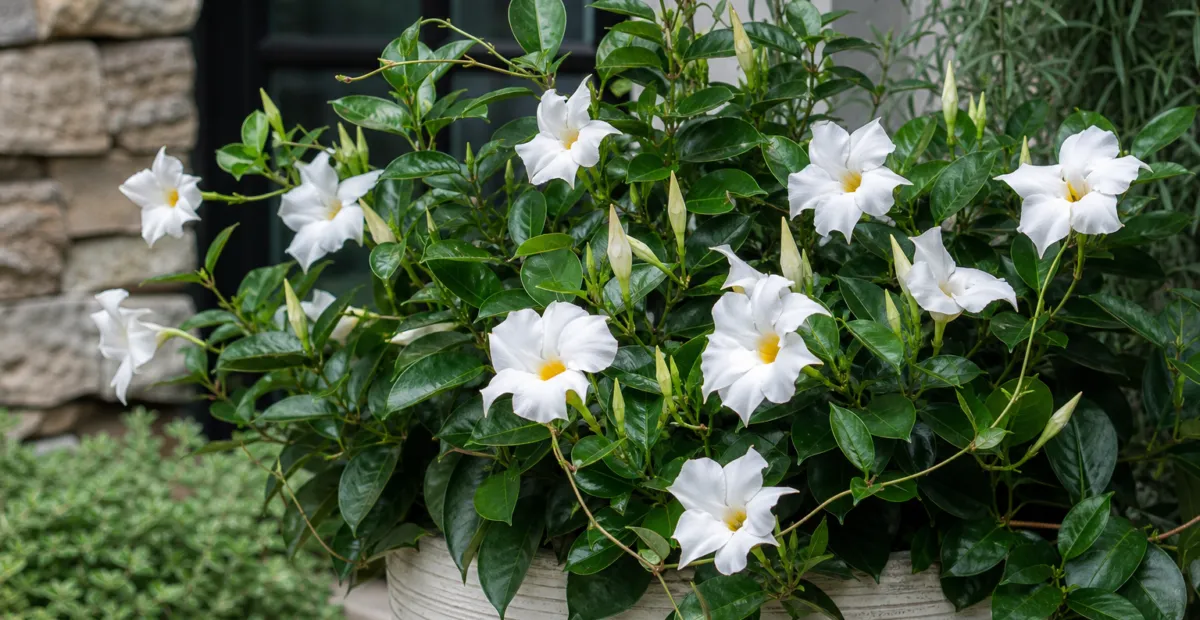
 AI-generated illustration
Mandevilla ‘Sundaville White’ short overview
Mandevilla 'Sundaville White' is a frost-tender tropical vine selected for glossy, dark green foliage and an extended display of large white trumpet flowers with yellow throats. In the United States it is most practical as a container, balcony or patio plant, although it can be planted outdoors in warm climates. Give it strong light, steady moisture, excellent drainage and a trellis or other support, then move it indoors before freezing weather.
Taxonomic classification
Mandevilla ‘Sundaville White’ care guide
Light and placement
Give the plant full sun to bright filtered light, ideally with 6 or more hours of direct sun for the strongest flowering. A south- or west-facing patio, balcony or greenhouse position is suitable, with some afternoon protection in extreme heat. Long, weak stems and sparse flowering indicate inadequate light; scorched foliage or rapid wilting suggests excessive heat, dry roots or reflected afternoon exposure.
Watering and humidity
Water thoroughly when the upper inch of mix begins to dry, allowing excess water to drain completely. Keep the root zone evenly moist during active summer growth but never saturated. Reduce watering in fall and winter, especially indoors, while avoiding prolonged drought. Good humidity helps in heated indoor rooms, but space plants for airflow to limit fungal problems.
Soil and growing medium
Use a fertile, porous potting mix with reliable drainage. A loam-based or peat/coir-based container substrate amended with compost works well, provided it does not remain saturated. Slightly acidic to neutral conditions are suitable. Avoid heavy garden clay in containers and do not allow the pot to stand in water.
Feeding
Feed during spring and summer when the plant is actively producing shoots and flowers. Use a balanced, water-soluble fertilizer at label strength or a controlled-release product according to its instructions. Do not fertilize dry, wilted, newly repotted or dormant plants; water first and resume feeding when active growth returns.
Growth and habit
This woody vine produces twining stems and can climb when given a trellis, while container-grown plants can be kept shorter through pinching and pruning. Growth is strongest in warm weather. Regularly tie or guide new stems before they become tangled, and remove weak or overcrowded shoots to maintain airflow and flowering.
Planting and repotting
Plant outdoors only after the danger of frost has passed and the soil has warmed. Set the root ball at the same depth it was growing, water thoroughly and provide support immediately. Space according to the intended training system; allow about 2–4 feet for a container-grown plant, with more room when grown as a vigorous climber.
Repot in spring when roots fill the container, moving up only one pot size. Use a sturdy container with drainage holes and refresh part of the substrate without heavily disturbing the root ball. Large specimens can be top-dressed instead of shifted every year.
Propagation and pruning
Propagation
Propagate by stem cuttings during active growth. Take healthy non-flowering shoots, remove lower leaves, use a clean, free-draining rooting medium and maintain warmth, bright indirect light and moderate humidity. Commercially protected cultivars may be subject to propagation restrictions.
Pruning
Prune in late winter or early spring before vigorous new growth, or lightly trim during the growing season to shape the plant and control long shoots. Remove dead, damaged or congested stems first. Avoid severe pruning immediately before flowering if preserving the current season's buds is important.
Overwintering
Move containers indoors before the first frost. Check for pests, prune lightly if needed and place the plant in the brightest available window or under grow lights. Keep it somewhat cooler and drier than in summer, but do not let the root ball become completely dry. Return outdoors gradually after frost danger has passed and nights are warm.
Uses
Use as a flowering container plant, patio accent, balcony specimen, hanging-basket subject or trained vine on a trellis, arbor or railing. It is especially useful where a long warm-season display is wanted. It has no supported culinary or medicinal use, and the plant should not be treated as edible.
Appearance
The plant has glossy, dark green, oval to elliptic leaves carried on twining, somewhat woody stems. White, five-lobed trumpets contrast strongly with the foliage and show a yellow throat. In compact containers it can appear bushy or trailing, while supported plants develop a climbing habit. Milky sap is characteristic of the dogbane family.
Flowering
The cultivar produces large, five-lobed, trumpet-shaped white flowers with yellow throats. Blooming is typically prolonged from late spring or early summer into fall in the United States, with the longest display in warm, bright conditions. Plants may flower intermittently indoors if warmth and strong light are maintained.
Pollination and visitors
Mandevilla flowers have tubular corollas and nectar-bearing floral structures associated with animal visitation. Butterfly visitation is documented for some Mandevilla species, but cultivar-specific records for 'Sundaville White' are limited; therefore attraction is rated low rather than assumed to be high.
Diseases and pests
Diseases
Prevent problems by providing airflow, bright light and well-drained soil. Watch for root or stem rot after persistently wet conditions, and remove affected tissue promptly. Leaf spots and powdery mildew are more likely when foliage stays wet or air movement is poor; water at the root zone and avoid crowding.
Pests
Inspect new growth and leaf undersides for aphids, whiteflies, spider mites and scale. Rinse foliage, improve air circulation and isolate affected containers. Use horticultural soap or oil only according to the product label, avoiding treatment during intense heat or on drought-stressed plants.
Related diseases and pests
Only Plant Doctor profiles whose host data indicate this plant may be affected are shown here.
 DiseaseMaple powdery mildewSawadaea bicornis
 DiseaseCucurbit Powdery MildewPodosphaera xanthii (Castagne) U. Braun & Shishkoff
 DiseaseRose powdery mildewPodosphaera pannosa
 DiseaseApple Powdery MildewPodosphaera leucotricha
 PestCitrus whiteflyDialeurodes citri
 PestSweetpotato whiteflyBemisia tabaci species complex
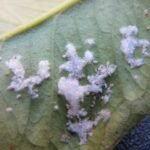 PestWoolly whiteflyAleurothrixus floccosus
 DiseaseAsh Powdery MildewPhyllactinia fraxini (DC.) Fuss
Toxicity and pollen
Mandevilla is listed in veterinary plant-safety references as capable of causing gastrointestinal upset if eaten by dogs or cats. The milky sap may also irritate skin or eyes. Keep the plant away from chewing pets and young children, wear gloves when pruning, and seek professional advice after significant ingestion.
- Typical season
- Typically late spring through fall outdoors in the United States
- Pollination / pollen
- Insect-carried pollen; limited airborne dispersal
This is an insect-pollinated flowering vine, so its pollen is not generally released as a large airborne cloud. That does not prove zero allergy risk: sensitive people may still react to pollen, floral contact or plant debris. Avoid rubbing eyes after handling and wash hands after pruning.
Native habitat
The cultivated hybrid reflects tropical and subtropical Mandevilla ancestry rather than a single wild habitat. Its parentage is associated with warm regions of the Americas, where related vines grow in bright conditions with seasonal moisture and free-draining soils. It is not naturally adapted to freezing winters in the continental United States.
Interesting fact
Sundaville is a branded group of Mandevilla hybrids associated with Suntory genetics. The white cultivar is also linked in horticultural records with the denomination 'Sunmandeho'. Large flowers may reach roughly 3 inches across in the Sundaville range, while related commercial forms can be larger. The plant is evergreen only where temperatures remain warm enough.
Frequently asked questions (FAQ)
The most relevant questions about this plant, with short and direct answers.
🌱Quick care
How do you care for Mandevilla 'Sundaville White'?⌄
Give Mandevilla 'Sundaville White' full sun to bright filtered light, regular watering, fertile well-drained soil, and a frost-free location. Let excess water drain completely and avoid keeping the roots constantly wet.
Is Mandevilla 'Sundaville White' an annual or perennial?⌄
Mandevilla 'Sundaville White' is a tender perennial in warm climates but is usually grown as an annual in areas with freezing winters. In colder parts of the United States, bring it indoors before frost to keep it for another season.
🌤️Environment and placement
How much sunlight does Mandevilla 'Sundaville White' need?⌄
Mandevilla 'Sundaville White' performs best in full sun, with bright filtered light as an alternative. More light generally supports heavier flowering, although some afternoon protection can help during extreme heat.
Can Mandevilla 'Sundaville White' grow indoors?⌄
Yes, Mandevilla 'Sundaville White' can be overwintered indoors near the brightest sunny window available. Expect slower growth and possibly fewer flowers indoors, especially if light levels are low.
What temperatures can Mandevilla 'Sundaville White' tolerate?⌄
Mandevilla 'Sundaville White' is frost-sensitive and should be protected before freezing weather arrives. Move container plants indoors when nighttime temperatures consistently approach about 50°F, particularly if cold weather is forecast.
Can Mandevilla 'Sundaville White' survive winter outdoors in the United States?⌄
It can remain outdoors year-round only in reliably frost-free parts of the United States, generally USDA Zones 10–11. Elsewhere, grow it in a container and overwinter it indoors or treat it as a seasonal annual.
💧Care and problems
How often should you water Mandevilla 'Sundaville White'?⌄
Water Mandevilla 'Sundaville White' when the surface of the potting mix begins to dry, then water thoroughly until excess drains from the container. Hot, sunny conditions may require more frequent watering, while indoor winter plants need less.
Why are the leaves on my Mandevilla 'Sundaville White' turning yellow?⌄
Yellow leaves on Mandevilla 'Sundaville White' are often caused by overwatering, poor drainage, or low light. Check that the container drains freely, allow the mix to dry slightly between waterings, and inspect the plant for pests.
Why is Mandevilla 'Sundaville White' dropping leaves?⌄
Leaf drop can result from cold temperatures, sudden changes in light, underwatering, overwatering, or moving the plant indoors. Correct the environmental stress, provide bright light, and keep the soil lightly but evenly moist.
Why is my Mandevilla 'Sundaville White' not blooming?⌄
Mandevilla 'Sundaville White' may fail to bloom because of insufficient light, excessive nitrogen, cold conditions, or inconsistent watering. Move it to a brighter location, avoid overfertilizing with nitrogen, and keep it warm and evenly watered.
Does Mandevilla 'Sundaville White' need fertilizer?⌄
Mandevilla 'Sundaville White' benefits from a balanced liquid fertilizer during active spring and summer growth. Follow the product label and reduce or stop feeding during winter or when the plant is growing slowly.
What pests commonly affect Mandevilla 'Sundaville White'?⌄
Mandevilla 'Sundaville White' may attract aphids, whiteflies, spider mites, or mealybugs, especially indoors or in dry conditions. Inspect leaves and stems regularly and treat an infestation promptly with a suitable labeled product.
🪴Planting and repotting
What soil is best for Mandevilla 'Sundaville White'?⌄
Use a fertile, well-drained loam or a quality container mix for Mandevilla 'Sundaville White'. The mix should retain some moisture while allowing excess water to drain quickly, because waterlogged roots can rot.
Can Mandevilla 'Sundaville White' grow in a container?⌄
Yes, Mandevilla 'Sundaville White' grows well in containers with drainage holes. Choose a stable pot that is only moderately larger than the root ball and provide a trellis or support if the plant begins to climb.
When should Mandevilla 'Sundaville White' be planted outdoors?⌄
Plant Mandevilla 'Sundaville White' outdoors after the local last frost date, once nights are reliably mild. Harden an indoor or greenhouse-grown plant gradually by increasing outdoor exposure over about one week.
When should Mandevilla 'Sundaville White' be repotted?⌄
Repot Mandevilla 'Sundaville White' in spring when roots circle the container or water runs through the pot unusually quickly. Move it into a container only one size larger and use fresh, well-drained potting mix.
✂️Propagation and pruning
Can Mandevilla 'Sundaville White' be propagated from cuttings?⌄
Yes, Mandevilla 'Sundaville White' can generally be propagated from stem cuttings taken during active growth. Use healthy nonflowering shoots, keep the medium lightly moist and warm, and wear gloves because the sap can irritate skin.
Should Mandevilla 'Sundaville White' be pruned?⌄
Prune Mandevilla 'Sundaville White' to control size, remove damaged growth, or encourage a bushier shape. Major pruning is usually best done in late winter or early spring, while light trimming can be done during the growing season.
How do you overwinter Mandevilla 'Sundaville White' indoors?⌄
Before frost, inspect the plant for pests, prune it if necessary, and move it to a bright, frost-free location. Water less during winter, avoid soggy soil, and return it outdoors gradually after the danger of frost has passed.
⚠️Toxicity and safety
Is Mandevilla 'Sundaville White' poisonous to dogs and cats?⌄
Mandevilla 'Sundaville White' should be treated as potentially toxic if ingested by pets or people. Keep it out of reach, and contact a veterinarian or poison-control service if a child or animal eats any part of the plant.
Can Mandevilla 'Sundaville White' sap irritate skin?⌄
Yes, the milky sap of Mandevilla 'Sundaville White' may irritate skin and eyes. Wear gloves when pruning or handling damaged stems, wash exposed skin promptly, and avoid touching your face during plant care.
🌸Flowering and special interest
When does Mandevilla 'Sundaville White' bloom?⌄
Mandevilla 'Sundaville White' typically blooms from late spring or summer until frost when it receives enough warmth and light. Flowering may slow during cold weather, low-light indoor conditions, or periods of drought.
How can I make Mandevilla 'Sundaville White' flower more?⌄
Provide several hours of direct sun, consistent moisture, warm temperatures, and regular but not excessive feeding during active growth. Removing spent flowers and avoiding heavy nitrogen fertilization can also help maintain flowering.
Does Mandevilla 'Sundaville White' need a trellis?⌄
A trellis is optional because Mandevilla 'Sundaville White' can be grown as a compact container plant. Provide support if you want to display its vining habit or guide longer stems upward.
Similar plants
 Mandevilla ‘Sun Parasol Pink’Mandevilla 'Sun Parasol Pink'
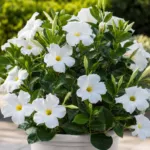 Mandevilla ‘Rio White’Mandevilla 'Rio White'
 Mandevilla ‘Red Riding Hood’Mandevilla 'Red Riding Hood'
 Mandevilla ‘Sundaville Red’Mandevilla 'Sundaville Red'
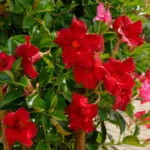 Mandevilla ‘Red Velvet’Mandevilla 'Red Velvet'
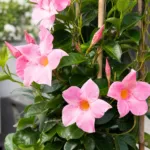 Mandevilla ‘Pink Charm’Mandevilla 'Pink Charm'