
 Source:
 Hibiscus ‘Syriacus’ short overview
Hibiscus 'Syriacus' is the supplied horticultural identity for the species Hibiscus syriacus, a deciduous woody hibiscus native to south-central and southeastern China and Taiwan. In U.S. gardens it forms an upright, multi-stemmed shrub with lobed green leaves and large, short-lived flowers produced successively from summer into early fall. It performs best in full sun, moderately moist well-drained soil, and USDA Zones 5–9.
Taxonomic classification
Hibiscus ‘Syriacus’ care guide
Light and placement
Give full sun for the best flowering, ideally with at least 6 hours of direct light and an open south- or west-facing exposure. Partial afternoon shade is tolerated in hot climates but may reduce flower production. Sparse flowering and stretched growth suggest too little light; scorched foliage or rapid wilting can indicate excessive reflected heat combined with water stress.
Watering and humidity
Water deeply when the upper few inches of soil begin to dry, especially during the first growing season. Established shrubs tolerate short dry periods but flower and grow best with even moisture. Reduce irrigation after leaf fall and during cool dormant weather, while avoiding both drought during bud development and saturated winter soil.
Soil and growing medium
Use moderately fertile, well-drained loam, clay, or sandy loam. The plant tolerates a broad soil range, including heavier clay, provided water does not remain stagnant around the roots. Neutral to slightly alkaline conditions are acceptable; organic matter improves structure and moisture balance.
Feeding
Apply compost or a balanced slow-release fertilizer in early spring as growth begins. Avoid heavy nitrogen feeding, which can produce excessive foliage and weaker flowering. Do not fertilize drought-stressed, newly transplanted, or dormant plants until roots and shoots are actively growing.
Growth and habit
This is an upright, multi-stemmed shrub that flowers on new growth. Young plants can grow quickly under favorable conditions; mature plants become denser and more architectural with age. Regular spring pruning keeps the framework open and encourages vigorous flowering shoots, while excessive pruning can delay bloom.
Planting and repotting
Plant in spring or fall when soil is workable. Set the root ball level with the surrounding soil, never deeply buried. Allow approximately 6–10 feet of space for a full-sized shrub, with closer spacing only for a maintained hedge. Water deeply and regularly during establishment.
For container plants, repot in late winter or early spring before active growth, moving up only one pot size. Refresh compacted mix and preserve the root ball. Large established shrubs are better transplanted while dormant, with consistent watering during the first growing season.
Propagation and pruning
Propagation
Semi-hardwood cuttings are the most dependable practical method and are taken in summer. Seed is possible, but seedlings may vary from the parent in flower color and form. Root cuttings or layering are less commonly used. Maintain even moisture while cuttings establish.
Pruning
Prune in late winter or early spring before new growth begins. Remove weak, crossing, or damaged stems and shorten selected branches to shape the shrub. Cutting back last season’s growth to a few buds can produce larger flowers, but severe annual reduction is not required.
Overwintering
Leave the shrub outdoors in its hardiness range. Apply a light organic mulch over the root zone after the ground cools, keeping mulch away from the stems. In colder Zone 5 sites, protect newly planted shrubs from drying winter winds. Container plants need insulation or a sheltered, unheated location because roots are less cold-tolerant than those in the ground.
Uses
Useful as a specimen shrub, flowering hedge, screen, foundation planting, border plant, or large container subject. It provides late-season flowers and supports documented insect visitors. Older selections may self-seed, so remove unwanted seedlings where escape or crowding is a concern. No medicinal or culinary use is assigned to this exact horticultural identity.
Appearance
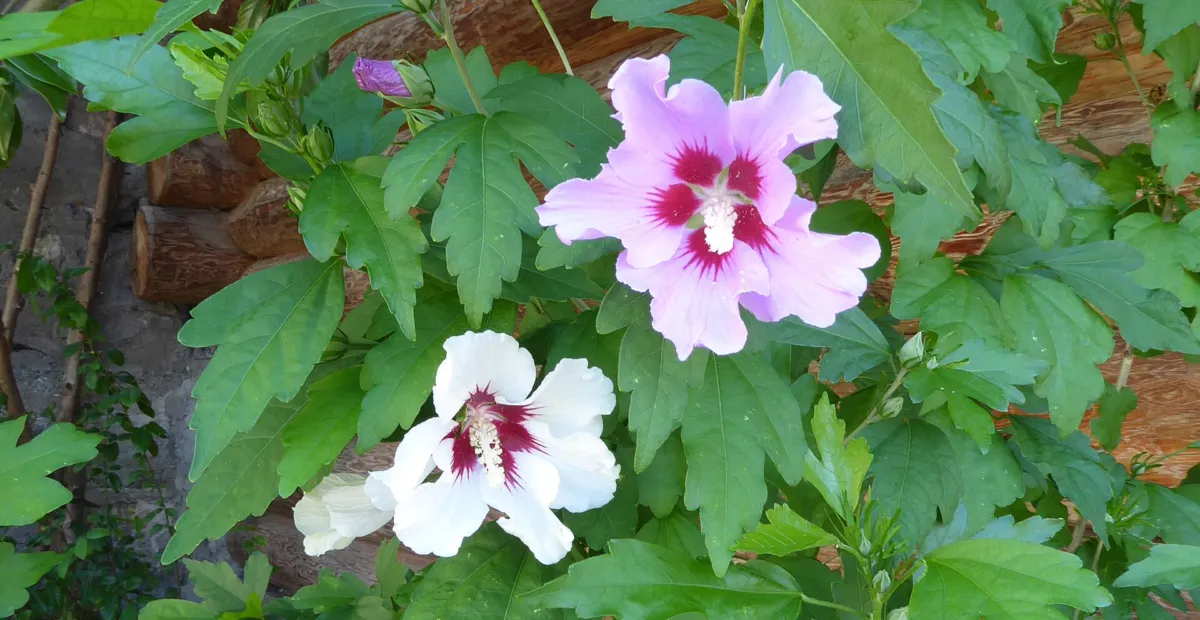
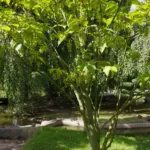
The shrub has upright, vase-shaped to rounded branching with multiple stems from the base. Leaves are alternate, green, simple, coarsely toothed, and often shallowly three-lobed. Smooth gray-brown stems and persistent brown seed capsules provide winter structure after leaf fall. The prominent central staminal column is a key hibiscus identification feature.
Flowering
Flowers are produced on current-season growth, opening successively rather than all at once. Individual blooms generally last about one day, but flowering can continue for many weeks from midsummer into early fall. Flowers may be single or double depending on the plant sold under this identity, so cultivar-level flower form is uncertain.
Pollination and visitors
Flowers are visited by bees, including the hibiscus-associated specialist Ptilothrix bombiformis, as well as butterflies and hummingbirds. Evidence for the exact supplied horticultural identity is limited, so visitor records are interpreted from the species rather than from a verified named cultivar.
Hibiscus 'Syriacus' photos
Click any photo for a larger view. Source, author and license are shown separately.
Diseases and pests
Diseases
Watch for leaf spot, blight, rust, canker, powdery mildew, and occasional honey fungus. Improve air circulation, avoid persistent wet foliage, remove badly affected leaves, and prune out diseased wood with clean tools. Do not overreact to minor cosmetic spotting on an otherwise vigorous shrub.
Pests
Aphids, scale insects, whiteflies, mealybugs, and Japanese beetles may occur. Inspect new growth and leaf undersides, wash off light infestations, and encourage beneficial insects. Use targeted treatment only when damage is significant. Japanese beetles can cause substantial foliage loss in some regions.
Related diseases and pests
Only Plant Doctor profiles whose host data indicate this plant may be affected are shown here.
 PestJapanese beetlePopillia japonica
 PestCotton mealybugPhenacoccus solenopsis Tinsley
 PestSweetpotato whiteflyBemisia tabaci species complex
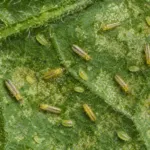 PestMelon thripsThrips palmi Karny
 DiseaseMaple powdery mildewSawadaea bicornis
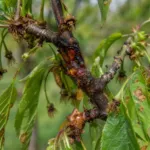 DiseaseBacterial blight and cankerPseudomonas syringae pv. syringae
 DiseaseCucurbit Powdery MildewPodosphaera xanthii (Castagne) U. Braun & Shishkoff
 DiseaseRose powdery mildewPodosphaera pannosa
Toxicity and pollen
ASPCA lists Hibiscus syriacus as non-toxic to dogs and cats. General reports about gastrointestinal upset after animals consume hibiscus foliage are not sufficiently specific to this exact identity, so avoid deliberate consumption and contact a veterinarian or poison service if a pet eats a large amount or develops symptoms.
- Typical season
- Summer into early fall
- Pollination / pollen
- Large, insect-dispersed pollen
Hibiscus pollen is relatively large and primarily moved during insect visits rather than released as a strongly wind-borne cloud. Direct U.S. clinical allergy evidence for Hibiscus syriacus pollen is limited, so a precise allergy-risk rating cannot be confirmed. Sensitive individuals should still avoid handling flowers during heavy pollen contact.
Native habitat
In its native range, Hibiscus syriacus occurs in temperate East Asian environments. It is adapted to warm summers, seasonal winter dormancy, and soils ranging from loam to clay or sand when drainage is adequate. In the United States it is widely cultivated and has naturalized or escaped locally in some areas.
Interesting fact
The species name suggests Syria, although authoritative botanical sources place its native range in China and Taiwan. Flowers close after a short display, but new buds open successively over a long season. Older plants can be trained as small standard trees. Seed-grown plants may not reproduce the parent flower color.
Frequently asked questions (FAQ)
The most relevant questions about this plant, with short and direct answers.
🌱Quick care
How do you care for Hibiscus 'Syriacus'?⌄
Grow Hibiscus 'Syriacus' in full sun to partial shade, water it moderately, and use well-drained soil. It is a hardy deciduous shrub that generally needs less winter protection than tropical hibiscus.
Is Hibiscus 'Syriacus' a perennial or an annual?⌄
Hibiscus 'Syriacus' is a hardy, deciduous perennial shrub. It loses its leaves in fall, goes dormant in winter, and regrows from woody stems in spring.
How big does Hibiscus 'Syriacus' get?⌄
Hibiscus 'Syriacus' commonly reaches about 8–12 feet tall and 6–10 feet wide in the landscape. Mature size varies with cultivar, pruning, soil, and growing conditions.
🌤️Environment and placement
How much sun does Hibiscus 'Syriacus' need?⌄
Hibiscus 'Syriacus' grows best in full sun, meaning at least 6 hours of direct sunlight daily, but it tolerates partial shade. More sun usually supports denser growth and heavier flowering.
What USDA hardiness zones can grow Hibiscus 'Syriacus'?⌄
Hibiscus 'Syriacus' is generally hardy in USDA Zones 5–8, although specific cultivars may differ slightly. In colder areas, protect young plants from severe winter exposure while they establish.
What type of soil is best for Hibiscus 'Syriacus'?⌄
Use well-drained loam, clay, or sandy loam enriched with organic matter. The plant tolerates a broad range of soil conditions but performs poorly in sites that remain constantly waterlogged or extremely dry.
Can Hibiscus 'Syriacus' grow in clay soil?⌄
Yes, Hibiscus 'Syriacus' can grow in clay soil if drainage is adequate. Incorporate organic matter and avoid planting it where compacted clay stays saturated after rain.
Can Hibiscus 'Syriacus' grow in a container?⌄
Yes, Hibiscus 'Syriacus' can be grown in a large container with drainage holes and well-drained potting mix. Container plants need more frequent watering and may require additional winter protection than plants in the ground.
💧Care and problems
How often should you water Hibiscus 'Syriacus'?⌄
Water Hibiscus 'Syriacus' when the upper inch of soil begins to dry, providing a deep soaking rather than frequent light sprinkling. Established plants tolerate some drought, but consistent moisture supports better flowering.
Why are the leaves on Hibiscus 'Syriacus' turning yellow?⌄
Yellow leaves may result from overwatering, poor drainage, drought stress, nutrient deficiency, or normal seasonal dormancy. Check soil moisture and drainage first, because constantly wet roots are a common cause.
Why is Hibiscus 'Syriacus' not blooming?⌄
Insufficient sunlight, excessive nitrogen, drought stress, immature growth, or overly severe pruning can reduce flowering. Move or thin surrounding plants if necessary and keep the soil evenly but not constantly wet.
Does Hibiscus 'Syriacus' need fertilizer?⌄
Hibiscus 'Syriacus' usually needs only modest fertilization when planted in reasonably fertile soil. If growth is weak, apply a balanced slow-release fertilizer in spring according to the product label, avoiding excessive nitrogen.
What pests affect Hibiscus 'Syriacus'?⌄
Common pests include aphids, Japanese beetles, whiteflies, and spider mites, especially on stressed plants. Inspect new growth and leaf undersides regularly, and use a targeted control only when damage is significant.
What diseases affect Hibiscus 'Syriacus'?⌄
Hibiscus 'Syriacus' can develop leaf spot, rust, powdery mildew, or root problems in persistently wet conditions. Improve air circulation, water at the soil line, remove severely affected debris, and correct drainage problems.
Does Hibiscus 'Syriacus' spread or reseed?⌄
Some Hibiscus 'Syriacus' plants produce seed capsules and can reseed, particularly in favorable conditions. Deadheading and choosing low-seed or nearly seedless cultivars can reduce unwanted seedlings.
Is Hibiscus 'Syriacus' invasive in the United States?⌄
Hibiscus 'Syriacus' is reported as invasive or potentially invasive in some U.S. states because certain plants can reseed freely. Check your state or local invasive-plant guidance before planting, and remove unwanted seedlings promptly.
🪴Planting and repotting
When is the best time to plant Hibiscus 'Syriacus'?⌄
Plant Hibiscus 'Syriacus' in spring after the ground can be worked or in early fall while soil remains warm. Avoid planting during frozen ground, extreme heat, or prolonged drought.
How far apart should Hibiscus 'Syriacus' be planted?⌄
Space Hibiscus 'Syriacus' about 6–10 feet apart for individual shrubs, adjusting the distance to the mature width of the cultivar. Provide more room if you want an open, naturally shaped plant rather than a hedge.
Can Hibiscus 'Syriacus' be planted near a house?⌄
Yes, but place it several feet from walls, windows, and walkways to accommodate its mature width and allow air circulation. Do not plant it where roof runoff keeps the soil saturated.
✂️Propagation and pruning
Can Hibiscus 'Syriacus' be grown from seed?⌄
Yes, Hibiscus 'Syriacus' can be grown from seed, but seedlings may not reproduce the exact flower color or form of the parent plant. Some cultivars also produce relatively few viable seeds.
Can Hibiscus 'Syriacus' be propagated from cuttings?⌄
Yes, Hibiscus 'Syriacus' can be propagated from softwood or semi-hardwood cuttings taken during the growing season. Success is usually best with healthy young shoots kept warm and evenly moist.
When should Hibiscus 'Syriacus' be pruned?⌄
Prune Hibiscus 'Syriacus' in late winter or early spring before new growth begins. Because it flowers on new wood, pruning at that time generally does not remove the season’s flower buds.
How do you prune Hibiscus 'Syriacus'?⌄
Remove dead, damaged, crossing, or weak stems first, then shorten selected branches to shape the shrub. Avoid removing more than about one-third of the plant in a single pruning session unless renovation is necessary.
⚠️Toxicity and safety
Is Hibiscus 'Syriacus' toxic to dogs and cats?⌄
Hibiscus 'Syriacus' is classified as non-toxic to dogs and cats by the ASPCA. Even non-toxic plants can cause mild stomach upset if eaten in quantity, so discourage pets from consuming large amounts.
Can people eat Hibiscus 'Syriacus' flowers?⌄
Do not assume Hibiscus 'Syriacus' flowers are suitable for food or tea simply because other hibiscus species are edible. Cultivar identity, pesticide exposure, and preparation matter, and reliable food-use evidence for a specific plant should be confirmed first.
🌸Flowering and special interest
When does Hibiscus 'Syriacus' bloom?⌄
Hibiscus 'Syriacus' typically blooms from midsummer into early fall, with timing varying by climate and cultivar. Individual flowers are short-lived, but new buds can provide a long succession of blooms.
What color flowers does Hibiscus 'Syriacus' have?⌄
Flowers may be white, pink, red, purple, blue-violet, or combinations of these colors, depending on the cultivar. Single, semi-double, and double flower forms are available.
Does Hibiscus 'Syriacus' attract pollinators?⌄
Yes, the flowers of Hibiscus 'Syriacus' can provide nectar and pollen for visiting bees and other insects. Flower accessibility varies among cultivars, especially in heavily double-flowered forms.
Should you deadhead Hibiscus 'Syriacus'?⌄
Deadheading is optional but can improve appearance and reduce self-seeding in plants that produce viable seed capsules. Removing spent flowers does not usually provide a major increase in bloom production.
Similar plants
 Azure Monkshood (Aconitum carmichaelii) care guideAconitum carmichaelii
 Monkshood (Aconitum ‘Stainless Steel’)Aconitum 'Stainless Steel'
 Monkshood (Aconitum ‘Bressingham Spire’)Aconitum 'Bressingham Spire'
 Golden full moon maple (Acer shirasawanum ‘Aureum’)Acer shirasawanum 'Aureum'
 Globosum (Acer platanoides ‘Globosum’)Acer platanoides 'Globosum'
 Striped maple (Acer pensylvanicum) care guideAcer pensylvanicum