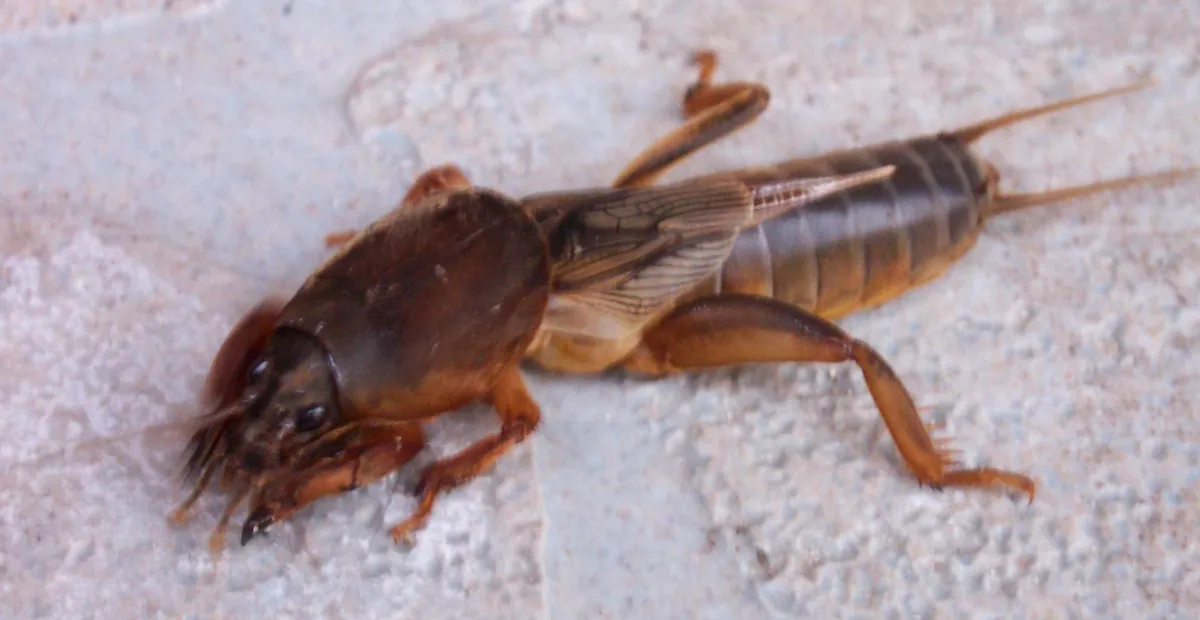
European Mole Cricket
Gryllotalpa gryllotalpaEuropean Mole Cricket overview
The European mole cricket, Gryllotalpa gryllotalpa, is a burrowing, mostly nocturnal insect that can injure seedlings, vegetable crops, potatoes, ornamental plants and turf by tunneling through the upper soil and cutting roots or stems. In the United States it has a limited, localized distribution and is generally less damaging than the invasive Scapteriscus mole crickets of the Southeast, so confirmation of identity is important before control.
Typical conditions
Overview
European mole crickets spend most of their lives below ground. Their enlarged, toothed forelegs are adapted for digging, and shallow tunnels can disturb the root zone, lift seedlings and expose roots to drying. Feeding may occur on roots, tubers, seeds, stems near the soil surface and young foliage, although the species is not exclusively herbivorous.
In U.S. gardens, a suspected European mole cricket may be confused with native mole crickets or the more damaging southern, tawny and short-winged mole crickets. Species-level confirmation is especially important where regulatory or quarantine concerns apply.
Symptoms and identification
- Seedlings wilt, loosen, topple or disappear after the soil surface is disturbed.
- Roots or stems are severed near or below the soil line.
- Shallow, raised tunnels and loose soil appear across beds, nursery areas or turf.
- Young plants may show poor establishment, root loss, drought-like stress or localized death.
- Potato and other underground crops may have feeding injury, but the exact severity varies with population density and soil conditions.
Surface chewing or missing seedlings alone is not diagnostic; look for tunnels, cut roots and the insect itself.
Causes and spread
Damage results from the insect’s underground movement and feeding. European mole crickets favor light, loose, moist soils rich in organic matter and soil organisms, because these conditions are easier to excavate and provide prey and plant material. Irrigation can increase activity and injury in susceptible sites.
Spread occurs mainly through adult flight and movement, and locally through the production of eggs in underground chambers. Transport of infested soil, nursery stock or turf may also move soil-dwelling stages where regulations permit.
Life cycle and persistence
Adults and immature stages overwinter in the soil at variable depths. Activity increases in spring as soils warm. Females construct underground chambers and lay eggs; published European references report several hundred eggs per chamber, although fecundity and development depend on temperature and locality. Nymphs pass through several molts without a pupal stage, remain in the soil and become increasingly active during the warm season. Adults may fly and are most noticeable on warm nights.
Because young nymphs are nearer the soil surface than older stages, monitoring and management are generally more effective when conducted early in the season.
Treatment and control
Confirm the insect before taking action. In small beds, disturb the upper soil around active tunnels and hand-remove exposed crickets. Repair or replace severed seedlings and check nearby plants for root loss. Improve drainage and reduce unnecessary irrigation, but do not allow valuable crops to suffer drought stress.
For larger plantings or turf, map damaged patches, sample the soil and estimate whether injury exceeds a practical treatment threshold. Target management only to confirmed infested areas and to the most vulnerable life stage, rather than applying a blanket treatment across the property.
Low-impact and biological control
Hand removal and localized physical exclusion are the most dependable low-input options for small plantings. Beneficial predators, including ground-active arthropods and insectivorous birds, can contribute to natural suppression, so avoid broad-spectrum treatments that unnecessarily disrupt them.
Commercial insect-parasitic nematodes may be marketed for mole cricket suppression, but performance is variable and depends on species, soil moisture, temperature, application quality and cricket depth. Use only products registered or legally permitted for the intended crop and site, and follow the product label. Nematodes used against insects are not the same as plant-parasitic nematodes.
Prevention
- Inspect soil, root balls and turf before moving plants or soil between properties.
- Maintain even irrigation rather than chronically wet beds; correct drainage problems.
- Firm the soil around newly planted seedlings without compacting the whole root zone.
- Use healthy transplants and protect high-value young plants with physical barriers where practical.
- Remove volunteer weeds and excess debris that provide shelter, while retaining habitat for beneficial predators away from crop rows.
- Monitor shallow tunnels and plant losses during warm, moist periods instead of treating solely because an adult is found.
Interesting facts
- The name “mole cricket” refers to the mole-like digging forelegs, not to a close relationship with moles.
- European mole crickets are omnivorous and may consume earthworms, insect larvae and other soil organisms as well as plant tissue.
- Burrowing can cause substantial seedling injury even when direct feeding is limited.
- The species is established in parts of the northeastern United States but is generally of minor significance there compared with the damaging Scapteriscus mole crickets of the Southeast.
- Identification based only on tunnel shape is unreliable; an adult or nymph should be examined by a qualified diagnostician when the record is unusual.
Chemical control is not automatically justified by the presence of one cricket. In the United States, use only a pesticide product legally authorized by the U.S. Environmental Protection Agency and applicable state authorities for the specific crop or turf site and target pest. Follow the current label exactly, including rate, timing, irrigation, reentry, harvest and pollinator precautions; do not extrapolate a label from another mole-cricket species or crop.
Affected plants
The plants below are linked to this problem by structured host-plant data. The list updates automatically as new plant profiles are added.