
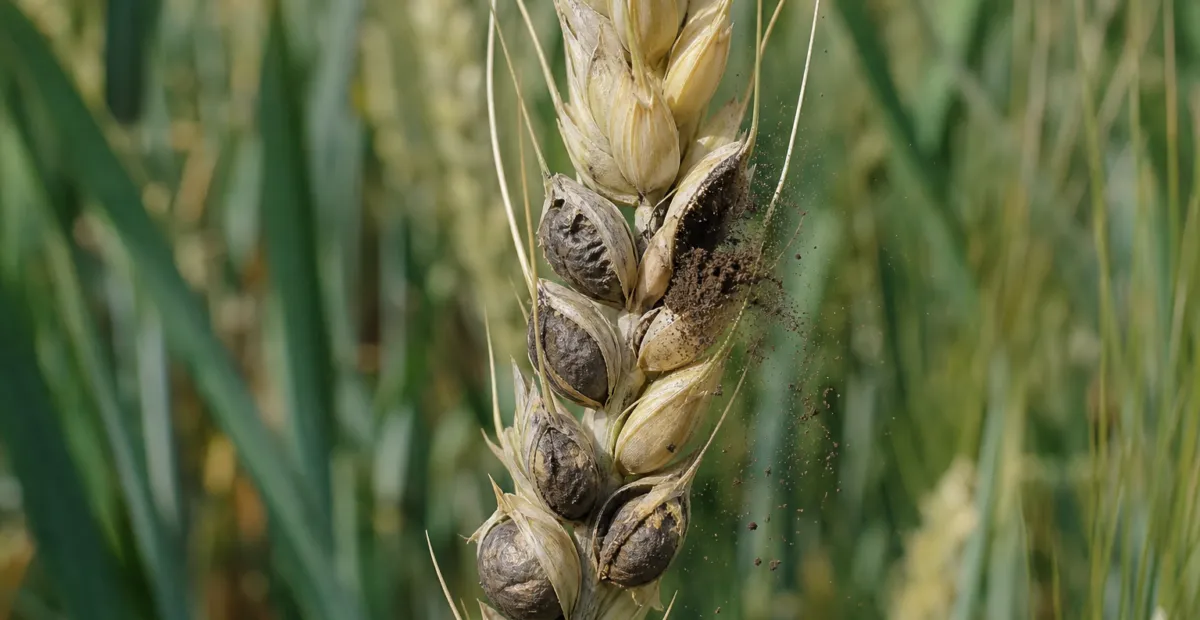
Common bunt (stinking smut) of wheat
Tilletia caries (syn. Tilletia tritici)Common bunt (stinking smut) of wheat overview
Common bunt, also called stinking smut, is a seedborne and soilborne fungal disease of wheat caused by Tilletia caries. Infected plants may look only slightly stunted until heading, when normal kernels are replaced by gray to black bunt balls packed with powdery spores. Crushing infected heads releases a characteristic fishy odor and can contaminate seed, equipment, grain and soil.
Typical conditions
Overview
Tilletia caries infects susceptible wheat during germination and early seedling growth. The fungus grows internally with the developing plant and eventually colonizes the florets and ovaries. By heading, affected kernels are converted into gray, brown or black sori, commonly called bunt balls. The disease is usually most important where untreated or contaminated seed is planted, especially in cool, slow-emergence conditions.
Field diagnosis should be considered provisional because common bunt symptoms overlap with those caused by T. laevis and, in some circumstances, other wheat bunt fungi. Microscopic examination or a validated molecular test may be needed for species-level identification.
Symptoms and identification
Early symptoms are inconspicuous. Infected plants may be somewhat shorter, develop narrower heads, or mature later than healthy plants, but these signs are not diagnostic. At heading, individual kernels or entire portions of a wheat head become enlarged, gray-green, gray-brown or black bunt balls. The glumes may remain partly open, exposing the altered kernels.
When a bunt ball is crushed, it releases a dark, soot-like mass of teliospores. Strongly infected grain or harvested material may smell fishy or like rotting fish because of volatile amines produced in association with the disease. Grain quality and marketability can be severely reduced even when visible field symptoms are limited.
Causes and spread
The pathogen is introduced mainly on contaminated wheat seed or in infested soil. During harvest, bunt balls break and release millions of teliospores. Spores can contaminate healthy kernels, seed lots, combines, trucks, grain-handling areas and soil. Volunteer wheat and spilled grain can help maintain the disease between crops.
Seedborne spores infect very young wheat seedlings near the soil surface. Soilborne spores can also germinate and infect emerging seedlings. The disease is favored by slow germination and prolonged contact between the seedling and inoculum; infected plants usually show few obvious symptoms until the head develops.
Life cycle and persistence
Teliospores survive on seed and in soil, often for several years under favorable storage or field conditions. After moisture is available, they germinate and produce infectious cells and hyphae. Infection occurs shortly after wheat seeds germinate, before or around seedling emergence.
The fungus remains largely hidden within the plant as it grows toward the shoot apex. When the wheat head forms, the pathogen invades developing ovaries and replaces kernel tissues with a sorus filled with teliospores. The sorus ruptures during harvest, completing the cycle when spores return to seed, equipment or soil.
Treatment and control
There is no practical foliar cure once wheat heads contain bunt balls because infection becomes systemic before symptoms are visible. If the disease is detected before planting, the most effective corrective action is to replace contaminated seed with clean, tested seed or apply an appropriate labeled seed treatment.
For a field already affected, harvest and transport grain carefully to limit dust and spore movement, clean equipment and storage areas thoroughly, and avoid using harvested grain as untreated seed. Submit suspicious grain or seed to a qualified plant diagnostic laboratory when species identification, seed certification or regulatory documentation is important.
Low-impact and biological control
Organic management depends on prevention because curative options are limited. Start with certified organic seed that has been tested for common bunt, select resistant or less susceptible cultivars, and prevent contamination during harvest and seed handling.
- Use validated organic seed-treatment options permitted by the applicable certification program and product label. Hot-water treatment can reduce seedborne inoculum in some cereal seed systems, but it requires strict control of temperature, exposure time, seed moisture and drying to avoid reducing germination.
- Clean seed lots and equipment to remove bunt dust and visibly affected kernels.
- Use crop rotation, destroy volunteer wheat, and support rapid emergence through good seedbed preparation.
- Biological and alternative treatments have shown variable results; use only methods supported for the crop, production system and region rather than assuming that a general microbial product will control established soilborne inoculum.
Prevention
- Plant certified, tested, clean wheat seed whenever possible. Do not save seed from fields with bunt symptoms unless it has been professionally tested and treated.
- Use wheat cultivars with documented resistance or improved tolerance where available for the region; resistance can vary among pathogen populations.
- Use a current, legally labeled seed treatment when appropriate. Systemic seed treatments generally provide better protection against both seedborne and soilborne inoculum than untreated seed, but performance depends on product, cultivar, pathogen population and application quality.
- Clean combines, augers, drills, seed cleaners, bins and transport equipment before handling clean seed or moving between fields.
- Control volunteer wheat and spilled grain, and use rotation or nonhost crops to reduce inoculum pressure. Rotation alone may not eliminate long-lived teliospores.
- Promote rapid, uniform emergence by planting into suitable soil conditions and avoiding unnecessarily deep planting or compaction.
Interesting facts
Common bunt is also called stinking smut because crushed infected kernels can produce a pronounced fishy odor. The disease is often hidden until heading, so apparently healthy seed can be an important source of introduction.
Tilletia caries is frequently discussed together with T. laevis, which causes an almost indistinguishable form of common bunt. Historical names and morphological identifications have sometimes been inconsistent, making laboratory confirmation important for precise records.
USDA grain-testing references list T. caries under the older synonym T. tritici. This disease should not be confused with Karnal bunt, which is caused by the different species Tilletia indica and has separate regulatory significance.
Use only fungicide seed-treatment products legally authorized for wheat and common bunt in the United States and in your state, and follow the current EPA-approved label exactly. Do not apply an off-label product, improvise rates or rely on foliar fungicides to cure systemically infected plants. Check current state registration, organic-certification requirements, seed-treatment restrictions and worker-safety directions before use.