Ceratocystis Wilt, Canker, and Black Rot
Ceratocystis fimbriata Ellis & Halst.Ceratocystis Wilt, Canker, and Black Rot overview
Ceratocystis fimbriata is a wound-infecting fungus associated with several serious diseases, including black rot of sweetpotato, Ceratocystis canker of almond, mango wilt, and wilt or canker diseases of selected woody hosts. Symptoms vary by host but may include dark vascular staining, sunken cankers, gumming, wilt, branch dieback, and internal black rot. Reliable diagnosis generally requires laboratory confirmation.
Typical conditions
Overview
This fungus primarily exploits wounds, bruises, harvest damage, graft unions, or other exposed tissues. On sweetpotato, it causes black rot of storage roots and can contaminate slips produced from infected roots. On almond and some other woody hosts, it produces elongated, water-soaked or brown cankers, amber gumming, internal staining, branch dieback, and sometimes tree death.
Host range and aggressiveness vary among lineages. A field diagnosis based only on wilt, gumming, or dark staining is unreliable because Phytophthora, other canker fungi, vascular pathogens, and mechanical injury can look similar.
Symptoms and identification
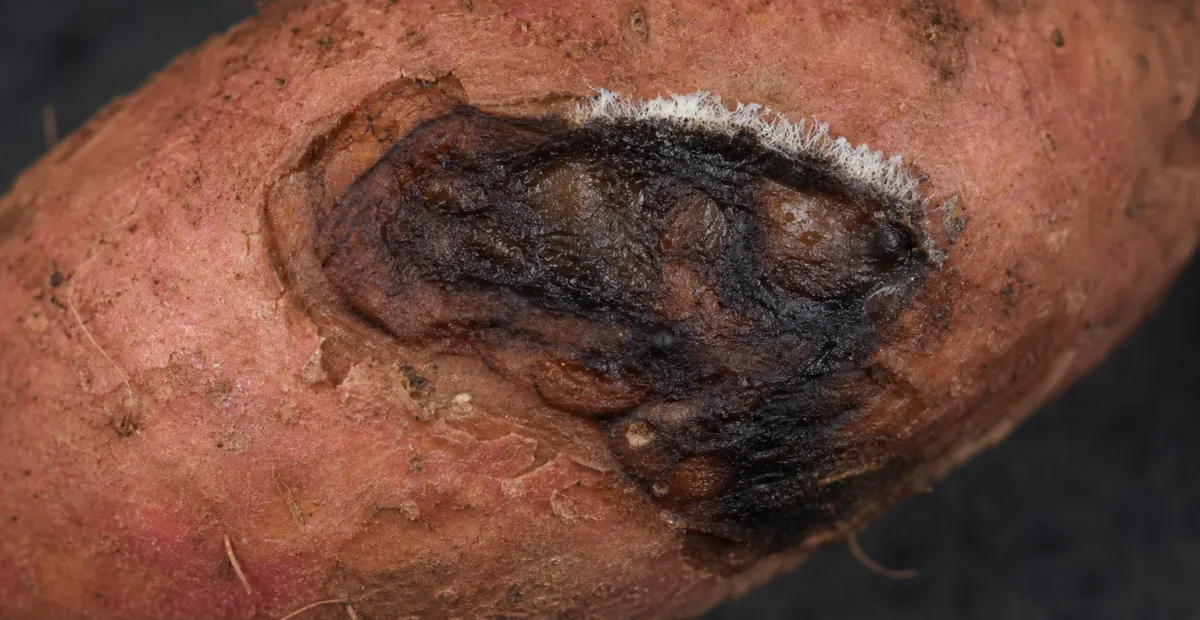
- Sweetpotato: firm, dark brown to black lesions on storage roots, often beginning at wounds; internal blackened tissue may expand during storage. White fungal growth and black perithecia can sometimes be visible on the lesion surface.
- Almond and other woody hosts: elongated water-soaked areas, amber gum at the canker margin, dark-brown sunken bark, longitudinal staining in sapwood or heartwood, branch girdling, sparse foliage, dieback, or tree decline.
- Wilt hosts: leaf wilting, chlorosis, rapid decline, and dead leaves that may remain attached can occur, but these symptoms are not specific.
Confirmation should use representative tissue from the advancing lesion margin, with culture and, where available, molecular identification by a qualified diagnostic laboratory.
Causes and spread
Infection commonly follows fresh wounds, bruises, bark removal, mechanical harvesting, pruning injuries, grafting, digging, or handling damage. In sweetpotato, infected seed roots and slips are important sources of spread. Diseased roots, contaminated soil, harvest containers, tools, and equipment can move the fungus between plants and fields.
Sticky spore masses can adhere to insects visiting wounded tissue, and insect-assisted movement has been documented or proposed for several Ceratocystis diseases. The importance of particular vectors varies by host and location; no single insect vector should be assumed in a home landscape or orchard.
Life cycle and persistence
The fungus survives in infected plant tissue, cull piles, roots, cankers, and contaminated debris. It produces asexual spores and, under suitable conditions, dark sexual fruiting bodies called perithecia. Spores germinate on moist exposed tissue, colonize the cambium, cortex, storage-root flesh, or vascular system, and may produce new inoculum on dead or actively decaying tissue.
Disease development is favored when susceptible tissue is wounded and remains moist. In woody hosts, cankers may enlarge slowly over several growing seasons, while some infections become inactive and compartmentalized. In sweetpotato, disease can continue after harvest when infected roots are stored or used for propagation.
Treatment and control
There is no dependable curative treatment for a well-established vascular or trunk infection. In sweetpotato, promptly remove and discard infected roots and do not use them for slips. Separate suspect lots, clean and sanitize bins and tools, and inspect roots during storage.
For localized woody cankers, consult a certified arborist, crop adviser, or extension diagnostician before cutting. Where the canker is limited and structurally safe to remove, pruning or canker excision may reduce inoculum, but cuts must be made into visibly healthy tissue with clean tools and should not create unnecessary wounds. Remove trees or limbs that are extensively girdled, unstable, or beyond practical recovery.
Because C. fimbriata can be confused with other canker and wilt pathogens, submit samples for diagnosis before major tree removal or treatment decisions.
Low-impact and biological control
Organic and low-input management is primarily preventive: start with clean propagation material, exclude contaminated soil and debris, reduce wounding, sanitize tools and containers, remove infected tissue, and improve drainage and crop rotation where feasible. Trichoderma and other biological products have been investigated for some Ceratocystis pathosystems, but performance is host-, strain-, product-, and site-dependent; use only products legally registered for the crop and disease and follow the current label. Do not rely on homemade disinfectants or unvalidated biological treatments as a cure for infected trees or storage roots.
Prevention
- Use certified, disease-free sweetpotato slips and seed roots, and reject roots with suspicious lesions.
- Plant sweetpotatoes in well-drained soil and rotate away from fields with a history of black rot when practical.
- Handle roots gently during digging, grading, and storage; cure and store only sound roots under recommended sweetpotato conditions.
- Remove and destroy infected roots, culls, and heavily diseased woody branches; do not compost them unless the system reliably reaches pathogen-destructive temperatures.
- Prevent bark injury during pruning, mowing, cultivation, digging, and almond harvest. Train and maintain mechanical harvest equipment to reduce shaker wounds.
- Disinfect pruning, cutting, digging, grading, and storage equipment between suspect plantings or lots.
- Avoid moving soil, roots, chips, or unprocessed plant material from infested sites to clean areas.
- Maintain plant vigor with appropriate irrigation, drainage, nutrition, and pest management, while recognizing that good vigor does not eliminate wound-based infection.
Interesting facts
- The name Ceratocystis fimbriata has historically been applied broadly, but DNA-based studies have divided the complex into distinct lineages and species; older host records may therefore require taxonomic re-evaluation.
- Sweetpotato black rot and woody-host cankers can involve biologically different populations even when older literature used the same species name.
- Black perithecia on a sweetpotato lesion and amber gum concentrated at an almond canker margin are useful diagnostic clues, but neither is sufficient for species confirmation.
- Some cankers enlarge for years and then become inactive, whereas infections in highly susceptible hosts may progress rapidly to wilt or death.
No pesticide program should be prescribed from the organism name alone. Use only products legally authorized in the United States for the specific crop, site, and disease, and follow the current label, including crop restrictions, personal-protection requirements, reentry intervals, and preharvest intervals. Chemical products generally cannot eradicate established infections in vascular wood; sanitation, wound avoidance, removal of infected material, and use of clean propagation stock are more important.
Affected plants
The plants below are linked to this problem by structured host-plant data. The list updates automatically as new plant profiles are added.