
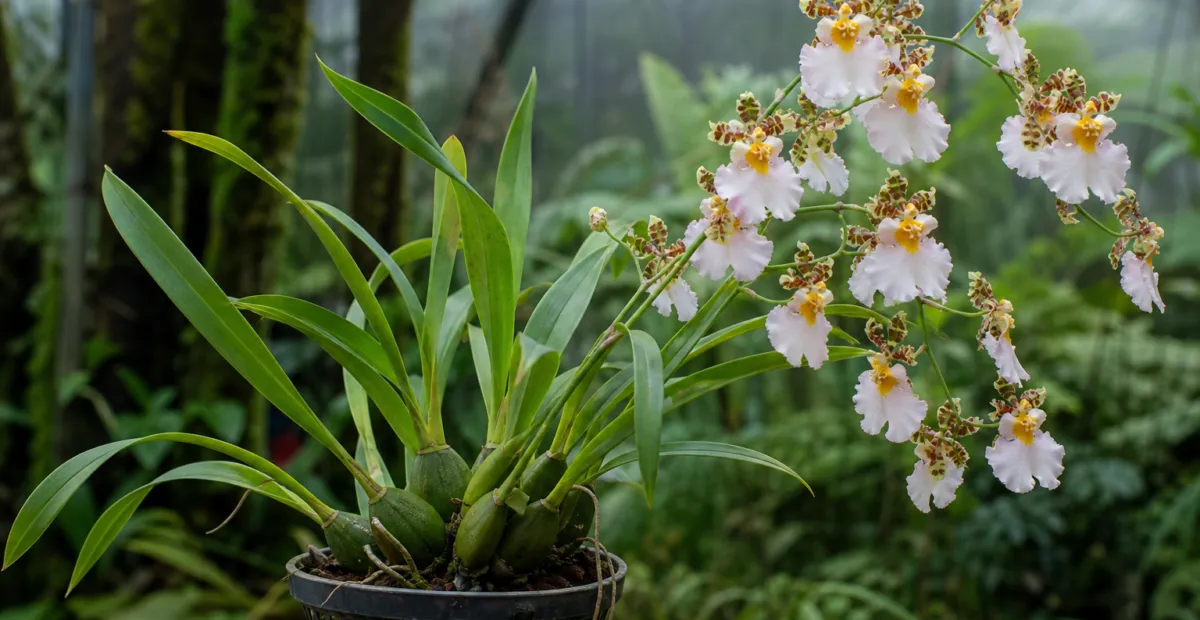
 AI-generated illustration
Oncidium alexandrae short overview
Oncidium alexandrae is a cool-growing Colombian orchid valued for its elegant, ruffled blooms and finely marked floral display. It forms ovoid pseudobulbs with long, narrow leaves and produces arching flower stems carrying several to many flowers. This epiphytic species comes from humid Andean forests at high elevations, so it performs best with bright filtered light, excellent air movement, steady moisture, and cooler temperatures than typical warm-house orchids.
Taxonomic classification
Oncidium alexandrae care guide
Light and placement
Provide bright, filtered light similar to an east window or a shaded west or south exposure. A sheer curtain or greenhouse shade is useful during intense summer sun. Leaves that become very dark green and produce weak growth suggest insufficient light; reddish or bleached foliage indicates excessive light. Avoid hot, stagnant glasshouse conditions, especially at midday.
Watering and humidity
Water thoroughly when the upper portion of the medium is approaching dryness, then allow excess water to drain completely. This cool-growing species prefers a more consistently moist root zone than many thick-leaved orchids, but roots must not remain waterlogged. Reduce frequency during slow winter growth while maintaining humidity and gentle air circulation; use room-temperature water and avoid leaving water trapped in the crown.
Soil and growing medium
Use a loose, airy epiphytic orchid medium such as fine-to-medium bark combined with perlite, charcoal, or a small amount of moisture-retentive sphagnum. The mix should drain rapidly while staying lightly moist between waterings. A slightly acidic medium is suitable. Do not use dense potting soil, which excludes oxygen from the roots and encourages rot.
Feeding
Feed during active root and pseudobulb growth with a balanced orchid fertilizer diluted to about one-quarter to one-half of the label rate every two to four waterings. Flush the pot with plain water periodically to limit salt accumulation. Avoid heavy feeding when the plant is dormant, severely stressed, freshly divided, or sitting in dry medium.
Growth and habit
The plant grows sympodially, producing successive ovoid pseudobulbs from a creeping rhizome. New flowering stems arise beside the newest mature pseudobulb, so avoid removing healthy older growth because it stores water and nutrients. Maintain even conditions during new growth; abrupt heat, drought, or root disturbance can delay flowering.
Planting and repotting
Mount on cork or place in a small, well-ventilated orchid pot with the rhizome resting at the surface. Anchor the plant firmly until new roots establish. Choose a container only slightly larger than the root mass, and keep the newest growth oriented toward the available space.
Repot every one to two years, or sooner when the medium decomposes, drains poorly, or the plant outgrows its container. Work after flowering and at the start of new root growth. Remove degraded medium and dead roots, then secure the plant in fresh, airy orchid mix without burying the rhizome.
Propagation and pruning
Propagation
Propagation is normally by division of mature sympodial clumps after flowering or when new roots begin to grow. Each division should retain several healthy pseudobulbs and at least one active lead. Seed propagation requires sterile laboratory culture and is not a practical home method.
Pruning
Do not cut a green flower stem immediately after blooming because it may produce additional flowers. Remove the spike only after it has turned fully brown or dry. Trim dead roots and spent sheaths during repotting with sterilized tools, while retaining healthy pseudobulbs and leaves.
Overwintering
Keep indoors or in a controlled cool greenhouse in the United States. Provide bright filtered light, good humidity, and night temperatures near 45–55°F. Water less often during slow growth but do not allow the pseudobulbs to shrivel severely. Protect from cold drafts, heating vents, and prolonged temperatures near freezing.
Uses
Primarily grown as a specimen orchid, conservatory plant, exhibition plant, and breeding parent. Its flowers are suitable for short-lived arrangements when stems are cut cleanly and kept hydrated, but the species is mainly valued as a living collection plant.
Appearance
Distinctive features include broadly ovoid to oblong-ovoid, somewhat flattened pseudobulbs; two long, narrow, leathery leaves per mature growth; and arching inflorescences with ruffled, often finely marked flowers. The prominent lip and frilled margins give the blooms a delicate, lace-like appearance.
Flowering
Flowering stems emerge from the side of the newest forming pseudobulb and may carry roughly 8–20 flowers. Individual blooms vary substantially in size and coloration, commonly showing pale backgrounds with a contrasting yellow lip and markings. Plants may flower in winter under cultivation, although timing is variable.
Pollination and visitors
Specific pollinator species or reliably characteristic visitor groups were not confirmed in the sources reviewed. As an orchid, it is insect-pollinated, but the identity and effectiveness of visitors for this exact species remain insufficiently documented here.
Oncidium alexandrae photos
Click any photo for a larger view. Source, author and license are shown separately.
Diseases and pests
Diseases
The main risks are root or pseudobulb rot caused by stagnant, saturated media and fungal or bacterial spotting favored by wet foliage with poor air movement. Use clean tools, fresh porous medium, good ventilation, and careful watering. Isolate affected plants and remove rotted tissue; avoid routine spraying without a confirmed diagnosis.
Pests
Watch for scale, mealybugs, aphids, thrips, and occasional spider mites, especially in dry indoor air. Inspect leaf undersides, pseudobulb bases, and flower spikes regularly. Remove small infestations manually or with an appropriate labeled horticultural treatment, and improve sanitation and air circulation.
Related diseases and pests
Only Plant Doctor profiles whose host data indicate this plant may be affected are shown here.
 DiseaseBacterial soft rotPectobacterium carotovorum
 PestMealy Plum AphidHyalopterus pruni (Geoffroy, 1762)
 PestOnion thripsThrips tabaci Lindeman
 PestMelon thripsThrips palmi Karny
 PestChilli thripsScirtothrips dorsalis Hood
 DiseaseRhabdocline Needle Cast of Douglas-FirRhabdocline pseudotsugae
 DiseaseBacterial WiltRalstonia solanacearum species complex
 DiseasePseudomonas viridiflava bacterial blightPseudomonas viridiflava
Toxicity and pollen
A reliable species-specific toxicity assessment for humans, dogs, cats, and children was not confirmed in the sources reviewed. Do not assume safety solely because it is an orchid. Keep plants and fertilizers away from children and pets, and seek professional advice if plant material or treatment products are swallowed.
- Typical season
- Usually during flowering, often winter in cultivation
- Pollination / pollen
- Pollen is packaged in orchid pollinia rather than released as a loose airborne dust.
Orchid pollen is contained in compact pollinia and is not typically dispersed as abundant loose airborne dust. This suggests relatively low airborne exposure compared with wind-pollinated plants, but individual sensitivity cannot be ruled out and species-specific allergy studies were not confirmed.
Native habitat
This orchid inhabits humid, cool Andean montane forests as an epiphyte on trees, generally at roughly 1,700–3,200 m elevation. The habitat has filtered light, frequent moisture, strong air movement, and cool nights. It is associated with wet tropical forest environments rather than warm, lowland conditions.
Interesting fact
The accepted name was published in 2008 when the species was transferred from Odontoglossum into Oncidium. It has also been widely used as a breeding resource and has contributed to several natural and cultivated orchid lineages. Historical horticultural literature recorded extensive variation in flower color and markings.
Frequently asked questions (FAQ)
The most relevant questions about this plant, with short and direct answers.
🌱Quick care
What is Oncidium alexandrae?⌄
Oncidium alexandrae is a cool-growing, epiphytic orchid in the Orchidaceae family, native to the Colombian Andes. It was formerly known by names including Odontoglossum crispum and is also called the lace orchid or curled odontoglossum.
Is Oncidium alexandrae difficult to grow?⌄
Yes, Oncidium alexandrae is considered challenging because it needs cool temperatures, high humidity, steady moisture, and good air movement. It is less forgiving of hot, dry indoor conditions than many common orchid hybrids.
What light does Oncidium alexandrae need?⌄
Provide bright filtered light, such as an east-facing window or a shaded south- or west-facing window. Protect the leaves from intense midday sun, which can cause bleaching or scorch.
How often should I water Oncidium alexandrae?⌄
Water when the potting mix is approaching dryness but before the plant stays dry for long, keeping it evenly moist overall. Water thoroughly, then let excess drain completely because constantly soggy roots can rot.
What temperature is best for Oncidium alexandrae?⌄
Oncidium alexandrae prefers cool to intermediate conditions, with cooler nights than typical warm-growing houseplants. Avoid prolonged heat, especially temperatures above about 80°F, and provide ventilation during warm weather.
🌤️Environment and placement
Where should I place Oncidium alexandrae indoors?⌄
Place it near a bright window with filtered light, cool nighttime temperatures, and gentle air circulation. An east-facing window is often a good starting point in U.S. homes.
Can Oncidium alexandrae grow outdoors in the United States?⌄
It can grow outdoors only where temperatures remain cool, humid, and frost-free, generally in a protected greenhouse or suitable USDA Zone 12 environment. In most of the United States, move it indoors before cold weather and never expose it to frost.
Does Oncidium alexandrae need high humidity?⌄
Yes, moderate to high humidity helps Oncidium alexandrae maintain healthy leaves and roots, especially indoors. Pair humidity with air movement and avoid leaving water trapped in the crown or between leaves.
Can Oncidium alexandrae tolerate direct sunlight?⌄
Only gentle morning or late-day sun is usually suitable, and even that should be monitored. Strong direct sunlight through a window can overheat or scorch its relatively soft leaves.
💧Care and problems
Why are the leaves of my Oncidium alexandrae turning yellow?⌄
Yellow leaves may result from normal aging, excessive light, watering stress, or root damage. Check whether older leaves are affected naturally, then inspect the roots and adjust light and moisture if several leaves yellow at once.
Why are the pseudobulbs of Oncidium alexandrae wrinkled?⌄
Wrinkled pseudobulbs usually indicate that the plant is losing water faster than its roots can supply it. Check for prolonged dryness, damaged roots, or a compacted mix, while avoiding sudden overwatering of severely compromised roots.
Why is Oncidium alexandrae not blooming?⌄
Lack of blooming is commonly linked to insufficient light, weak growth, excessive heat, or an immature pseudobulb. Give the plant bright filtered light, cool conditions, consistent care, and time for a new growth to mature.
Should I fertilize Oncidium alexandrae?⌄
Yes, feed during active growth with a balanced orchid fertilizer diluted according to the product label. Fertilize lightly and regularly rather than applying strong doses, and flush the pot with plain water periodically to limit salt buildup.
Does Oncidium alexandrae need air circulation?⌄
Yes, gentle continuous air movement is important because the plant prefers humid but well-ventilated conditions. A small fan can help indoors, provided it does not blow strongly enough to dry the plant rapidly.
🪴Planting and repotting
What potting mix is best for Oncidium alexandrae?⌄
Use an open, well-draining orchid mix that retains some moisture without becoming compacted, such as fine orchid bark with moisture-holding material. The mix should provide both aeration and more consistent moisture than a very coarse, fast-drying medium.
Should Oncidium alexandrae be grown in a pot or mounted?⌄
A pot is usually easier because it helps maintain the even moisture this species prefers. Mounting can work in a humid greenhouse, but mounted plants generally require more frequent watering and careful monitoring.
When should I repot Oncidium alexandrae?⌄
Repot when the potting mix has broken down or when new growth and roots are beginning to develop. Repotting during active new growth usually helps the plant re-establish more quickly than disturbing it during flowering.
How often should I repot Oncidium alexandrae?⌄
Repot when the medium decomposes or drainage declines, commonly every one to two years depending on the mix and growing conditions. Do not repot solely because roots are growing over the pot if the medium remains open and healthy.
✂️Propagation and pruning
How do you propagate Oncidium alexandrae?⌄
The practical home method is division of a mature plant into sections containing several healthy pseudobulbs and active roots. Divide only when the plant is large enough to retain strong growth on each section.
Can Oncidium alexandrae be grown from seed?⌄
Yes, but orchid seed is extremely small and normally requires sterile laboratory conditions and a suitable fungal or artificial culture medium. Seed propagation is therefore not a practical method for most home growers.
Should I cut off the flower spike after Oncidium alexandrae finishes blooming?⌄
Cut the flower spike near its base once it has completely finished and turned brown. Do not remove green pseudobulbs or healthy leaves, because they continue supplying energy for future growth.
⚠️Toxicity and safety
Is Oncidium alexandrae toxic to cats or dogs?⌄
The toxicity of Oncidium alexandrae has not been firmly established in the available references. Keep it away from pets and children that may chew plants, and contact a veterinarian or poison-control service if ingestion causes symptoms.
🌸Flowering and special interest
When does Oncidium alexandrae bloom?⌄
Oncidium alexandrae often blooms in winter, although the exact season can vary with the clone and growing conditions. Flowering generally follows the maturation of a new pseudobulb.
What do Oncidium alexandrae flowers look like?⌄
The flowers are large, showy, and often white to pale rose with ruffled or wavy margins and a prominent lip. Color and spotting can vary considerably among forms and cultivars.
Are Oncidium alexandrae flowers fragrant?⌄
Many plants are reported to produce fragrant flowers, but fragrance intensity can vary by individual plant and growing conditions. Cooler, brighter conditions may help the plant flower more strongly.
How long do Oncidium alexandrae flowers last?⌄
Individual flowers can remain attractive for several weeks under stable indoor or greenhouse conditions. The full display may last longer because a spike can carry many flowers that open over time.
How large can an Oncidium alexandrae flower spike become?⌄
A mature spike can reach roughly 18 inches and carry multiple flowers, although size varies with the plant’s age and culture. Strong, well-established pseudobulbs are more likely to produce impressive inflorescences.
Similar plants
 Yellow lantern chili (Capsicum chinense) care guideCapsicum chinense
 Capsicum baccatum care guideCapsicum baccatum
 Serrano (Capsicum annuum ‘Serrano’)Capsicum annuum 'Serrano'
 Purple Beauty (Capsicum annuum ‘Purple Beauty’)Capsicum annuum 'Purple Beauty'
 Numex Twilight (Capsicum annuum ‘Numex Twilight’)Capsicum annuum 'Numex Twilight'
 Explosive Ember Chili Pepper (Capsicum annuum ‘Explosive Ember’)Capsicum annuum 'Explosive Ember'