
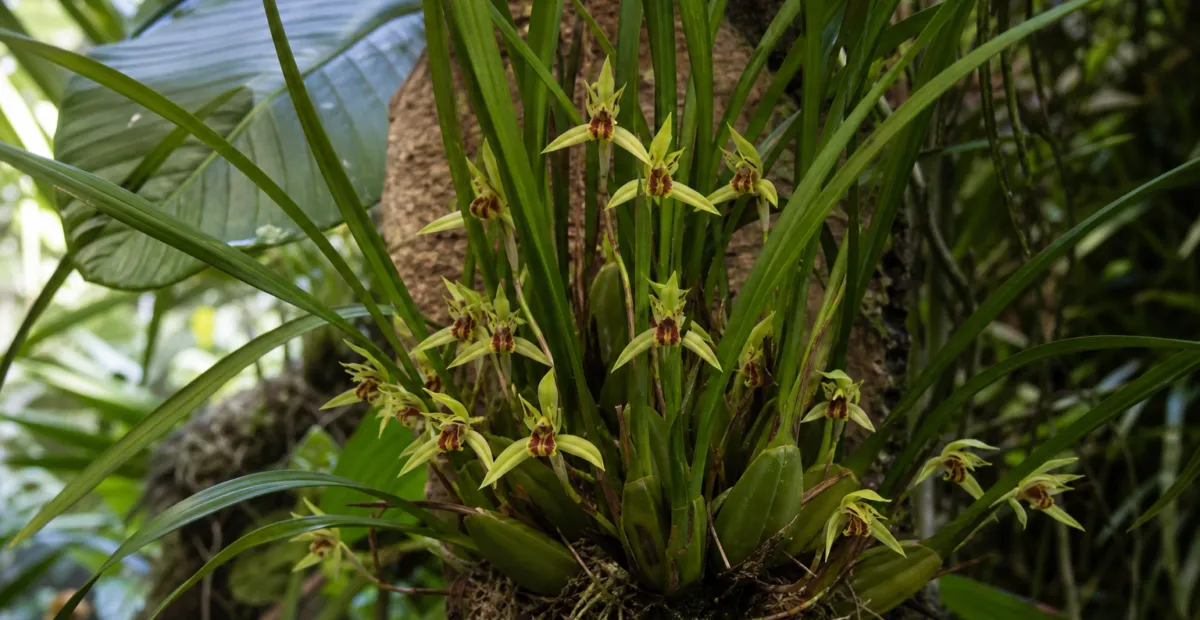
 AI-generated illustration
Coconut Orchid (Maxillaria tenuifolia) short overview
The Coconut Orchid, Maxillaria tenuifolia, is a tropical, epiphytic orchid prized for compact clumps of slender, grasslike leaves and strongly fragrant flowers reminiscent of coconut cream or coconut pie. Native from Mexico through Central America, it grows from clustered pseudobulbs and prefers bright filtered light, steady moisture with modest drying between waterings, excellent air movement, and an airy bark-based orchid mix. In the United States, it is usually grown indoors, in a greenhouse, or outdoors only during warm weather.
Taxonomic classification
Coconut Orchid (Maxillaria tenuifolia) care guide
Light and placement
Place in bright, filtered light near an east- or shaded south-facing window, or under strong grow lights. A little gentle morning sun can be useful, but hot direct afternoon sun may scorch the narrow leaves and overheat the roots. Too little light produces weak, dark-green growth and poor flowering; excessive light causes yellowing, bleached patches, or reddish stress coloration.
Watering and humidity
Water thoroughly when the upper part of the mix is approaching dryness, then let excess water drain completely. Keep the root zone evenly but not constantly saturated during active growth. Reduce frequency somewhat in winter or after flowering, while avoiding prolonged desiccation. Humidity is helpful, but stagnant, wet foliage and poor ventilation increase disease risk.
Soil and growing medium
Use a loose, fast-draining epiphytic orchid medium based on medium-grade bark, with optional perlite, sphagnum, or coir to moderate moisture. The roots need both moisture and abundant oxygen, so dense garden soil is unsuitable. A slightly acidic to near-neutral medium is appropriate; replace decomposing or compacted mix before drainage declines.
Feeding
Feed during active growth with a balanced orchid fertilizer diluted to about one-quarter to one-half of the label strength, generally every two to four waterings. Water first if roots are dry, and flush the pot periodically to reduce salt accumulation. Do not fertilize freshly divided, newly repotted, severely stressed, or dormant plants until active root or shoot growth resumes.
Growth and habit
This species forms a gradually expanding clump of small pseudobulbs, each supporting narrow leaves and storing water and nutrients. Pendulous or arching growth can spill over the edge of a pot or basket. Keep older pseudobulbs attached during division because they help support new growth after disturbance.
Planting and repotting
Mount on cork or plant in a shallow, well-drained orchid container with the rhizome near the surface. Position the newest growth toward open space so the clump can expand. Secure the plant until roots establish, and avoid burying pseudobulbs in wet medium, which can encourage rot.
Repot when the medium breaks down, drainage slows, or the plant outgrows its container, preferably in early spring as new growth starts. Use a shallow pot or basket only slightly larger than the root mass. Remove dead roots and preserve healthy roots; keep pseudobulbs above the medium and stabilize the division until it re-roots.
Propagation and pruning
Propagation
The practical method is division of an established clump in early or mid-spring. Each division should retain several healthy pseudobulbs, ideally at least three or four, with viable roots and an active or emerging growth point. Seed propagation requires controlled laboratory conditions and specialized orchid culture.
Pruning
No routine pruning is required. Remove only dead, fully dried leaves, spent flower stems, or rotted tissue with sterile tools. Do not remove firm older pseudobulbs, because they store resources and help support new growth.
Overwintering
Protect from temperatures below about 57°F, cold drafts, and frost. In most of the United States, move outdoor plants indoors or into a heated greenhouse before cool nights arrive. Provide bright filtered light, ventilation, and somewhat reduced watering during the cooler, less active season without allowing the pseudobulbs to remain deeply shriveled.
Uses
Primarily grown as a fragrant ornamental orchid for windowsills, orchid collections, conservatories, greenhouses, and shaded warm-season patios. Its foliage remains attractive outside the flowering period, and mature clumps can be displayed in baskets or broad shallow pots. No culinary or medicinal use should be assumed from the coconut fragrance.
Appearance
The plant is identified by clustered, rounded to ovoid pseudobulbs and narrow, grasslike evergreen leaves. Flowers arise low on the plant near the bases of mature pseudobulbs rather than on a tall upright spike. The compact clumping habit and richly scented, patterned blooms distinguish it from many larger-leaved tropical orchids.
Flowering
Mature pseudobulbs produce short flowering stems from their bases, often with several blooms distributed through a well-established clump. Flowers are small and richly patterned, with a powerful coconut-like scent. American Orchid Society material places the main cultivated flowering period around March and April, while broader horticultural references report spring into summer; timing varies with temperature, light, and winter rest.
Pollination and visitors
A specific pollinator or characteristic visitor group was not confirmed in the authoritative sources reviewed. The coconut-like floral fragrance is well documented, but fragrance alone does not establish which animals pollinate or visit the flowers.
Maxillaria tenuifolia photos
Click any photo for a larger view. Source, author and license are shown separately.
Diseases and pests
Diseases
The main preventable problems are root or pseudobulb rot and bacterial disease associated with stagnant air, saturated medium, or water trapped around the plant base. Use a clean, open medium, disinfect cutting tools, water early enough for foliage to dry, and isolate plants showing soft, foul-smelling, or rapidly spreading lesions.
Pests
Watch for scale insects, mealybugs, aphids, and glasshouse spider mites, especially on stressed plants or in dry indoor air. Inspect leaf bases and pseudobulbs regularly, isolate infested plants, remove small infestations mechanically, and use a labeled horticultural soap or oil only as directed and after testing orchid sensitivity.
Related diseases and pests
Only Plant Doctor profiles whose host data indicate this plant may be affected are shown here.
 DiseaseBacterial soft rotPectobacterium carotovorum
 DiseaseRhizopus soft rotRhizopus stolonifer
 PestMealy Plum AphidHyalopterus pruni (Geoffroy, 1762)
 DiseaseRhabdocline Needle Cast of Douglas-FirRhabdocline pseudotsugae
 DiseaseBacterial WiltRalstonia solanacearum species complex
 PestObscure mealybugPseudococcus viburni
 PestLong-tailed mealybugPseudococcus longispinus
 PestCitrus mealybugPlanococcus citri
Toxicity and pollen
A species-specific, authoritative toxicity assessment for Maxillaria tenuifolia was not located in the sources reviewed. Do not treat the plant as edible or assume complete safety from the absence of a listing. Prevent children and pets from chewing plant material, use ordinary hand-washing after handling potting media, and seek professional advice if ingestion causes symptoms.
- Typical season
- Typically spring flowering indoors or in warm climates
- Pollination / pollen
- Packed orchid pollinia rather than freely airborne pollen
Orchid pollen is packaged into pollinia rather than released as a loose airborne cloud, which may reduce ordinary airborne exposure compared with wind-pollinated plants. However, species-specific allergy testing and exposure data for Maxillaria tenuifolia were not found, so a zero-risk claim is not justified. People with strong floral or occupational sensitivities should avoid handling flowers if symptoms occur.
Native habitat
A wet-tropical epiphyte native from Mexico through Central America. In nature it grows above ground on trees or other supports rather than rooted in ordinary soil, receiving abundant moisture, rapid drainage, humid air, and fluctuating light filtered through forest vegetation.
Interesting fact
The species was described by John Lindley in 1837 after material collected in Mexico. Its accepted name remains Maxillaria tenuifolia, although Maxillariella tenuifolia has also been used in alternative taxonomic treatments. The common name reflects the unusually strong coconut-like fragrance of the flowers, while the foliage remains ornamental between blooming periods.
Frequently asked questions (FAQ)
The most relevant questions about this plant, with short and direct answers.
🌱Quick care
What is Maxillaria tenuifolia commonly called?⌄
Maxillaria tenuifolia is commonly called the Coconut Orchid because its flowers have a coconut-like fragrance. It is an epiphytic orchid in the Orchidaceae family.
Is Maxillaria tenuifolia easy to grow indoors?⌄
Yes, Maxillaria tenuifolia is generally manageable indoors when provided with bright filtered light, steady moisture, humidity, and good drainage. It is more tolerant of moisture than many commonly grown orchids.
🌤️Environment and placement
How much light does a Coconut Orchid need?⌄
Give a Coconut Orchid bright filtered light, similar to the brighter end of typical indoor orchid conditions. Too little light can produce weak, elongated growth and fewer flowers, while intense hot sun through glass can scorch the leaves.
Can Maxillaria tenuifolia grow under artificial lights?⌄
Yes, Maxillaria tenuifolia can grow under artificial orchid lighting if the light is bright enough and the plant receives a consistent daily schedule. Keep the foliage far enough from strong fixtures to prevent heat or leaf burn.
What temperature is best for Maxillaria tenuifolia?⌄
Maxillaria tenuifolia prefers intermediate indoor temperatures, with slightly cooler nights in winter. Protect it from frost, freezing temperatures, and prolonged exposure to cold drafts.
Can I grow Coconut Orchid outdoors in the United States?⌄
You can grow Coconut Orchid outdoors during warm, frost-free weather, but it should be brought indoors before temperatures approach freezing. In most of the United States, it is best treated as an indoor or greenhouse orchid.
How much humidity does Maxillaria tenuifolia need?⌄
Moderate to high humidity supports healthy growth, especially in heated or air-conditioned homes. Use a humidifier or another safe humidity method while maintaining air movement and avoiding constantly wet foliage.
💧Care and problems
How often should I water Maxillaria tenuifolia?⌄
Water Maxillaria tenuifolia thoroughly when the open orchid mix is beginning to dry, keeping it moist but not waterlogged. Water more often during active growth and reduce frequency during the cooler, darker part of winter.
Should a Coconut Orchid dry out completely between waterings?⌄
A Coconut Orchid should not remain completely dry for long periods. Allow the surface and some of the mix to dry slightly, but water before the pseudobulbs become severely shriveled.
Why are my Maxillaria tenuifolia pseudobulbs wrinkled?⌄
Wrinkled pseudobulbs usually indicate insufficient water uptake, underwatering, damaged roots, or a mix that stays too dry. Check the roots and potting medium before simply increasing watering, because root loss can produce similar symptoms.
Why are the leaves on my Coconut Orchid turning yellow?⌄
Yellow leaves may result from natural aging, excessive light, watering stress, or root problems. Inspect the roots and growing conditions rather than treating leaf color alone as proof of overwatering.
Why is my Maxillaria tenuifolia losing roots?⌄
Root loss most often occurs when the potting mix remains saturated or breaks down and restricts air around the roots. Move the plant into a fresh, open orchid mix and adjust watering so the medium becomes slightly drier between applications.
How should I fertilize Maxillaria tenuifolia?⌄
Fertilize Maxillaria tenuifolia lightly during active growth with a balanced orchid fertilizer diluted according to the product label. Flush the pot with plain water periodically to reduce fertilizer-salt buildup.
Does Maxillaria tenuifolia need air circulation?⌄
Yes, gentle air circulation helps the foliage and potting mix dry evenly and lowers the risk of fungal problems. Do not aim a strong fan directly at the plant for extended periods.
🪴Planting and repotting
What potting mix is best for Coconut Orchid?⌄
Use an open, bark-based orchid mix that drains freely while retaining some moisture. Fine or decomposed media that stays wet for several days can increase the risk of root decline.
Should Maxillaria tenuifolia be planted in a pot or mounted?⌄
Maxillaria tenuifolia can grow in a pot, basket, or mounted setup, but a pot with an open bark-based mix is usually simpler for indoor growers. Mounted plants dry faster and require more frequent monitoring and watering.
When should I repot Maxillaria tenuifolia?⌄
Repot Maxillaria tenuifolia when the mix has decomposed, drainage has declined, or the plant has clearly outgrown its container. Repotting is easiest when new roots or new growth are beginning, because the plant can establish more quickly.
How do I repot a Coconut Orchid without damaging it?⌄
Remove the old mix carefully, preserve healthy roots, and place the rhizome near the surface of fresh orchid bark rather than burying the pseudobulbs deeply. Choose a stable container that accommodates the plant’s climbing or spreading growth.
✂️Propagation and pruning
How do you propagate Maxillaria tenuifolia?⌄
Propagate Maxillaria tenuifolia by dividing the rhizome and pseudobulb clump into sections with roots and active growth when possible. Small divisions can survive, but larger divisions generally establish more reliably.
Can Maxillaria tenuifolia be grown from seed at home?⌄
Seed propagation is not practical for most home growers because orchid seeds require sterile laboratory-style flask culture and specialized conditions. Division is the realistic method for producing new plants at home.
Should I prune Coconut Orchid leaves or pseudobulbs?⌄
Do not routinely prune healthy leaves or pseudobulbs because they store energy for future growth and flowering. Remove only dead, diseased, or badly damaged material with sterile tools.
⚠️Toxicity and safety
Is Maxillaria tenuifolia toxic to cats or dogs?⌄
The toxicity of Maxillaria tenuifolia to cats, dogs, and people has not been firmly established in the available plant references. Keep it away from pets and children who may chew plant parts, and contact a veterinarian or poison-control service if ingestion occurs.
🌸Flowering and special interest
When does Maxillaria tenuifolia bloom?⌄
Maxillaria tenuifolia commonly flowers in spring, although indoor plants may bloom at other times when mature and well established. Flowering timing varies with light, temperature, plant age, and seasonal care.
Why is my Maxillaria tenuifolia not flowering?⌄
Insufficient light, an immature plant, recent division, weak roots, or overly uniform conditions can prevent flowering. Increase light gradually and maintain healthy growth rather than relying on high-phosphorus fertilizer alone.
Do Coconut Orchid flowers really smell like coconut?⌄
Yes, the flowers are known for a noticeable coconut-like fragrance, especially when they are open and conditions are warm. Fragrance intensity can vary by clone, time of day, and growing conditions.
How long do Maxillaria tenuifolia flowers last?⌄
Individual flowers generally last for a limited period rather than remaining open for many months. Keeping the plant evenly watered and avoiding heat stress can help preserve the display.
Where do Maxillaria tenuifolia flower buds appear?⌄
Flower buds emerge from the bases of the pseudobulbs along the rhizome, near the point where the leaves and pseudobulbs meet. Inspect the clump closely because the buds can be small and partly concealed by papery coverings.
Similar plants
 Azure Monkshood (Aconitum carmichaelii) care guideAconitum carmichaelii
 Monkshood (Aconitum ‘Stainless Steel’)Aconitum 'Stainless Steel'
 Monkshood (Aconitum ‘Bressingham Spire’)Aconitum 'Bressingham Spire'
 Golden full moon maple (Acer shirasawanum ‘Aureum’)Acer shirasawanum 'Aureum'
 Globosum (Acer platanoides ‘Globosum’)Acer platanoides 'Globosum'
 Striped maple (Acer pensylvanicum) care guideAcer pensylvanicum