
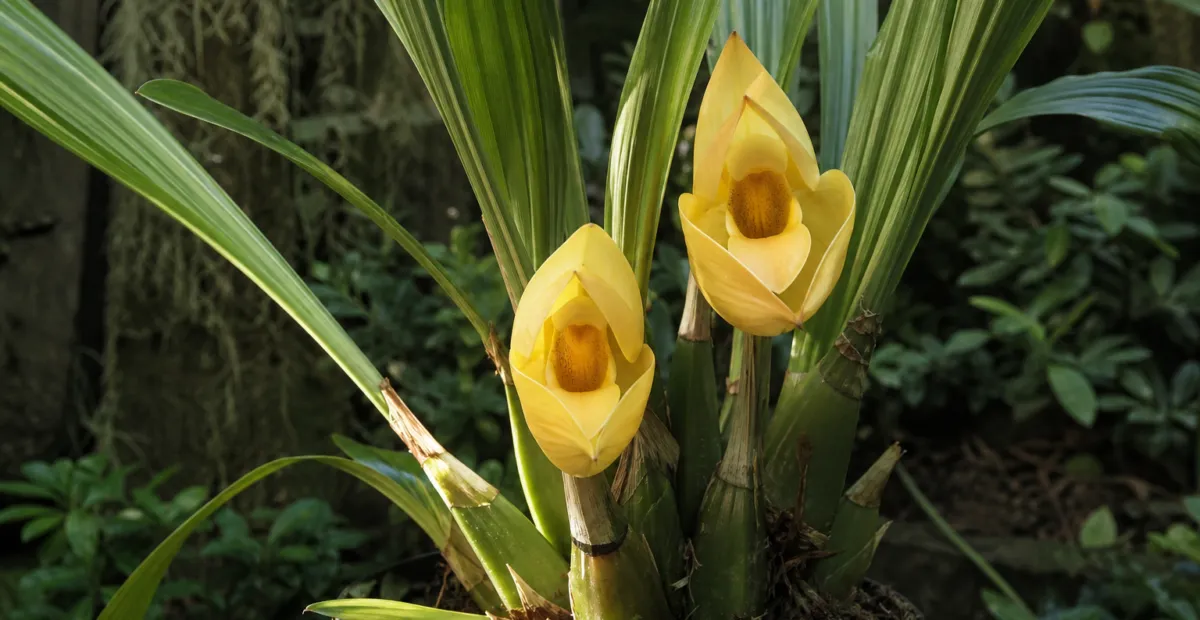
 AI-generated illustration
Clowes’ Tulip Orchid (Anguloa clowesii) short overview
Clowes’ Tulip Orchid is a striking, cool-growing orchid from the Colombian and Venezuelan Andes. Its clustered pseudobulbs produce pleated leaves and fragrant, waxy yellow flowers whose enclosed lips and rounded form resemble tulips. Grow it in bright filtered light with an open, moisture-retentive but fast-draining orchid mix, good air movement, and consistently humid conditions. It is best suited to an intermediate or experienced grower who can provide cooler nights and a seasonal reduction in watering.
Taxonomic classification
Clowes’ Tulip Orchid (Anguloa clowesii) care guide
Light and placement
Provide bright filtered light, similar to an east-facing window, lightly shaded greenhouse bench, or bright conservatory position. A little early or late sun can be useful, but strong midday sun may scorch the pleated leaves and overheat the pseudobulbs. Pale, bleached foliage suggests excessive light; very dark leaves with weak growth suggest insufficient light.
Watering and humidity
Water thoroughly when the upper portion of the mix begins to dry, then allow excess water to drain completely. Keep the medium evenly but not constantly saturated during active growth, using slightly less water as growth matures and temperatures fall. High humidity helps, but it must be paired with air movement; stagnant wetness is more dangerous than brief dryness.
Soil and growing medium
Use a loose, airy terrestrial-orchid mix containing fine to medium bark, moisture-retentive organic material, and drainage components such as perlite or pumice. The medium should hold some moisture without becoming stagnant around the pseudobulbs. A slightly acidic orchid substrate is appropriate; avoid dense garden soil and containers that stay saturated.
Feeding
Feed during active leaf and pseudobulb growth with a complete orchid fertilizer diluted to about one-quarter to one-half the label rate, applied after watering rather than to dry roots. Fertilize regularly but lightly, flush the pot with plain water periodically to limit salt accumulation, and reduce or pause feeding during the cooler, drier rest period or whenever roots are damaged.
Growth and habit
This species forms a clump of large, clustered pseudobulbs. New growth and flower spikes emerge seasonally, followed by a period in which older leaves may yellow or drop. Keep the plant stable while new pseudobulbs mature; avoid dividing too frequently because small divisions may take several seasons to flower.
Planting and repotting
In the United States, grow in a container or greenhouse rather than outdoors except in frost-free, cool highland conditions. Plant the pseudobulbs shallowly, with the rhizome at or just above the medium surface. Allow space for the clump to expand and avoid burying dormant buds or new growths.
Repot when the medium decomposes or when the plant outgrows its container, preferably as new growth begins. Handle the brittle roots carefully, keep the newest growth positioned with room to expand, and use a pot only slightly larger than the root mass. Resume thorough watering after signs of root recovery.
Propagation and pruning
Propagation
Division of established clumps is the practical vegetative method and should be done when new growth is beginning, retaining several healthy pseudobulbs per division. Seed propagation requires sterile orchid-flask culture and specialized laboratory conditions, so it is not practical for ordinary home growers.
Pruning
Remove only dead or fully dried leaves, spent flower spikes, and rotted tissue. Do not cut healthy green pseudobulbs or remove aging leaves prematurely, because they can continue supporting the developing clump. Sterilize cutting tools between plants.
Overwintering
Keep plants protected from frost and cold wet conditions. During the cooler rest period, maintain bright light, good ventilation, and slightly reduced watering. Do not let pseudobulbs remain continuously cold and saturated. In most of the United States, overwinter in a heated greenhouse, conservatory, or protected indoor orchid space.
Uses
Primarily grown as a collector’s ornamental orchid for its unusual tulip-like flowers, fragrance, and architectural pseudobulbs. It is best suited to a greenhouse, conservatory, or specialized orchid collection. No culinary, medicinal, or household-use claims are supported for this species.
Appearance
The plant has large, conical to pear-shaped, furrowed pseudobulbs arranged in clusters. Each mature pseudobulb bears several pleated, obovate to elliptic leaves that may be deciduous. Flower spikes arise near the base and hold substantial waxy blooms around mid-leaf height, making the tulip-like floral structure especially distinctive.
Flowering
Flowers are produced on short, erect basal inflorescences as new growth begins. The solitary, waxy blooms are enclosed by the sepals and petals and have a distinctive rocking lip. Flowering is commonly reported from spring through summer, although the exact timing varies with temperature, light, maturity, and cultivation conditions.
Pollination and visitors
The enclosed, rocking-lip flower is adapted for insect visitation, and orchid references discuss bee-mediated pollination in Anguloa. However, a species-specific pollinator for Anguloa clowesii was not clearly documented in the authoritative sources reviewed, so the visitor record remains uncertain.
Anguloa clowesii photos
Click any photo for a larger view. Source, author and license are shown separately.
Diseases and pests
Diseases
Watch for root and pseudobulb rot when the medium remains wet or air movement is poor. Remove damaged tissue with sterile tools, replace decomposed medium, improve drainage and ventilation, and avoid watering onto crowded new growth. Isolate plants showing soft tissue or rapidly spreading lesions; fungicides should be used only according to the product label.
Pests
Common protected-culture pests include scale, mealybugs, aphids, thrips, and spider mites. Inspect undersides of leaves, new growth, and pseudobulb joints regularly. Remove small infestations manually or with an appropriate labeled horticultural treatment, repeat as directed, and avoid spraying stressed plants in hot conditions.
Related diseases and pests
Only Plant Doctor profiles whose host data indicate this plant may be affected are shown here.
 DiseaseRhizopus soft rotRhizopus stolonifer
 DiseaseBacterial soft rotPectobacterium carotovorum
 PestMealy Plum AphidHyalopterus pruni (Geoffroy, 1762)
 PestOnion thripsThrips tabaci Lindeman
 PestMelon thripsThrips palmi Karny
 PestChilli thripsScirtothrips dorsalis Hood
 DiseaseRhabdocline Needle Cast of Douglas-FirRhabdocline pseudotsugae
 DiseasePseudomonas viridiflava bacterial blightPseudomonas viridiflava
Toxicity and pollen
No authoritative species-specific toxicity warning for Anguloa clowesii was located in the reviewed botanical and horticultural sources. That absence is not proof of complete safety. Keep the plant and potting materials away from children and pets, and avoid ingesting plant tissue or fertilizer. Seek professional advice after ingestion or a significant exposure.
- Typical season
- No documented U.S. airborne pollen season; orchid pollinia are not typically wind-dispersed.
- Pollination / pollen
- Pollinia, not freely airborne pollen
Orchid pollen is packaged into pollinia rather than released as a loose airborne cloud. For that reason, routine airborne exposure is expected to be low, but species-specific allergy studies for Anguloa clowesii were not located. Handle flowers and potting media normally, avoiding unnecessary contact if personally sensitive.
Native habitat
It is native to the eastern Andean region from Colombia into northwestern Venezuela, with records around 1,800 m and horticultural accounts extending the range to about 2,500 m. The habitat is wet tropical highland forest or adjacent terrestrial orchid sites, where cool conditions, high humidity, organic debris, and rapid drainage can occur together.
Interesting fact
The flower’s lip can rock within the enclosed floral structure, contributing to its tulip-like appearance. The species was first published by John Lindley in 1844. Kew records Colombia to northwestern Venezuela as its native range. It is listed as Endangered in Colombia and is included in CITES Appendix II according to Kew’s linked Colombian plant resources.
Frequently asked questions (FAQ)
The most relevant questions about this plant, with short and direct answers.
🌱Quick care
How do you care for Clowes’ Tulip Orchid (Anguloa clowesii)?⌄
Grow Clowes’ Tulip Orchid in bright filtered light, an open moisture-retentive orchid mix, moderate watering, and temperatures above 50°F. Water more during active growth and reduce watering during its seasonal rest.
Is Anguloa clowesii easy to grow indoors?⌄
Anguloa clowesii can be grown indoors, but it is best suited to a cool, bright room, greenhouse, or controlled growing space. Maintaining bright light, humidity, airflow, and a seasonal reduction in water is usually more challenging than with common beginner orchids.
🌤️Environment and placement
How much light does Clowes’ Tulip Orchid need?⌄
Clowes’ Tulip Orchid needs bright filtered light, such as an east-facing window or a shaded south- or west-facing window. Protect the leaves from intense midday sun if they become hot or show scorch.
Can Anguloa clowesii grow under artificial lights?⌄
Anguloa clowesii can grow under artificial lights when the light is bright but not close enough to overheat the foliage. Use a timer for a consistent daily schedule and provide airflow around the leaves.
What temperatures are best for Anguloa clowesii?⌄
Anguloa clowesii prefers intermediate to cool orchid conditions, with cooler nights supporting healthy growth and flowering. Protect it from frost and temperatures below 50°F.
Can Clowes’ Tulip Orchid grow outdoors in the United States?⌄
Clowes’ Tulip Orchid can grow outdoors during mild weather if it receives filtered light and stays above 50°F. In most of the United States, move it indoors or into a protected greenhouse before cold nights and frost.
What humidity does Anguloa clowesii need?⌄
Anguloa clowesii prefers moderate to high humidity with steady air movement. Avoid placing it in stagnant, constantly wet conditions, especially indoors near poorly ventilated windows.
💧Care and problems
How often should you water Clowes’ Tulip Orchid?⌄
Water Clowes’ Tulip Orchid thoroughly when the mix is nearly dry in the center, then let excess water drain completely. Water more frequently during active growth and much less after the pseudobulbs mature and the plant rests.
Should Anguloa clowesii dry out completely?⌄
Anguloa clowesii should not remain completely dry for long because its fine root hairs can be damaged by severe dehydration. During dormancy, keep the mix substantially drier but give enough occasional moisture to prevent excessive pseudobulb shriveling.
Does Anguloa clowesii need a winter rest?⌄
Anguloa clowesii benefits from a slight seasonal rest after growth and pseudobulb maturation, often with reduced watering and little or no fertilizer. Resume more regular watering when new growth or new roots begin.
Why is my Anguloa clowesii losing its leaves?⌄
Leaf loss can be a normal seasonal response because Anguloa clowesii is deciduous or semi-deciduous during its rest period. Sudden loss with soft pseudobulbs, foul-smelling medium, or black roots may instead indicate root stress or rot.
Why are the pseudobulbs of Clowes’ Tulip Orchid shriveling?⌄
Shriveling pseudobulbs usually indicate insufficient water, damaged roots, or a normal dry rest taken too far. Check the roots and potting mix, then increase watering gradually only if the plant is actively growing.
What fertilizer is best for Anguloa clowesii?⌄
Use a balanced orchid fertilizer at reduced strength during active growth, allowing occasional plain-water flushes. Reduce or stop fertilizing during the seasonal rest and never fertilize a severely dehydrated or root-damaged plant.
How do you prevent root rot in Clowes’ Tulip Orchid?⌄
Prevent root rot by using an airy, moisture-retentive orchid mix, a pot with drainage, and thorough drainage after watering. Do not keep the plant sitting in water or maintain heavy watering during dormancy.
🪴Planting and repotting
What potting mix is best for Anguloa clowesii?⌄
Anguloa clowesii grows well in an open orchid mix that retains some moisture, such as fine to medium bark combined with sphagnum moss and perlite. The mix should stay evenly moist during growth without becoming dense or waterlogged.
When should you repot Clowes’ Tulip Orchid?⌄
Repot Clowes’ Tulip Orchid when the mix has broken down, the plant is outgrowing its container, or new root growth is beginning. Repotting near the start of active growth helps new roots establish with less damage.
How do you repot Anguloa clowesii without damaging the roots?⌄
Repot Anguloa clowesii gently and disturb the roots as little as possible, because its fine roots are easily damaged. If the existing medium is still usable, pot the plant on rather than aggressively removing every piece of mix.
What type of pot should Clowes’ Tulip Orchid use?⌄
Use a stable plastic orchid pot or another container with ample drainage and enough room for the next new growth. Position the oldest pseudobulb near the pot edge so the newest growth has space to expand.
✂️Propagation and pruning
How do you propagate Anguloa clowesii?⌄
Anguloa clowesii is normally propagated by dividing a mature clump of pseudobulbs. Each division should retain several healthy pseudobulbs and active or viable growth points so it can establish reliably.
Can you propagate Clowes’ Tulip Orchid from a backbulb?⌄
A healthy backbulb of Clowes’ Tulip Orchid can sometimes produce a new growth when kept slightly moist in a shaded, well-ventilated location. Backbulb divisions may take several years to reach flowering size.
Should you prune Anguloa clowesii?⌄
Anguloa clowesii generally needs little pruning beyond removing dead leaves, spent flower stems, and rotten tissue with sterilized tools. Do not cut healthy pseudobulbs or green leaves merely because the plant is resting.
⚠️Toxicity and safety
Is Clowes’ Tulip Orchid toxic to cats or dogs?⌄
No species-specific toxicity warning was located for Clowes’ Tulip Orchid. Even so, keep it away from pets and children because ingesting plant material or potting media can cause problems and the species has not been established as edible.
Is Anguloa clowesii safe to touch?⌄
Anguloa clowesii is generally safe to handle during routine care, but wash your hands after handling the plant, fertilizer, or potting mix. Avoid contact with eyes and do not ingest any part of the orchid.
🌸Flowering and special interest
When does Clowes’ Tulip Orchid bloom?⌄
Clowes’ Tulip Orchid typically flowers around the transition from its rest period into active growth, although timing varies with culture and climate. Adequate light, mature pseudobulbs, healthy roots, and a seasonal reduction in water all support blooming.
What do Anguloa clowesii flowers look and smell like?⌄
Anguloa clowesii produces waxy yellow flowers whose petals and sepals form a tulip-like shape. The flowers are borne on upright stems from the base of the pseudobulbs and may be fragrant.
Why is my Anguloa clowesii not flowering?⌄
Failure to flower is commonly associated with insufficient light, immature pseudobulbs, weak roots, or an absent seasonal rest. Improve light and growth conditions, then reduce watering after pseudobulbs mature without allowing them to remain severely dehydrated.
How long do Clowes’ Tulip Orchid flowers last?⌄
Clowes’ Tulip Orchid flowers are waxy and can remain attractive for an extended period under stable conditions. Their exact longevity depends on temperature, plant health, humidity, and whether the flowers are exposed to drafts or heat.
Similar plants
 Azure Monkshood (Aconitum carmichaelii) care guideAconitum carmichaelii
 Monkshood (Aconitum ‘Stainless Steel’)Aconitum 'Stainless Steel'
 Monkshood (Aconitum ‘Bressingham Spire’)Aconitum 'Bressingham Spire'
 Golden full moon maple (Acer shirasawanum ‘Aureum’)Acer shirasawanum 'Aureum'
 Globosum (Acer platanoides ‘Globosum’)Acer platanoides 'Globosum'
 Striped maple (Acer pensylvanicum) care guideAcer pensylvanicum