
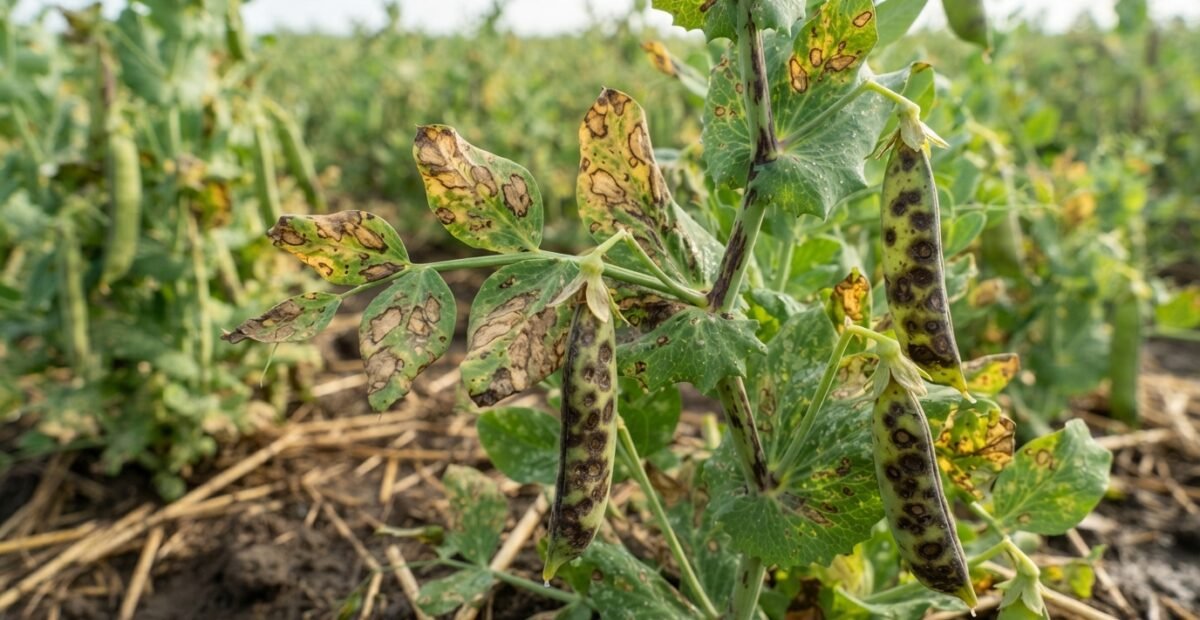
Ascochyta leaf and pod blight of pea
Ascochyta pisi Lib.Ascochyta leaf and pod blight of pea overview
Ascochyta pisi causes a fungal leaf and pod spot disease of garden and field pea in the United States. Symptoms include tan to brown, circular or irregular lesions with dark margins and tiny black pycnidia, plus damaging spots on stems, flowers, and pods. The disease is favored by cool, wet weather, dense canopies, overhead irrigation, infected seed, and short rotations. Accurate diagnosis matters because pea blight is a disease complex and bacterial blight can look similar.
Typical conditions
Overview
Ascochyta pisi causes leaf, stem, flower, and pod lesions on garden pea and field pea. The disease is commonly called Ascochyta leaf and pod blight, Ascochyta blight, or Ascochyta spot. In the United States, especially in the northern Great Plains, pea Ascochyta symptoms may result from a complex that also includes Didymella pinodes and Didymella pinodella. A visible diagnosis can therefore identify the disease pattern without proving that A. pisi is the only species present.
Early disease may be limited to scattered leaf spots, but infections that reach stems, nodes, flowers, or pods can reduce plant vigor, seed quality, and yield. The disease is most important when susceptible pea tissue remains wet during cool to mild weather.
Symptoms and identification
- Leaves develop circular, oval, or irregular tan to brown spots, often with darker brown margins.
- Lesion centers may look papery or gray-tan and contain tiny black pycnidia, visible as pepper-like dots with a hand lens.
- Stems and nodes can develop elongated brown to purplish lesions; severe stem infections may girdle tissue and cause breakage or plant death.
- Pods may show small to large tan, brown, or purplish lesions with dark margins and pycnidia.
- Flowers may become discolored or rot, and infected seed can be shriveled or discolored and may produce weak stands.
Ascochyta lesions are generally not restricted by leaf veins. Bacterial blight more often begins as water-soaked, angular or translucent lesions, while Septoria leaf spot can also produce small dark fruiting bodies; laboratory diagnosis may be needed when the distinction affects management.
Causes and spread
The pathogen can be introduced in infected seed and can survive in infected pea residue. Spores produced in pycnidia are spread mainly by rain splash, irrigation water, and movement through a wet crop canopy. Wind-driven rain, hail, cultivation, handling, and equipment can help move inoculum between plants.
Risk increases when peas are planted repeatedly in the same area, residue remains near the new crop, seed is contaminated, or the canopy stays wet for long periods. Dense stands, poor drainage, excessive weed growth, and overhead irrigation increase the duration of leaf wetness and favor secondary spread.
Life cycle and persistence
Ascochyta pisi survives between crops primarily in infected pea residue and may also be seedborne. Under wet conditions, pycnidia in lesions release conidia. Splashing water moves these spores to nearby leaves, stems, flowers, and pods, where infection occurs during suitable periods of moisture.
New lesions become sources of additional spores, allowing disease to move upward through a dense canopy. Disease development is favored by cool, wet weather; some US extension guidance places the favorable temperature range near 68–82°F, while broader pea disease guidance emphasizes cool conditions from bloom through pod development. Infected residue left close to the soil surface can initiate disease in a following pea crop.
Treatment and control
There is no practical curative treatment that removes the fungus from established lesions. In a home garden, rogue and discard plants with extensive stem, flower, or pod infection when disease is first detected, and remove fallen leaves and pods after harvest. Avoid handling healthy plants immediately after diseased plants, especially when foliage is wet.
For commercial field peas, management decisions should be based on local scouting, weather, crop stage, cultivar susceptibility, and state or regional extension recommendations. Foliar fungicides may be useful in some production systems when applied preventively or at the earliest disease stage, but they cannot reliably restore already damaged tissue. Rotate fungicide modes of action when products are used and follow all resistance-management requirements.
Low-impact and biological control
- Use clean seed, long rotations, sanitation, and residue management as the primary controls.
- Favor open plant spacing, good drainage, and low-humidity cultural conditions rather than trying to suppress disease after the canopy is continuously wet.
- Use drip or carefully directed irrigation and avoid unnecessary sprinkler use.
- Remove isolated infected plants promptly to reduce local spore production.
- Biological products may be marketed for disease suppression, but performance is product- and site-dependent; use only products registered or otherwise legally permitted for the intended crop and follow the label.
Prevention
- Start with certified or pathogen-tested seed from a reputable supplier and avoid saving seed from visibly diseased plants.
- Rotate out of peas for at least four years where practical, particularly after a severe outbreak. Rotation reduces inoculum but does not guarantee exclusion.
- Remove diseased garden plants and heavily infected residue. Do not place infected pea material in a home compost pile unless the pile reliably reaches pathogen-killing temperatures.
- Use raised beds or well-drained soil, adequate row spacing, and weed control to improve airflow and speed drying.
- Water at the soil surface or use drip irrigation; avoid working among peas while foliage is wet.
- Inspect seedlings, leaves, stems, and pods regularly from early growth through pod set, especially after extended rainy periods.
Interesting facts
- The name Ascochyta pisi is often encountered within a broader pea Ascochyta blight complex rather than as the sole field pathogen.
- In North Dakota surveys, multiple pathogens were recovered from Ascochyta-like lesions, illustrating why species-level diagnosis can matter.
- Tiny black pycnidia in a lesion are useful diagnostic clues, but they are not by themselves proof of A. pisi.
- Ascochyta lesions are readily confused with bacterial blight and Septoria leaf spot, which require different management decisions.
Use only fungicides legally authorized for pea and this disease in your state and country. Product registrations, permitted crops, rates, preharvest intervals, applicator requirements, and resistance restrictions change over time; follow the current EPA-approved label exactly. Do not treat an unidentified pea leaf spot solely on the assumption that it is Ascochyta pisi.