 Source:
 Dragon’s Blood Tree (Dracaena cinnabari) short overview
Dragon's Blood Tree is a rare, slow-growing evergreen endemic to Socotra, where its thick trunk and branching crown form a distinctive umbrella adapted to dry, rocky highlands. The species produces red resin, small greenish-white flowers, and orange fruit. In the United States it is primarily a specialty greenhouse or container plant: provide intense light, excellent drainage, restrained watering, and complete protection from frost.
Taxonomic classification
Dragon’s Blood Tree (Dracaena cinnabari) care guide
Light and placement
Give the brightest practical position, ideally several hours of direct sun through a greenhouse, sunroom, or sheltered outdoor exposure. Acclimate gradually when moving from filtered indoor light to strong sun. Weak, stretched growth and sparse leaf clusters suggest insufficient light; bleached patches or sudden scorch indicate an abrupt increase in intense sun or excessive heat at the foliage.
Watering and humidity
Water thoroughly, then allow the mix to dry substantially before watering again. The root zone should never remain saturated. Water somewhat more often during warm active growth, but reduce sharply in winter or during cool, cloudy periods. Good airflow and a dry interval between irrigations are more important than high humidity; avoid misting as a substitute for proper drainage.
Soil and growing medium
Use a very porous, gritty mineral mix with rapid drainage, such as cactus soil amended with pumice, coarse perlite, or fine gravel. Rocky, sandy, or limestone-influenced substrates suit its native ecology. Avoid dense peat-heavy mixes that remain wet. A slightly acidic to slightly alkaline reaction is tolerated, but drainage is more important than precise pH.
Feeding
Feed only during active growth, using a balanced liquid fertilizer diluted to about one-quarter to one-half the label rate every four to six weeks. Do not fertilize newly repotted, drought-stressed, chilled, or dormant plants. Excess fertilizer can accumulate in mineral-poor container media and damage roots, so occasional thorough flushing is useful.
Growth and habit
This is a very slow-growing, long-lived tree with a strongly architectural branching pattern. Branch tips carry the leaf rosettes, and flowering or damage can be associated with later branching. Young specimens remain small for many years, so container culture is practical, but mature plants eventually require substantial vertical and lateral space.
Planting and repotting
Plant or pot up in spring after temperatures are reliably warm. Set the root ball at its original depth and keep the trunk base above any zone that stays wet. In outdoor frost-free climates, allow ample clearance for the eventual crown and use a raised or naturally rocky site. Establish young plants with careful irrigation rather than frequent shallow watering.
Repot only when the root system has filled the container or the mix has degraded. Move up one pot size in spring, disturb the roots as little as practical, and use a heavy container for stability. Do not water immediately if roots were damaged; allow any injuries to dry before resuming a restrained watering schedule.
Propagation and pruning
Propagation
Seed is the preferred practical method. Clean fresh seeds from ripe fruit, sow in a warm, very free-draining medium, and keep evenly but lightly moist rather than wet. Germination may be slow and uneven. Semi-ripe stem cuttings are possible in horticultural guidance but are less certain for preserving the characteristic tree form and may root slowly.
Pruning
Little routine pruning is needed. Remove dead, damaged, or diseased material with sterilized tools and make clean cuts. Avoid topping or repeatedly shortening healthy branches because the plant's value lies in its natural branching architecture. Any cut surface should be kept dry until healed.
Overwintering
Bring containers indoors or into a heated greenhouse before temperatures approach 45°F. Protect completely from frost and cold, wet soil. In winter, provide the strongest available light, keep the plant away from drafts and heaters, and water sparingly only when the mix has dried well.
Uses
Primarily valued as a conservation-significant specimen, architectural container plant, greenhouse subject, and dry-climate landscape feature. It is especially suitable for botanical collections focused on Socotran or island endemics. Do not harvest resin from cultivated or wild plants, and do not treat traditional resin uses as established medical advice.
Appearance
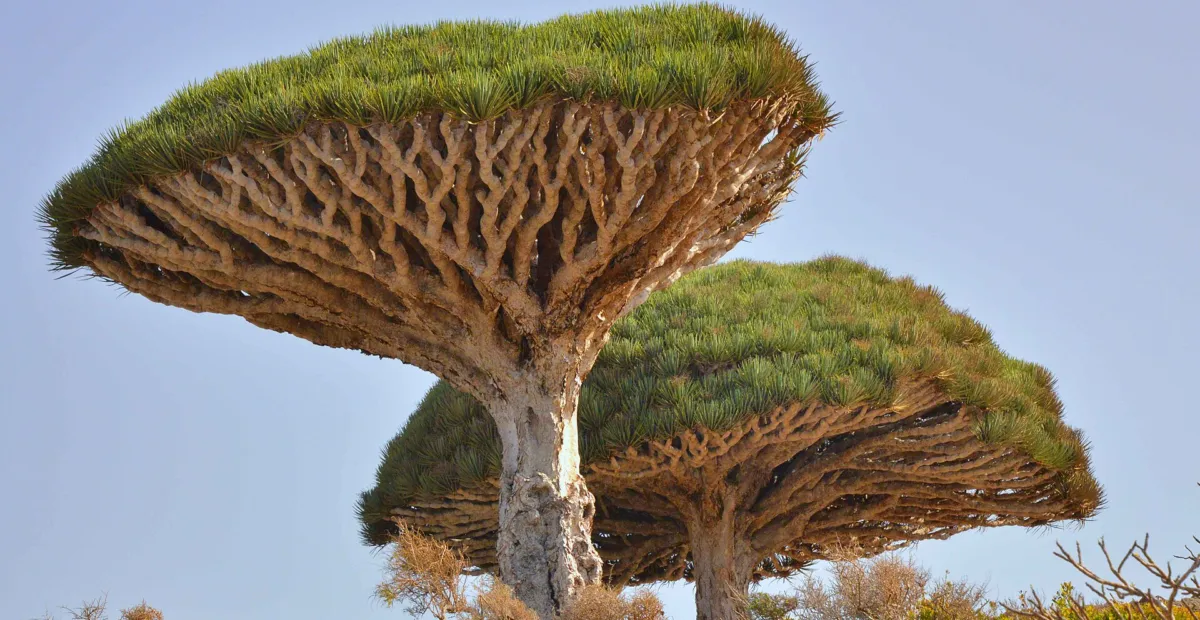
The species forms a thick, stout trunk that divides into stout branches ending in dense rosettes of narrow, stiff, strap-shaped leaves. With age, the branching framework becomes a distinctive rounded or umbrella-like crown. The dark red resin released from wounds is a diagnostic cultural feature, while the overall form distinguishes it from smaller, cane-like indoor Dracaena commonly sold as houseplants.
Flowering
Mature plants produce branched terminal inflorescences with clusters of small greenish-white flowers. Flowering is associated with branch development and is followed by fleshy berries that ripen from green through darker tones to orange. Flowering is uncommon in ordinary indoor collections and is more likely on established plants grown in warm, bright conditions.
Pollination and visitors
Research documents flower visitation by Socotran geckos, which may feed on nectar or pollen and potentially contribute to pollination. Small insects may also visit the flowers, but the relative importance of particular insect groups is not well resolved. Animal visitation evidence is therefore present but limited.
Dracaena cinnabari photos
Click any photo for a larger view. Source, author and license are shown separately.
Diseases and pests
Diseases
Generally low disease pressure when grown in sharply draining media. The main risk is root or stem rot caused by persistent moisture, poor drainage, or watering during cool conditions. Remove affected tissue, replace saturated substrate, improve airflow, and avoid routine irrigation until the mix has dried appropriately.
Pests
Watch for mealybugs, scale insects, thrips, and spider mites, especially under glass. Inspect leaf bases and branch joints regularly. Isolate infested plants, remove light infestations with a cotton swab or water spray, and use horticultural oil or another labeled treatment only according to its product directions. Avoid stressing the plant with excessive irrigation.
Toxicity and pollen
Dracaena species contain saponins and are listed by veterinary poison-control guidance as toxic to dogs and cats. Ingestion can cause vomiting, diarrhea, drooling, depression, weakness, or other gastrointestinal and neurologic signs, with cats potentially showing dilated pupils. Species-specific clinical data for D. cinnabari are limited, so prevent chewing and seek veterinary advice after ingestion.
- Typical season
- No reliable United States airborne-pollen season documented
- Pollination / pollen
- Flower pollen; dispersal and allergenicity not well documented
No dependable species-specific airborne-pollen or allergy studies were identified. The flowers produce pollen, but the extent of wind dispersal and clinical allergy relevance is unknown. During flowering, avoid rubbing the eyes after handling flowers and use ordinary hygiene if sensitive to plant pollen.
Native habitat
The species is restricted to Socotra, Yemen, where it occurs in dry shrubland and desert biomes, especially rocky and limestone-influenced uplands affected by seasonal moisture and fog. Natural populations face regeneration pressures from grazing, aridification, and habitat change. Its container culture should mimic rapid drainage, strong light, and a pronounced dry period.
Interesting fact
Its red resin, known as dragon's blood, gives the species its common name.
The umbrella crown helps shade the trunk and reduce water loss.
Unlike most monocots, Dracaena develops substantial secondary stem growth.
The species is endemic to the Socotra Archipelago.
Established trees can persist for centuries in their native habitat.
Frequently asked questions (FAQ)
The most relevant questions about this plant, with short and direct answers.
🌱Quick care
What is Dracaena cinnabari commonly called?⌄
Dracaena cinnabari is commonly called the Dragon's Blood Tree. It is a rare Socotran tree species in the genus Dracaena and family Asparagaceae.
Is Dracaena cinnabari a succulent?⌄
Dracaena cinnabari is a drought-adapted, tree-forming monocot with a water-storing trunk, although it is not a true succulent in the usual horticultural classification. Its care resembles that of many drought-tolerant container plants.
How fast does Dracaena cinnabari grow?⌄
Dracaena cinnabari is generally very slow-growing, especially in containers or cool indoor conditions. Limited light, low temperatures, transplant stress, and excessive watering can slow it further.
Is Dracaena cinnabari difficult to grow?⌄
Dracaena cinnabari is manageable in a container if it receives strong light, warmth, and sharply drained soil. Its main risks are cold exposure and keeping the roots wet for too long.
🌤️Environment and placement
How much light does Dracaena cinnabari need?⌄
Give Dracaena cinnabari full sun or the brightest light available. Acclimate greenhouse-grown or indoor plants gradually to intense direct sun to reduce the risk of leaf scorch.
Can Dracaena cinnabari grow indoors?⌄
Yes, Dracaena cinnabari can be grown indoors in a bright, warm location, preferably near a sunny south- or west-facing window. A grow light may be needed during dark U.S. winters or in rooms with limited sunlight.
Can Dracaena cinnabari grow outdoors in the United States?⌄
It can grow outdoors year-round only in frost-free parts of the United States, broadly comparable to USDA Zones 10–12. In colder areas, grow it in a container and move it indoors or into a heated, bright greenhouse before cold weather.
What temperature is best for Dracaena cinnabari?⌄
Keep Dracaena cinnabari warm, with active growth favored by typical warm-season temperatures around 65–85°F. Protect it from frost, freezing temperatures, cold drafts, and prolonged cool, wet conditions.
Does Dracaena cinnabari need high humidity?⌄
No, high humidity is not essential because Dracaena cinnabari is adapted to arid conditions. Good airflow and dry periods around the roots are more important than misting or maintaining tropical humidity.
Is Dracaena cinnabari the same plant as Dracaena draco?⌄
No, Dracaena cinnabari and Dracaena draco are different species. D. cinnabari is the Socotra Dragon's Blood Tree, while D. draco is commonly associated with the Canary Islands and nearby Atlantic islands.
💧Care and problems
How often should I water Dracaena cinnabari?⌄
Water Dracaena cinnabari thoroughly, then allow the soil to dry substantially before watering again. The schedule depends on light, temperature, pot size, and soil, so check the mix rather than watering on a fixed weekly timetable.
Should Dracaena cinnabari soil dry out completely?⌄
Allow the mix to become mostly dry between waterings, but do not treat complete, prolonged dehydration as a goal for a small or newly transplanted plant. Resume watering when the root zone is dry and the plant is actively growing.
Why are the leaf tips on my Dracaena cinnabari turning brown?⌄
Brown leaf tips can result from inconsistent watering, root stress, accumulated salts, dry air, physical damage, or normal aging. Check drainage and roots first, and avoid both chronically wet soil and repeated severe drought.
Why is my Dracaena cinnabari losing leaves?⌄
Leaf loss is commonly linked to cold temperatures, sudden changes in light or watering, transplant stress, or root problems. Remove only leaves that are fully dead and correct the environmental stress before increasing water.
How do I know if Dracaena cinnabari has root rot?⌄
Suspect root rot when the plant has soft or dark roots, a worsening decline, foul-smelling soil, or a trunk that becomes soft while the mix remains wet. Remove damaged roots, repot into dry sharply drained medium, and reduce watering.
Does Dracaena cinnabari need fertilizer?⌄
Dracaena cinnabari needs little fertilizer and can often grow with light feeding during warm active growth. Use a dilute, balanced fertilizer sparingly and avoid feeding a stressed, dormant, freshly repotted, or poorly lit plant.
Does Dracaena cinnabari need calcium-rich soil?⌄
There is no reliable general recommendation to spray calcium or add calcium supplements routinely to container-grown Dracaena cinnabari. A stable, well-drained mineral-based mix with a suitable general fertilizer is safer than correcting an unconfirmed deficiency.
🪴Planting and repotting
What soil is best for Dracaena cinnabari?⌄
Use a gritty, rocky, sharply drained mix containing mineral materials such as pumice, lava rock, coarse sand, or grit. The mix should drain quickly while retaining enough moisture for roots to absorb water during active growth.
What type of pot is best for Dracaena cinnabari?⌄
Choose a pot with a drainage hole and a stable base that will not tip as the plant develops. Unglazed clay can help the mix dry faster, while plastic is acceptable if watering is adjusted accordingly.
When should I repot Dracaena cinnabari?⌄
Repot Dracaena cinnabari when roots fill the container, drainage declines, or the potting mix has broken down, preferably during warm active growth. Move it into a slightly larger pot rather than an oversized container that stays wet.
Can Dracaena cinnabari be planted in the ground?⌄
It can be planted in the ground only where frost is absent and the soil drains exceptionally well. In most of the United States, container culture is safer because the plant must be protected from winter cold and excessive rain.
✂️Propagation and pruning
How is Dracaena cinnabari propagated?⌄
Dracaena cinnabari is primarily propagated from seed, although specialized growers may use other vegetative methods. Seed availability can be limited, germination may be inconsistent, and seedlings develop slowly.
Can Dracaena cinnabari be grown from cuttings?⌄
Cuttings may be possible, but reliable species-specific guidance is limited compared with seed propagation. Because the plant is rare and slow-growing, use only legally sourced material and expect rooting to require warmth, patience, and excellent drainage.
Can I prune Dracaena cinnabari?⌄
Prune Dracaena cinnabari only to remove dead, damaged, or diseased growth or to correct a serious structural problem. Avoid unnecessary cuts because the plant grows slowly and major pruning can permanently alter its form.
⚠️Toxicity and safety
Is Dracaena cinnabari toxic to dogs?⌄
Yes, Dracaena cinnabari should be treated as moderately toxic to dogs if chewed or eaten. Ingestion may cause gastrointestinal upset or weakness, so keep it away from dogs that chew plants and contact a veterinarian if ingestion occurs.
Is Dracaena cinnabari toxic to cats?⌄
Yes, Dracaena cinnabari should be treated as moderately toxic to cats if eaten. Keep it inaccessible to cats, and contact a veterinarian or animal poison-control service if a cat chews the plant or develops symptoms.
Is Dracaena cinnabari poisonous to people?⌄
Avoid eating Dracaena cinnabari because the plant contains compounds associated with irritation or toxicity in Dracaena species. Wear gloves when handling sap if you have sensitive skin, and keep plant material away from children.
🌸Flowering and special interest
Does Dracaena cinnabari flower?⌄
Yes, mature Dracaena cinnabari can produce branched clusters of small, fragrant flowers. Container-grown and juvenile plants may take many years to reach flowering size, and indoor flowering is uncommon.
How long does it take Dracaena cinnabari to mature?⌄
Dracaena cinnabari matures very slowly and may require decades to develop its characteristic broad, umbrella-like crown. A container plant grown in the United States is unlikely to reach the scale of a mature wild tree.
Why is Dracaena cinnabari called the Dragon's Blood Tree?⌄
The name refers to the reddish resin traditionally obtained from cuts in the trunk and branches. Resin production and tree harvesting should not be attempted on a young cultivated plant, especially because the species is rare and slow-growing.