
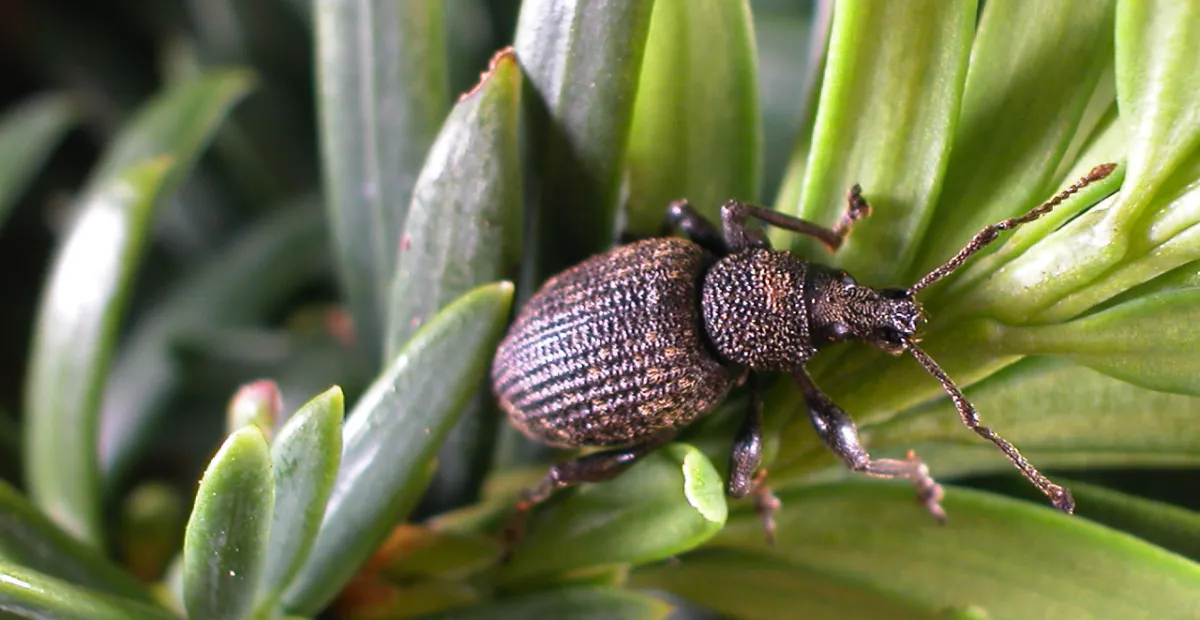
Black Vine Weevil
Otiorhynchus sulcatusBlack Vine Weevil overview
Black vine weevil is a flightless, night-active root weevil that attacks many ornamental plants, nursery crops, berries and some vines in the United States. Adults leave scalloped notches along leaf margins, but the more serious injury is usually caused by legless larvae feeding on roots and crowns underground. Infested container plants may decline or die after transplanting.
Typical conditions
Overview
Black vine weevil is an introduced North American pest with a broad but uneven host range. It is particularly important on rhododendron and azalea, yew, euonymus, Japanese holly, hemlock, strawberries, caneberries, grapes and many herbaceous ornamentals. Adults are slate-gray to black, flightless beetles about 9–13 mm long, with a short snout, elbowed antennae and pale flecks or scales on the wing covers.
Adult feeding is conspicuous but often relatively tolerable on established plants. Larvae feed below ground and can sever feeder roots, girdle larger roots or damage the crown, causing poor growth, wilting and plant death. A diagnosis should be confirmed where possible because several other root-weevil species produce similar symptoms.
Symptoms and identification
Adults feed primarily at night and make U-shaped or scalloped notches along leaf and sometimes flower margins. On yew and other narrow-leaved plants, needle edges may be clipped or irregularly removed. Buds and young shoot tips can also be damaged when adults emerge during active spring growth.
Larval injury is often less visible at first. Plants may show reduced vigor, yellowing, wilting despite adequate moisture, poor establishment after planting or sudden collapse. Inspection of the root ball or crown may reveal white, legless, C-shaped grubs with brown heads, chewed roots, crown feeding and detached bark. Root injury can intensify problems caused by root-rot pathogens.
Causes and spread
Black vine weevils are commonly introduced or moved in infested container plants, root balls, potting media, soil, plant debris and nursery stock. Adults cannot fly, but they walk from nearby infested plants and unmanaged vegetation. During daylight they shelter in leaf litter, mulch, dense foliage, under containers and around the soil surface; at night they climb onto host plants to feed.
Because adults are usually female and can reproduce without mating, a small introduced population can expand rapidly. Eggs are deposited in soil near host crowns after several weeks of adult feeding. Broad host range, hidden soil-dwelling larvae and movement of infested nursery material make detection and prevention important.
Life cycle and persistence
The pest passes through egg, larva, pupa and adult stages and generally completes one generation per year in the United States, although timing varies by climate and production system. Most individuals overwinter as late-instar larvae or prepupae in soil; some adults may overwinter in protected locations.
Adults commonly emerge from late spring into early summer, with emergence often occurring from late May through June in Pennsylvania and comparable northern regions. They feed at night for roughly 3–4 weeks before females begin laying eggs, and a female may lay up to about 500 eggs over several weeks. Eggs hatch in approximately 10–14 days. Larvae feed on roots through summer, fall and often the following spring, then pupate in the soil before adult emergence.
Treatment and control
Begin with confirmation and targeted scouting. After dark, place a light-colored sheet beneath affected plants, gently shake branches or containers, and hand-pick or crush adults. Repeat on several nights because adults hide during the day and may drop quickly when disturbed.
For declining container plants or nursery stock, remove the root ball from its container and inspect the outer root zone and crown. Where larvae are found, isolate the plant, remove and dispose of heavily infested media according to local rules, and clean or discard contaminated containers. Protect replacement plants from contact with infested soil or stock.
In commercial production, control decisions should be based on crop-specific scouting and the stage present. Foliar measures, when justified, are generally directed at adults before substantial egg laying; soil or media treatments must be selected for the larval stage and applied only where the product label permits that crop, site and use.
Low-impact and biological control
Entomopathogenic nematodes can suppress black vine weevil larvae in containers, nursery media and soil. Products or programs may involve species such as Heterorhabditis bacteriophora, Heterorhabditis megidis, Steinernema kraussei or other labeled species, but performance depends strongly on nematode species, larval size, temperature, moisture, media structure and application quality.
Apply biological nematodes only according to the product directions. Keep the treated root zone adequately moist, protect nematodes from drying and direct sunlight, and verify that the temperature range is appropriate. Late summer or early fall applications are commonly used in systems where larvae are present, but local timing should be based on scouting and the product label. Hand-picking adults, sanitation, clean stock and isolation remain important because biological controls may not eliminate the pest.
Prevention
- Buy plants from reputable sources and inspect root balls, crowns and potting media for white, legless grubs before planting.
- Quarantine or isolate new container plants and monitor them for marginal leaf notching and adult weevils before placing them near established plantings.
- Remove excessive leaf litter, weeds, fallen plant debris and loose mulch from around susceptible crowns and containers, while maintaining appropriate soil moisture for the crop.
- Use raised benches or clean container surfaces in nursery production, and avoid placing clean stock directly on infested soil.
- Choose less susceptible cultivars where reliable local information is available, particularly when establishing rhododendron or azalea plantings.
- Scout from spring through early fall: inspect leaf margins, examine sheltered areas after dark and periodically check roots of declining plants.
Interesting facts
- Adult black vine weevils are flightless, so long-distance spread is strongly associated with movement of infested plants, soil or growing media.
- The most damaging stage is often the larva, even though the adult’s leaf notching is easier to notice.
- Nearly all adults are female, and reproduction can occur without mating.
- A single female may lay several hundred eggs, helping explain why small infestations can become persistent.
- Black vine weevil is frequently confused with the smaller strawberry root weevil, Otiorhynchus ovatus; adult size and specialist identification may be needed for confirmation.
Use insecticides only when monitoring shows a justified need and only products legally authorized for black vine weevil on the specific crop, site and use in the United States. Follow the current EPA-approved label exactly, including rate, timing, personal protective equipment, re-entry and preharvest intervals. Do not apply a product to edible crops, pollinator-attractive plants, soil or containers unless that use is specifically labeled. Avoid treating open flowers or exposing pollinators, and consult your state extension service or pesticide regulatory agency for current local options.
Affected plants
The plants below are linked to this problem by structured host-plant data. The list updates automatically as new plant profiles are added.
 Wild Rosemary (Andromeda polifolia) care guideAndromeda polifolia
 Polka Dot Begonia (Begonia maculata) care guideBegonia maculata
 Astilbe ‘Rheinland’Astilbe 'Rheinland'
 False goatsbeard (Astilbe × arendsii ‘Fanal’)Astilbe × arendsii 'Fanal'
 Begonia ‘Escargot’Begonia 'Escargot'
 Begonia ‘Gryphon’Begonia 'Gryphon'
 Begonia ‘Lucerna’Begonia 'Lucerna'
 Tuberous begonia (Begonia boliviensis) care guideBegonia boliviensis
 Iron Cross Begonia (Begonia masoniana) care guideBegonia masoniana
 White heartleaf bergenia (Bergenia ‘Bressingham White’)Bergenia 'Bressingham White'
 Bergenia ‘Silberlicht’Bergenia 'Silberlicht'
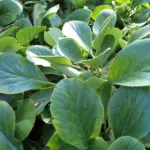 Bergenia stracheyi care guideBergenia stracheyi