
 Source:
 White heartleaf bergenia (Bergenia ‘Bressingham White’) short overview
Bergenia 'Bressingham White' is an evergreen, clump-forming perennial grown for its glossy, rounded leaves and upright spring racemes of exceptionally clear white flowers. The compact clumps suit borders, woodland-style plantings, wildlife gardens, containers, and durable ground-cover schemes. Give it full sun to partial shade, consistent moisture, and soil that drains well without becoming excessively dry. It is notably cold hardy and generally low maintenance once established.
Taxonomic classification
White heartleaf bergenia (Bergenia ‘Bressingham White’) care guide
Light and placement
Grow in full sun to partial shade. In cooler climates, open sun encourages the best flowering; in hot areas, provide morning sun or afternoon shade to protect evergreen leaves. Excessive shade can reduce bloom and produce looser growth, while harsh reflected heat and drought can scorch foliage.
Watering and humidity
Water deeply when the upper soil begins to dry, keeping the root zone consistently moist during establishment and active growth. Reduce frequency in cool or wet weather, but do not allow prolonged drought. Containers usually need more frequent checks. Good drainage is essential because saturated crowns can decline.
Soil and growing medium
Plant in loam, clay, sand, or humus-rich soil that holds moisture while draining excess water. Bergenias tolerate acidic, neutral, and alkaline conditions, but stagnant winter wet and extreme drought should be avoided. Improve heavy or poor soil with organic matter while preserving open drainage around the rhizomes.
Feeding
In spring, apply a thin layer of compost or a balanced slow-release perennial fertilizer according to the product label. Feed lightly rather than heavily; excessive nitrogen can produce lush foliage with weaker flowering. Do not fertilize drought-stressed, newly divided, or dormant plants until active growth resumes.
Growth and habit
Forms a dense, spreading clump from short rhizomes and remains evergreen in suitable climates. It is generally steady rather than fast, with mature plants becoming broader over time. Divide congested clumps when flowering declines in the center or when the planting exceeds its allotted space.
Planting and repotting
Plant in spring or early fall, setting the crown at soil level and spacing plants about 12–18 inches apart for a continuous cover. Water regularly during the establishment season. In hot regions, afternoon shade helps preserve foliage and reduces stress, while brighter exposure generally encourages heavier flowering.
Repot container plants in spring or early fall when the clump fills the pot. Move into a slightly larger container with a moisture-retentive but well-drained multipurpose potting mix. Keep the rhizome crown at the same level rather than burying it deeply, and water thoroughly after transplanting.
Propagation and pruning
Propagation
Divide established clumps or use sections of rhizome in spring or fall. Replant divisions promptly with the crown at soil level and keep them evenly moist while roots re-establish. Division is the most practical method for preserving the cultivar's characteristics.
Pruning
Remove faded flower stems after bloom to keep the clump tidy and reduce the chance of weak, untidy stalks. Remove damaged or winter-burned leaves in spring after new growth makes living tissue clear. Avoid cutting healthy evergreen foliage unnecessarily.
Overwintering
Plants are generally hardy outdoors in cold climates, especially when established in well-drained soil. Leave healthy evergreen foliage in place through winter, mulch lightly after the ground cools, and remove winter-damaged leaves in spring. Protect early flower stems from late frosts when practical.
Uses
Use it as an evergreen ground cover, edging plant, border perennial, woodland accent, container specimen, or wildlife-garden plant. Its dense foliage can help cover soil on slopes and under open trees. It is ornamental rather than a recommended food or medicinal plant.
Appearance
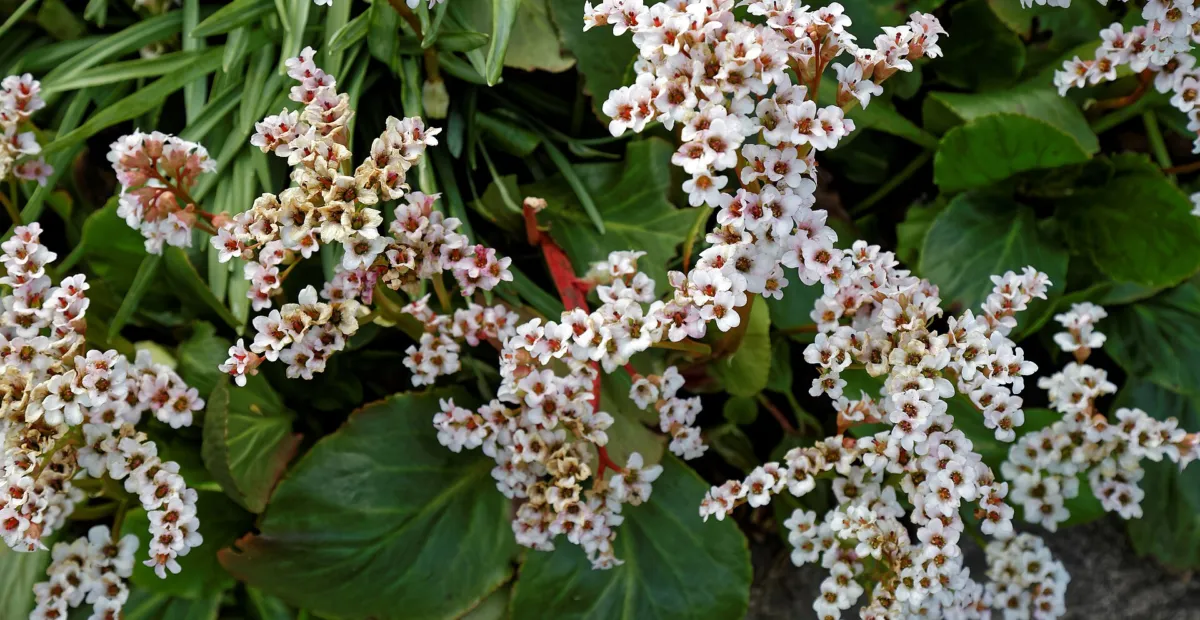
The plant forms a low mound of thick, rounded, leathery evergreen leaves with a glossy surface. Reddish flower stems rise above the foliage in spring. The combination of persistent rounded leaves, clumping rhizomatous growth, and clear white racemes is distinctive for this cultivar.
Flowering
Upright reddish flower stems rise above the foliage in spring, carrying plentiful erect racemes of bell-shaped flowers. Buds can be very pale pink before opening white. In the United States, bloom is typically reported from April through June, with timing varying by climate; late frosts can damage early flower stems.
Pollination and visitors
The white spring flowers are documented as attracting butterflies and are suitable for insect-oriented wildlife plantings. No single pollinator species is sufficiently documented for this exact cultivar to assign a species-level Latin name.
Bergenia 'Bressingham White' photos
Click any photo for a larger view. Source, author and license are shown separately.
Diseases and pests
Diseases
Leaf spot can occur, especially where foliage remains crowded and damp. Remove affected leaves, improve air circulation, avoid overhead watering, and clear fallen foliage. Avoid routinely wetting the crown or keeping containers waterlogged.
Pests
Watch for vine weevil, slugs, and snails. Inspect foliage and crowns regularly, remove hiding places, hand-pick slugs and snails where practical, and use labeled controls only when damage is persistent. Avoid excessive nitrogen, which can encourage soft, crowded growth.
Toxicity and pollen
No authoritative evidence located in the reviewed sources establishes significant toxicity for this exact cultivar. As with any ornamental plant, avoid deliberate ingestion, supervise young children, and seek medical or veterinary advice if a substantial amount is eaten or irritation develops.
- Typical season
- Spring during flowering
- Pollination / pollen
- Insect-borne flower pollen
This is an insect-pollinated flowering perennial, so pollen is generally released within or near the flowers rather than dispersed broadly by wind. A low airborne-allergy classification is a cautious practical assessment, not evidence of zero risk for unusually sensitive individuals.
Native habitat
Bergenia is a garden genus originating in temperate parts of Asia, including mountainous and woodland environments. The plants favor moisture-retentive soils, seasonal cool conditions, and sites ranging from open sun to woodland shade. This cultivar is a garden selection rather than a wild native population.
Interesting fact
It was bred by British horticulturist and plant breeder Alan Bloom.
The cultivar received the RHS Award of Garden Merit.
Very pale pink buds open into clear white flowers.
Its evergreen leaves remain ornamental outside the bloom period.
It is rhizomatous and expands into dense clumps.
Frequently asked questions (FAQ)
The most relevant questions about this plant, with short and direct answers.
🌱Quick care
What is Bergenia 'Bressingham White'?⌄
Bergenia 'Bressingham White' is an evergreen, clump-forming perennial grown for rounded green leaves and upright clusters of white spring flowers. It belongs to the Saxifragaceae family and slowly spreads as a durable ground cover.
How big does Bergenia 'Bressingham White' get?⌄
Bergenia 'Bressingham White' typically reaches about 12 to 18 inches tall and 18 to 24 inches wide at maturity. Flower stems rise above the foliage during the spring bloom period.
Is Bergenia 'Bressingham White' evergreen?⌄
Yes, Bergenia 'Bressingham White' is generally evergreen in suitable climates. Leaves may become damaged or discolored by severe winter weather, but healthy plants usually retain foliage year-round.
Is Bergenia 'Bressingham White' easy to grow?⌄
Yes, Bergenia 'Bressingham White' is considered an easy-care perennial once established. It tolerates a range of soils and light conditions, but performs best with moisture that is consistent without remaining waterlogged.
🌤️Environment and placement
Does Bergenia 'Bressingham White' grow in full sun or shade?⌄
Bergenia 'Bressingham White' grows in full sun to partial shade. In hot climates, morning sun or light afternoon shade can help prevent drought stress and leaf scorch.
Can Bergenia 'Bressingham White' grow in deep shade?⌄
Bergenia 'Bressingham White' can survive in fairly shady locations, but deep shade may reduce flowering and produce less vigorous growth. Bright, filtered light or partial shade is usually a better choice.
What soil is best for Bergenia 'Bressingham White'?⌄
Plant Bergenia 'Bressingham White' in moist but well-drained loam, clay, sand, or humus-rich soil. Adding compost improves poor soil, but avoid sites that stay saturated because persistent wetness can cause rhizome or root problems.
How much water does Bergenia 'Bressingham White' need?⌄
Bergenia 'Bressingham White' prefers moderate, consistent moisture, especially during its first growing season and during hot, dry weather. Once established it can tolerate some drought, but prolonged dryness may reduce vigor and flowering.
Can Bergenia 'Bressingham White' grow under trees?⌄
Yes, Bergenia 'Bressingham White' can grow beneath trees if it receives enough filtered light and is not forced to compete with dense tree roots for moisture. Water newly planted specimens carefully while they establish.
Is Bergenia 'Bressingham White' cold hardy?⌄
Yes, Bergenia 'Bressingham White' is cold hardy and suitable for many temperate U.S. gardens. In colder regions, exposed foliage and early flower stems may suffer winter or frost damage even when the plant survives.
Is Bergenia 'Bressingham White' drought tolerant?⌄
Established Bergenia 'Bressingham White' has some drought tolerance, particularly in partial shade and moisture-retentive soil. It should not be treated as drought-proof, especially during prolonged heat or while newly planted.
Is Bergenia 'Bressingham White' a good ground cover?⌄
Yes, Bergenia 'Bressingham White' makes a useful evergreen ground cover for borders, woodland edges, slopes, and mass plantings. It spreads slowly by rhizomes and is generally well behaved rather than aggressively invasive.
💧Care and problems
How often should I water Bergenia 'Bressingham White'?⌄
Water when the soil surface begins to dry, providing a thorough soaking rather than frequent light sprinkling. Increase watering during hot, dry periods and reduce it in cool weather or naturally moist soil.
Why are Bergenia 'Bressingham White' leaves turning brown?⌄
Brown leaves on Bergenia 'Bressingham White' can result from drought, winter injury, excessive sun, or salt and heat stress. Check soil moisture and exposure, then remove badly damaged leaves after new growth makes the extent of injury clear.
Why is my Bergenia 'Bressingham White' not flowering?⌄
Bergenia 'Bressingham White' may fail to flower because of deep shade, drought stress, overcrowding, or insufficient establishment time. Move or divide the plant only if necessary, and provide bright light with steady moisture.
What pests affect Bergenia 'Bressingham White'?⌄
Slugs and snails may chew Bergenia 'Bressingham White' leaves, while vine weevil can damage roots or rhizomes in some settings. Inspect plants at night for feeding damage and check container-grown plants for declining roots.
What diseases affect Bergenia 'Bressingham White'?⌄
Bergenia 'Bressingham White' can be susceptible to leaf spot, particularly where foliage stays wet and air circulation is poor. Remove affected leaves, avoid overhead watering, and improve spacing and airflow.
Should Bergenia 'Bressingham White' be fertilized?⌄
Bergenia 'Bressingham White' usually needs little fertilizer when grown in reasonably fertile soil. A thin spring layer of compost or a balanced slow-release perennial fertilizer is generally sufficient; excessive nitrogen can produce foliage at the expense of flowers.
Should I mulch Bergenia 'Bressingham White'?⌄
Yes, apply a thin layer of compost or organic mulch around Bergenia 'Bressingham White' to conserve moisture and improve soil. Keep mulch away from the crown and avoid creating constantly wet conditions.
🪴Planting and repotting
When is the best time to plant Bergenia 'Bressingham White'?⌄
Plant Bergenia 'Bressingham White' in spring or fall when temperatures are moderate and soil moisture is dependable. Fall planting allows root establishment before summer, while spring planting is useful in colder areas.
How far apart should Bergenia 'Bressingham White' be planted?⌄
Space Bergenia 'Bressingham White' about 18 to 24 inches apart for a ground-cover planting. Use wider spacing for individual specimens and closer spacing only when quicker coverage is more important than immediate airflow.
How do I plant Bergenia 'Bressingham White' in the ground?⌄
Plant Bergenia 'Bressingham White' with the crown at soil level, spreading the roots through loosened soil and watering thoroughly afterward. Add compost if the soil is poor, but do not bury the central crown or rhizomes deeply.
Can Bergenia 'Bressingham White' grow in containers?⌄
Yes, Bergenia 'Bressingham White' grows well in a container with drainage holes and a moisture-retentive but well-drained potting mix. Containers dry and freeze faster than garden soil, so monitor watering and provide added winter protection in cold regions.
Can Bergenia 'Bressingham White' grow in clay soil?⌄
Yes, Bergenia 'Bressingham White' can grow in clay soil if drainage is adequate. Incorporate organic matter and plant slightly high or on a gentle mound where water tends to collect.
✂️Propagation and pruning
How do I propagate Bergenia 'Bressingham White'?⌄
The most reliable way to propagate Bergenia 'Bressingham White' is by dividing established clumps or rooting sections of rhizome. Division is best performed in early spring or fall, with each section retaining healthy roots and growing points.
When should Bergenia 'Bressingham White' be divided?⌄
Divide Bergenia 'Bressingham White' in early spring or fall, preferably when the weather is cool and soil moisture is reliable. Division is useful when clumps become crowded or flowering declines.
Can Bergenia 'Bressingham White' be grown from seed?⌄
Bergenia can be grown from seed, but seed propagation is slower and may not reproduce the exact characteristics of the named cultivar. Division or rhizome cuttings are preferred when you want plants identical to Bergenia 'Bressingham White'.
How do I prune Bergenia 'Bressingham White'?⌄
Prune Bergenia 'Bressingham White' by removing spent flower stems after flowering and cutting away damaged or unattractive leaves as needed. In cold climates, wait until spring to remove winter-damaged foliage so living tissue can be identified.
⚠️Toxicity and safety
Is Bergenia 'Bressingham White' poisonous to dogs or cats?⌄
No significant toxicity is documented for Bergenia 'Bressingham White', but ingestion is not recommended. Prevent pets from consuming large quantities and contact a veterinarian if a pet shows symptoms after eating the plant.
Is Bergenia 'Bressingham White' safe for children?⌄
Bergenia 'Bressingham White' has no significant toxicity documented, but it should not be eaten. Supervise children around garden plants and seek medical advice if a large amount is swallowed or symptoms develop.
🌸Flowering and special interest
When does Bergenia 'Bressingham White' bloom?⌄
Bergenia 'Bressingham White' usually blooms in spring, often from late winter into mid-spring depending on the local climate. Frost can damage early flower stems, especially in exposed locations.
What color are Bergenia 'Bressingham White' flowers?⌄
Bergenia 'Bressingham White' produces plentiful white flowers on upright stems. New or younger flowers may show a slight pink flush before developing a clearer white appearance.
How can I encourage more flowers on Bergenia 'Bressingham White'?⌄
To encourage flowering, grow Bergenia 'Bressingham White' in full sun or bright partial shade and keep the soil evenly moist during active growth. Divide severely crowded clumps and avoid excessive nitrogen fertilizer.
Are Bergenia 'Bressingham White' flowers good for pollinators?⌄
Yes, Bergenia flowers can provide an early-season nectar source for bees and other pollinating insects. Its spring bloom is especially useful when relatively few other garden plants are flowering.
Similar plants
 Yellow lantern chili (Capsicum chinense) care guideCapsicum chinense
 Capsicum baccatum care guideCapsicum baccatum
 Serrano (Capsicum annuum ‘Serrano’)Capsicum annuum 'Serrano'
 Purple Beauty (Capsicum annuum ‘Purple Beauty’)Capsicum annuum 'Purple Beauty'
 Numex Twilight (Capsicum annuum ‘Numex Twilight’)Capsicum annuum 'Numex Twilight'
 Explosive Ember Chili Pepper (Capsicum annuum ‘Explosive Ember’)Capsicum annuum 'Explosive Ember'