
South American palm borer
Paysandisia archon (Burmeister)South American palm borer overview
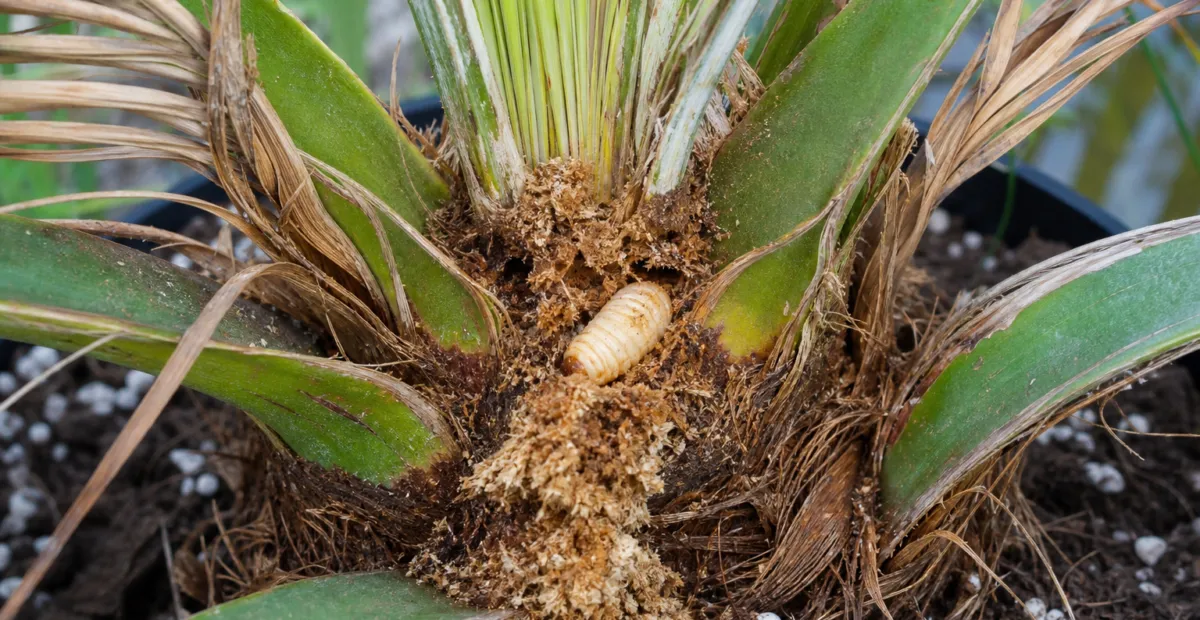
South American palm borer (Paysandisia archon) is a large day-flying moth whose larvae spend most of their development concealed inside palms. They tunnel through crowns, young leaves and trunks, producing sawdust-like frass, rows of holes, distorted growth and eventual crown dieback. In the United States, any suspected detection should be documented and reported promptly because USDA APHIS lists this insect as a pest of concern.
Typical conditions
Overview
South American palm borer is native to northeastern Argentina, Uruguay, Paraguay and southern Brazil and has become an important ornamental-palm pest in parts of southern Europe. USDA APHIS lists it among animal and plant pests of concern. The species is not established broadly in the United States based on the sources reviewed, so a suspected finding should be treated as a potential regulatory detection rather than assumed to be a routine landscape pest.
All reliably documented hosts are palms in the family Arecaceae. Larvae are mostly endophagous: after hatching, they enter palm tissue and feed in galleries near the crown, young leaves, rachises or trunk. Because external symptoms may be delayed, healthy-looking nursery palms can still carry larvae.
Symptoms and identification
Early symptoms may be subtle. Inspect palms for:
- sawdust-like frass or fibrous boring debris in the crown, at leaf bases or on the trunk;
- rows of holes, notches or perforations in emerging or expanding fronds;
- chewed young leaves that emerge shredded, asymmetric or with repeated holes;
- abnormal development, twisting or deformation of the crown and spear leaves;
- weak, shortened or abnormally angled new growth;
- gallery openings, larval tunnels or concealed cocoons made from palm fibers;
- progressive drying of central leaves, crown dieback and, in severe cases, palm death.
Symptoms are not diagnostic by themselves. Damage can resemble red palm weevil and other borers, and internal galleries may require careful crown examination or destructive sampling for confirmation.
Causes and spread
Long-distance spread is primarily associated with movement of infested palms and planting material containing concealed larvae, pupae or cocoons. Local spread can occur when adult moths fly to nearby palms and lay eggs in crown fibers. Moving infested trunks, pruned material, palm crowns or unprocessed debris can also transport immature stages.
Risk is increased when palms are purchased from unknown sources, held without quarantine, planted densely, or traded without close inspection of the crown, leaf bases and trunk. In the United States, suspected detections should be reported to the state plant-health authority or USDA APHIS before transporting the plant or pest.
Life cycle and persistence
Adults are strong, diurnal moths that fly mainly in hot, sunny weather. In the introduced European range, adult activity generally begins in mid-May, peaks in June and July, and declines by late September; seasonal timing in the United States would depend on local climate and should not be assumed to match Europe.
Females lay rice-shaped eggs singly or in small numbers among fibers near the palm crown or where leaves meet the trunk. Eggs hatch in approximately 12–21 days, depending on temperature. Newly hatched larvae quickly bore into the host. The larval stage normally includes about nine instars and lasts roughly 10.5–18.5 months, producing either an approximately one-year or two-year cycle. Larvae overwinter inside the palm.
Mature larvae construct stout cocoons from palm fibers and silk near the trunk, crown or leaf bases. Pupation may last about 35–68 days, after which adults emerge and the cycle repeats. Adults do not normally feed, so larval damage—not adult feeding—is responsible for plant injury.
Treatment and control
Begin with confirmation and containment. If a palm is heavily infested, declining, or confirmed by regulatory or diagnostic personnel, prompt removal and destruction is often the most reliable way to eliminate larvae and prevent emergence. Chipping or other disposal must be performed in a manner that destroys internal stages; do not transport intact infested material.
Palms with early or limited infestations may sometimes be managed by a qualified arborist or licensed pesticide applicator using a legally labeled treatment directed at the crown or trunk. Because larvae are protected inside plant tissue, coverage, timing and application method are critical, and rescue is not guaranteed. Reinspect treated palms for new frass, perforated emerging leaves and continued crown decline. Coordinate any suspected U.S. detection with state and federal plant-health officials.
Low-impact and biological control
Organic and nonchemical measures are most useful when combined with early detection:
- Isolate suspect palms and stop moving them, cut fronds, mulch, logs or crown debris from the site.
- Remove and destroy heavily infested palms by cutting, chipping or other methods that reliably kill larvae and cocoons; do not compost infested material.
- Where feasible, inspect and manually remove accessible cocoons, frass and damaged tissues without injuring the growing point.
- Use physical crown netting or exclusion barriers during the local adult flight period where the palm structure allows a tight, durable barrier.
- Consider entomopathogenic nematodes or fungi only as properly selected, legally permitted biological-control products and only when label directions, palm access and moisture requirements can be met. Evidence and field performance are still variable.
- Protect beneficial insects and avoid broad, unnecessary applications that can disrupt biological control.
Prevention
Buy palms from reputable suppliers that can document pest-free production and inspect every incoming plant before installation. Pay particular attention to crown fibers, leaf bases, spear leaves, trunk cavities and any fresh sawdust.
- Quarantine new palms when practical and monitor them through at least one warm growing season.
- Record the source, date received and location of each palm so suspect plants can be traced quickly.
- Do not move suspect palms, offsets, cut trunks or crown debris.
- Prune conservatively; avoid creating unnecessary wounds and sanitize tools between palms.
- During warm weather, inspect new growth frequently for rows of holes, frass and abnormal spear development.
- Report suspected South American palm borer to the state department of agriculture or USDA APHIS for guidance before disposal or shipment.
Interesting facts
- The species is a moth, not a true butterfly, despite its conspicuous day-flying adult appearance.
- Adults are active by day and are not reliably monitored with ordinary nighttime light traps.
- Most of the insect’s life is spent hidden inside the palm, which explains why infestations can spread unnoticed in nursery stock.
- Females may lay up to about 140 eggs, although the number laid under natural conditions is variable.
- In its native range, the insect is not generally reported as causing the same level of ornamental-palm damage seen in parts of Europe.
Use only insecticide products legally authorized for South American palm borer on the specific palm crop and application site in the United States, and follow the current product label exactly. Do not assume that products reported from Europe or older literature are legal, effective or suitable for U.S. landscapes. Treatment decisions should be made with a licensed applicator, state pesticide regulator or local extension specialist, especially for tree injection or work near people, pollinators and water.