
 Source:
Coccothrinax argentata short overview
Coccothrinax argentata is a slow-growing, solitary palm native to South Florida, the Florida Keys, the Bahamas, and parts of the Caribbean and nearby tropical Americas. Its deeply divided fan leaves are blue-green above and strikingly silver beneath, creating a bright architectural effect in warm landscapes. White flowers emerge among the leaves, followed by small purple-black fruits. Give it strong light, sharply drained soil, modest irrigation, and protection from freezing weather.
Taxonomic classification
Coccothrinax argentata care guide
Light and placement
Provide full sun for the strongest crown and best silver-leaf contrast, with light shade tolerated, especially during establishment or in very hot sites. South or southeast exposure is suitable where winter protection is needed. Too little light produces a weaker, more open crown; severe reflected heat combined with drought can scorch leaflets.
Watering and humidity
Water deeply and infrequently once established, allowing the upper soil to dry between irrigations. During the first year, irrigate more regularly while roots spread, then reduce watering in cooler or rainy periods. Avoid chronic saturation. Humidity is usually adequate outdoors in its native climate, but container plants should still have rapid drainage.
Soil and growing medium
Use sharply draining sandy, rocky, or loamy soil. The species tolerates acidic through alkaline conditions, including calcareous soils, but persistent saturation can damage roots. In containers, use a coarse palm mix amended with mineral material rather than dense, water-retentive potting soil.
Feeding
Feed in spring and summer with a controlled-release palm fertilizer containing potassium and magnesium, following the product label. A light compost top-dressing is suitable in the ground. Do not fertilize drought-stressed, newly frozen, or actively declining plants; water first and wait for renewed growth.
Growth and habit
This is a very slow-growing, usually single-trunked palm with an upright open crown. It may occasionally develop more than one stem. Slow establishment rewards careful siting and minimal root disturbance; routine pruning is limited once the palm is established.
Planting and repotting
Plant in spring or early summer once the soil is warm. Set the root ball at the original soil level, water deeply during establishment, and allow generous drainage. Leave about 6 to 8 feet between specimens where a full crown is desired; tighter spacing is possible for a managed group planting.
Repot only when roots have substantially filled the container, preferably during warm weather. Disturb the root ball as little as possible, use a very free-draining palm mix, and avoid burying the stem deeper than it was previously planted.
Propagation and pruning
Propagation
Propagate by fresh seed. Clean the fleshy fruit, sow promptly in a warm, very well-drained medium, and keep evenly moist but never saturated. Germination and juvenile growth are slow, so use deep containers and avoid unnecessary root disturbance.
Pruning
Little pruning is needed. Remove only dead, broken, or clearly diseased leaves and spent inflorescences, cutting close without injuring the trunk. Do not strip green fronds or climb the palm with spikes.
Overwintering
Protect from freezes with a sheltered microclimate, frost cloth, and dry root conditions. Container specimens can be moved under bright cover before cold events. Do not keep the palm in a dark heated room for extended periods; give it bright light and reduce watering during cool weather.
Uses
Use as a specimen, accent, patio or container palm, coastal planting, median or parking-lot landscape plant, and native habitat restoration subject in suitable South Florida settings. Its salt tolerance and drought tolerance are useful near the coast. Do not promote the reported edible palm heart as a routine food use because it is uncommon and harvesting can kill the palm.
Appearance
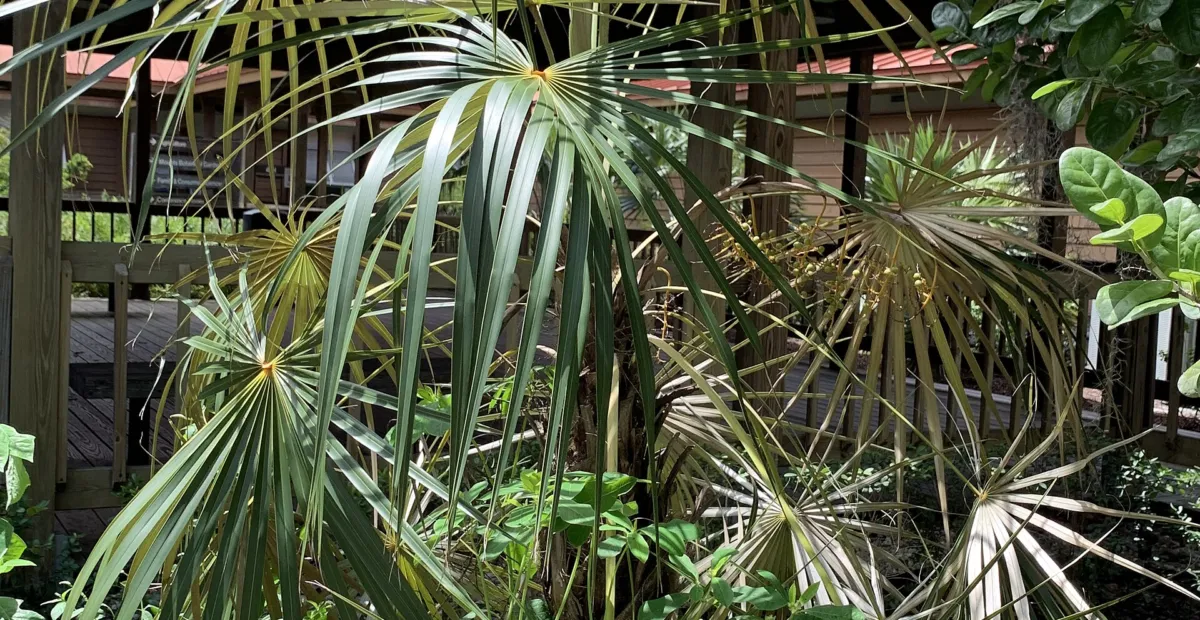
The palm has a slender solitary trunk that may be smooth and gray or partly covered with woven fibers from old leaf bases. Its fan leaves are deeply divided into narrow, often drooping segments, blue-green on top and silvery below. The open crown and reflective undersides are its most distinctive identification features.
Flowering
Small white flowers are arranged singly along branched, interfoliar inflorescences that emerge among the leaves. Flowers last less than a week. In South Florida, blooming is commonly concentrated from late winter through spring, with some cultivated plants showing a second fall flowering period.
Pollination and visitors
A South Florida study recorded five insect species visiting the flowers and found abundant species pollen on visitors, especially bees. Honey bees and carpenter bees were documented collecting pollen; insects appear to contribute to pollination, although the study was preliminary and the plant can also set some fruit without visitors.
Coccothrinax argentata photos
Click any photo for a larger view. Source, author and license are shown separately.
Diseases and pests
Diseases
No major disease problem is consistently reported. Reduce risk by avoiding waterlogged soil, planting with good air circulation, and removing severely diseased material with clean tools. Monitor stressed palms rather than applying routine fungicides.
Pests
Serious pest pressure is not generally reported. Inspect flowers and new growth for caterpillars, weevils, scale, or mites, especially on stressed plants. Improve drainage and airflow, remove heavily affected inflorescences when necessary, and use targeted controls only after confirming the pest.
Toxicity and pollen
No reliable authoritative evidence was located establishing this species as toxic to people or companion animals. Avoid relying on that absence as proof of safety; prevent ingestion of ornamental plant material and consult a veterinarian or poison service after a suspected exposure.
- Typical season
- Late winter through spring in South Florida; possible fall flowering in cultivation
- Pollination / pollen
- White, medium-sized pollen collected by flower-visiting insects
The species produces white pollen and can place substantial pollen on visiting insects. Reliable data on airborne dispersal, seasonal allergenicity, and clinical allergy risk were not located, so the allergy classification remains unknown. Avoid making concentrated flower dust airborne when handling flowering material.
Native habitat
Native populations occur in South Florida, the Florida Keys, the Bahamas, and parts of the wider Caribbean and tropical Americas. It is associated with pine rocklands, tropical hardwood hammocks, coastal strand, dunes, and other sunny, well-drained limestone or sandy habitats.
Interesting fact
The species is associated with fire-dependent pine rocklands and coastal habitats in South Florida.
Its leaf undersides are markedly silvery while the upper surfaces are blue-green.
Open-pollination trials produced more fruit than pollinator-excluded flowers.
Its dark fruits are important food for several native animals.
Frequently asked questions (FAQ)
The most relevant questions about this plant, with short and direct answers.
🌱Quick care
What is Coccothrinax argentata?⌄
Coccothrinax argentata is a slow-growing, solitary fan palm native to southern Florida and the Caribbean. It is valued for blue-green leaves with strikingly silvery undersides.
How much light does Coccothrinax argentata need?⌄
Coccothrinax argentata grows best in full sun but tolerates light shade. Give young plants some protection from intense afternoon sun until they are established.
How often should I water Coccothrinax argentata?⌄
Water Coccothrinax argentata regularly while it establishes, then allow the soil to dry between waterings. Established plants are drought tolerant, but prolonged extreme drought can still cause stress.
Is Coccothrinax argentata easy to grow?⌄
Coccothrinax argentata is relatively low maintenance in warm climates with sharply drained soil. Its main limitations are slow growth, freezing temperatures, and poor tolerance of waterlogged roots.
🌤️Environment and placement
What USDA zones are suitable for Coccothrinax argentata?⌄
Coccothrinax argentata is generally suited to USDA Zones 10A through 11, with the warmest sites being safest. It is frost tender and should be protected whenever freezing temperatures are expected.
Can Coccothrinax argentata grow in Florida?⌄
Coccothrinax argentata grows well in suitable parts of southern Florida, especially warm coastal and tropical areas. It is native to southern Florida and naturally occurs in habitats such as pine rocklands, hammocks, and coastal strand.
Can Coccothrinax argentata grow near the coast?⌄
Coccothrinax argentata is well suited to coastal landscapes because it tolerates salt spray and salty soils. Avoid locations subject to prolonged inundation by salty or brackish water.
What soil is best for Coccothrinax argentata?⌄
Use sandy or loamy soil that drains sharply, including calcareous or alkaline soil. Heavy, persistently wet soil can cause root problems even though the palm tolerates several soil types.
Can Coccothrinax argentata grow in clay soil?⌄
Coccothrinax argentata can tolerate clay if drainage is improved and water does not remain around the roots. Amend the planting site by improving drainage rather than creating a sharply different pocket of soil.
Can Coccothrinax argentata grow in a container?⌄
Coccothrinax argentata can be grown in a container when young, provided the pot has large drainage holes and a very free-draining mix. Container plants need more frequent monitoring for drying and should be protected from freezes.
💧Care and problems
How fast does Coccothrinax argentata grow?⌄
Coccothrinax argentata grows slowly, especially when young or grown outside consistently warm conditions. Do not expect rapid trunk development or a mature specimen within only a few seasons.
Does Coccothrinax argentata need fertilizer?⌄
Coccothrinax argentata benefits from a balanced palm fertilizer during active growth when the soil is poor. Follow the product label and avoid heavy applications, particularly in dry soil or poorly drained sites.
What pests and diseases affect Coccothrinax argentata?⌄
Coccothrinax argentata has no major pest or disease problems commonly associated with it. Poor drainage, cold injury, drought stress, and improper pruning are more likely causes of decline in home landscapes.
Why are the leaves of Coccothrinax argentata turning brown?⌄
Brown leaves on Coccothrinax argentata commonly indicate drought, cold damage, salt stress, root problems, or normal aging of older fronds. Check soil moisture and drainage first, and protect the palm from freezing weather.
Should I remove brown leaves from Coccothrinax argentata?⌄
Remove completely dead or broken fronds from Coccothrinax argentata, but leave partly green fronds in place. Green tissue still contributes energy to the slow-growing palm.
🪴Planting and repotting
When is the best time to plant Coccothrinax argentata?⌄
Plant Coccothrinax argentata during the warm growing season so roots can establish before cooler weather. In frost-prone areas, spring is usually safer than fall.
How do I plant Coccothrinax argentata in the ground?⌄
Plant Coccothrinax argentata at the same depth at which it was growing in its container, in a sunny site with sharply drained soil. Water thoroughly after planting, then reduce irrigation gradually as the root system establishes.
How much space does Coccothrinax argentata need?⌄
Allow enough room for a solitary palm that may eventually reach roughly 6 to 15 feet in cultivation, with a narrow trunk and an open fan-shaped crown. Keep the trunk away from structures and avoid crowding the developing canopy.
✂️Propagation and pruning
How do you propagate Coccothrinax argentata?⌄
Propagate Coccothrinax argentata from mature seed, which is the standard method for this species. Clean the fruit from the seed and sow it in a warm, well-drained medium kept lightly moist.
How long do Coccothrinax argentata seeds take to germinate?⌄
Coccothrinax argentata seeds may take several weeks to germinate, and germination can be uneven. Warm conditions, fresh seed, good drainage, and consistent moisture improve the chances of success.
Can Coccothrinax argentata be propagated from cuttings?⌄
Coccothrinax argentata is not normally propagated from stem or leaf cuttings. Because it is a solitary palm, seed propagation is the practical method for producing new plants.
⚠️Toxicity and safety
Is Coccothrinax argentata toxic to dogs or cats?⌄
There is no established species-specific toxicity classification for Coccothrinax argentata, so evidence is insufficient to confirm that it is harmless to pets. Prevent pets from chewing plant material and contact a veterinarian if ingestion causes symptoms.
Is Coccothrinax argentata poisonous to people?⌄
No confirmed species-specific human toxicity classification was identified for Coccothrinax argentata. Avoid eating ornamental plant material or fruit unless it has been reliably identified and confirmed safe by an appropriate expert.
🌸Flowering and special interest
Does Coccothrinax argentata flower?⌄
Coccothrinax argentata produces small white flowers on inflorescences that are often partly hidden among the leaves. Flowering is more likely when the palm is mature and growing in warm, bright conditions.
When does Coccothrinax argentata bloom?⌄
Coccothrinax argentata commonly flowers during the warm season, although timing varies with climate and growing conditions. In subtropical regions, flowering and fruiting may extend beyond one season.
What fruit does Coccothrinax argentata produce?⌄
Coccothrinax argentata produces small, round fruits that mature to purple or purplish black. The fruits contain a single seed and may attract birds and other wildlife.
Why is my Coccothrinax argentata not flowering?⌄
A young Coccothrinax argentata may not flower because the species matures slowly. Insufficient light, cold exposure, drought, root stress, or excessive shade can also delay flowering.
Similar plants
 Woolly jelly palm (Butia eriospatha) care guideButia eriospatha
 Blue Mediterranean fan palm (Chamaerops humilis) care guideChamaerops humilis
 Burmese Fishtail-palm (Caryota mitis) care guideCaryota mitis
 Rattan (Calamus rotang) care guideCalamus rotang
 Quindio Wax Palm (Ceroxylon quindiuense) care guideCeroxylon quindiuense
 Palmyra palm (Borassus flabellifer) care guideBorassus flabellifer