
 Source:
He Petticoat palm (Copernicia macroglossa) short overview
he Petticoat palm (Copernicia macroglossa) is a slow-growing Cuban fan palm prized for its stiff, silvery-green leaves and unusual skirt of old foliage that remains beneath the crown. It forms a solitary trunk and makes a dramatic specimen for warm, sunny landscapes, patios, and conservatories. Once established it handles drought and poor, sharply drained soil, but it needs protection from freezing temperatures and prolonged cold.
Taxonomic classification
He Petticoat palm (Copernicia macroglossa) care guide
Light and placement
Give full sun with unobstructed exposure for the strongest crown and most compact growth; south- or southwest-facing positions are suitable in the United States. Young plants tolerate some bright filtered light, but persistent shade can produce weaker, less symmetrical growth. Scorched leaf tips may indicate reflected heat or drought stress, while elongated, soft growth suggests inadequate light.
Watering and humidity
Water deeply after planting whenever the upper few inches of soil begin to dry, then gradually reduce frequency as the root system establishes. Mature plants are drought tolerant but perform best with occasional deep irrigation during prolonged heat and drought. In winter or cool weather, water sparingly and never leave the root zone saturated. Humidity is acceptable when drainage is rapid.
Soil and growing medium
Use a sharply draining palm soil, sandy loam, or gritty mineral mix. The species tolerates relatively poor and infertile ground and can grow in limestone-derived soils, but waterlogged sites encourage root problems. A slightly acidic to slightly alkaline reaction is acceptable; drainage and aeration matter more than exact pH.
Feeding
Feed during active warm-season growth with a complete palm fertilizer containing potassium, magnesium, and micronutrients, applied at label rates. Keep fertilizer away from the trunk and water it into the root zone. Do not feed during cold, dark, or waterlogged conditions. Pale or distorted new leaves can reflect nutritional stress, but confirm the cause before adding supplements.
Growth and habit
This is a solitary, upright palm that develops slowly and retains old leaves for many years before the lower skirt gradually thins on older plants. The persistent foliage is a major maintenance and design feature: leave healthy old leaves in place when the characteristic petticoat is desired, but keep dry material away from structures and ignition sources.
Planting and repotting
Plant after the danger of cold weather has passed, when soil is warm. Set the palm at the same depth at which it was growing; do not bury the stem. Allow ample room for the crown and skirt, and keep the planting area free of standing water. Water deeply during establishment, then extend the interval as roots develop.
Repot container plants only when roots have filled the pot, preferably during warm active growth. Move into a deep, stable container with large drainage holes and a very free-draining palm mix. Handle the root ball carefully and avoid burying the stem base. Large specimens are best transplanted only when essential.
Propagation and pruning
Propagation
Propagate from fresh seed. Clean away fruit residue, sow just below the surface in a warm, airy, well-drained medium, and keep evenly warm rather than wet. Germination commonly takes several weeks to a few months. Seedlings are slow to moderate in early development and should be potted on carefully.
Pruning
Do not strip the skirt routinely if the characteristic form is desired. Remove only completely detached, hazardous, diseased, or obstructive material, using clean tools and protective clothing. Never cut into the growing point. Excessive pruning can reduce the palm’s natural architectural character and create wounds.
Overwintering
Protect from frost, cold rain, and prolonged temperatures near freezing. In marginal climates, use a warm microclimate, trunk wrapping, and breathable frost cloth during brief cold events, while keeping the crown dry where possible. Container plants should be moved indoors or into a bright, warm conservatory before freezing weather; reduce watering but do not allow prolonged severe dryness.
Uses
Primarily an ornamental specimen palm for parks, gardens, courtyards, large containers, and conservatories. Its architectural crown and persistent leaf skirt provide year-round structure. It is not the principal commercial carnauba-wax palm; avoid transferring uses documented for Copernicia prunifera to this species.
Appearance
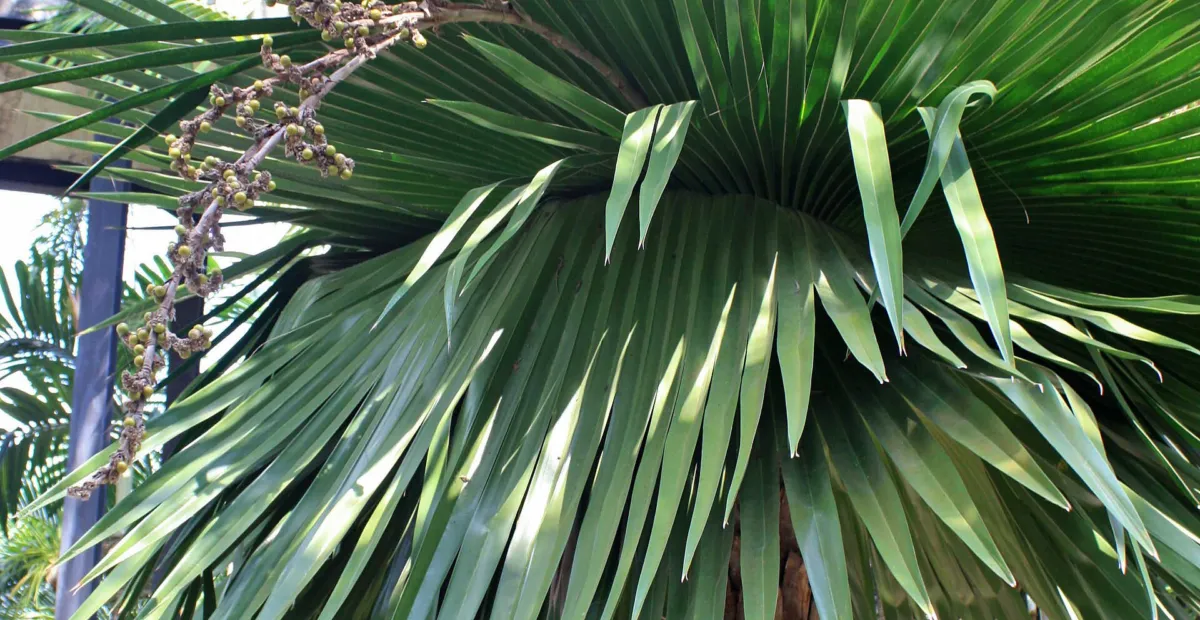
The solitary trunk supports a spiral crown of nearly circular, stiff fan leaves with extremely short petioles and a conspicuous hastula. Young and middle-aged plants may appear stemless because old leaves remain folded and layered around the trunk, forming a dense skirt. Older specimens can reveal a smooth gray upper trunk as lower foliage is shed.
Flowering
Mature plants produce long, branching inflorescences that extend well beyond the leaf crown and carry numerous tiny cream to yellowish flowers. The species is monoecious, with male and female flowers on the same plant. Flowering is most often reported during warm-season growth in cultivation; exact timing varies by climate and maturity.
Pollination and visitors
The species has small flowers in extended inflorescences, but reliable species-specific records identifying animal pollinators were not found. Treat pollinator value as undocumented rather than assuming that all palm flowers attract bees or butterflies.
Copernicia macroglossa photos
Click any photo for a larger view. Source, author and license are shown separately.
Diseases and pests
Diseases
Prevent disease by avoiding saturated soil, planting deeply, or damaging the trunk. Watch for crown or trunk decline associated with poor drainage and for leaf-spot symptoms during persistently wet weather. Remove badly affected material with sterilized tools, improve airflow, and correct irrigation rather than relying on routine fungicide use.
Pests
Inspect for scale insects, mealybugs, mites, and palm-feeding caterpillars, especially on stressed container plants. Check leaf bases and the crown during warm weather. Improve light, airflow, and watering practices first; treat localized infestations with horticultural oil or insecticidal soap only when label directions permit and foliage is not heat-stressed.
Toxicity and pollen
No species-specific toxic principle or established poisoning record was located in the authoritative sources reviewed. This does not prove complete safety: do not encourage children or pets to chew plant material, and seek professional advice if a substantial ingestion causes symptoms. The persistent dry leaf skirt can also be scratchy or harbor debris.
- Typical season
- Usually during the warm growing season; exact U.S. timing varies by climate
- Pollination / pollen
- Flower pollen; dispersal and allergenicity are poorly documented
Palms produce pollen, but no species-specific airborne-pollen or clinical allergy data were located for Copernicia macroglossa. Its flowers are not documented as a major U.S. aeroallergen source. Sensitive people should still avoid handling flowering structures during visible pollen release and rely on local symptoms and medical advice.
Native habitat
Native to western and central Cuba, where it occurs in seasonally dry tropical landscapes including savanna, hilly areas, and sites near salt marshes. It is associated with open, sunny conditions and can tolerate poor, mineral-rich or calcareous soils when drainage is good.
Interesting fact
The old leaves fold downward and persist beneath the crown, creating the characteristic petticoat. The species is endemic to western and central Cuba. Its leaves have exceptionally short petioles and a prominent hastula. The genus name honors Nicolaus Copernicus.
Frequently asked questions (FAQ)
The most relevant questions about this plant, with short and direct answers.
🌱Quick care
How do you care for Copernicia macroglossa, also called he Petticoat palm?⌄
Grow Copernicia macroglossa in full sun, sharply drained soil, and water sparingly once established. Protect it from frost and prolonged cold, especially when temperatures approach 30°F.
Is Copernicia macroglossa easy to grow?⌄
Yes, Copernicia macroglossa is generally easy to grow in warm, sunny climates with well-drained soil. Its main limitations are frost sensitivity, slow establishment, and eventual size.
How fast does Copernicia macroglossa grow?⌄
Copernicia macroglossa grows at a slow to moderate rate, depending on heat, sunlight, nutrition, and water. Young palms may take years to develop the characteristic trunk and petticoat of old leaves.
🌤️Environment and placement
How much sunlight does Copernicia macroglossa need?⌄
Copernicia macroglossa needs full sun for the strongest growth and best form. Give it a location with direct sunlight for most of the day rather than deep shade or heavily filtered light.
Can Copernicia macroglossa grow indoors?⌄
Copernicia macroglossa is not well suited to ordinary indoor conditions because it needs intense light and substantial space. A bright conservatory or greenhouse may work temporarily, but outdoor cultivation is preferable in warm climates.
What USDA zones can grow Copernicia macroglossa outdoors?⌄
Copernicia macroglossa is best suited to frost-free USDA Zones 10 and 11, with some success in protected warm pockets of Zone 9b. In cooler areas, grow it in a container that can be moved under protection.
How cold hardy is Copernicia macroglossa?⌄
Copernicia macroglossa is frost tender and should be protected when temperatures approach 30°F. Brief cold may cause damage, while repeated or prolonged freezing can seriously injure or kill the palm.
Can Copernicia macroglossa tolerate humidity?⌄
Yes, Copernicia macroglossa can tolerate humid conditions when its soil drains quickly and the crown is not kept wet. Good airflow and avoidance of waterlogged soil remain important.
Is Copernicia macroglossa drought tolerant?⌄
Yes, Copernicia macroglossa is drought tolerant once established. Water it deeply during establishment, then allow the soil to dry substantially between irrigation cycles.
Can Copernicia macroglossa tolerate salt spray?⌄
Copernicia macroglossa has some tolerance of coastal conditions, but it should not be treated as fully salt-proof. Place it away from constant direct ocean spray when possible and rinse foliage after severe salt exposure.
💧Care and problems
How often should you water Copernicia macroglossa?⌄
Water Copernicia macroglossa regularly while it establishes, then reduce irrigation as the root system develops. In established plantings, water only when the soil has dried deeply, increasing frequency during extreme heat or prolonged drought.
What soil is best for Copernicia macroglossa?⌄
Use sandy, gritty, well-drained palm soil for Copernicia macroglossa. It can tolerate relatively poor soil, but heavy clay or sites that stay wet can lead to root problems.
What fertilizer does Copernicia macroglossa need?⌄
Feed Copernicia macroglossa with a controlled-release palm fertilizer during active growth, following the label rate. Avoid excessive feeding, and investigate distorted or accordion-like new leaves for possible micronutrient imbalance rather than simply adding more fertilizer.
Why are the leaves of my Copernicia macroglossa turning brown?⌄
Brown leaves can result from cold damage, drought, salt exposure, root stress, or normal aging. Check soil drainage, recent temperatures, irrigation, and fertilizer use before removing affected fronds.
Why is my Copernicia macroglossa not growing?⌄
Slow growth is normal, especially in young Copernicia macroglossa plants. Growth is further reduced by insufficient sun, cool weather, poor drainage, transplant shock, or a restricted root system.
🪴Planting and repotting
When is the best time to plant Copernicia macroglossa?⌄
Plant Copernicia macroglossa in spring or early summer after cold weather has passed. Warm soil helps new roots establish before the next cool season.
How should you plant Copernicia macroglossa in the ground?⌄
Plant Copernicia macroglossa at the same depth it was growing in its container, in a sunny site with rapid drainage. Do not bury the trunk or amend a heavy planting hole in a way that creates a water-holding pocket.
Can Copernicia macroglossa grow in a container?⌄
Yes, young Copernicia macroglossa can be grown in a large container with a gritty, fast-draining mix. Container culture becomes difficult as the palm develops a large crown and eventually needs protection from cold.
When should you repot Copernicia macroglossa?⌄
Repot Copernicia macroglossa when roots have filled the container or drainage has declined, preferably during warm active growth. Move it into only the next pot size and avoid disturbing the root ball more than necessary.
✂️Propagation and pruning
How do you propagate Copernicia macroglossa?⌄
Propagate Copernicia macroglossa primarily from fresh seed. Clean the fruit from the seed, sow it just below the surface in a sterile, well-drained mix, and keep it warm and lightly moist.
How long do Copernicia macroglossa seeds take to germinate?⌄
Copernicia macroglossa seeds commonly germinate in about 30 to 90 days under warm, suitable conditions. Fresh, clean seed and steady warmth generally improve results.
Can Copernicia macroglossa be propagated from cuttings?⌄
No, Copernicia macroglossa is normally propagated from seed rather than stem cuttings. As a solitary palm, it does not usually produce separable basal offsets.
Should you remove the dead leaves from Copernicia macroglossa?⌄
Remove only completely dead, loose, or hazardous leaves when necessary, using clean tools and care around the spiny leaf margins. Retained dead leaves form the species’ distinctive petticoat, so routine stripping changes its natural appearance.
Does Copernicia macroglossa have spines?⌄
Copernicia macroglossa can have small teeth or prickles along parts of the leaf margins and a sharp leaf structure. Wear gloves and eye protection when pruning or handling mature foliage.
⚠️Toxicity and safety
Is Copernicia macroglossa toxic to people or pets?⌄
No documented species-specific toxicity is established for Copernicia macroglossa. Nevertheless, do not allow people or pets to ingest plant material, and handle the leaves carefully because their margins may be sharp.
Is Copernicia macroglossa safe to plant near walkways?⌄
Copernicia macroglossa can be planted near walkways only where its mature crown and sharp leaf edges will not interfere with traffic. Leave generous clearance and account for falling or retained old fronds.
🌸Flowering and special interest
Does Copernicia macroglossa flower?⌄
Yes, mature Copernicia macroglossa produces long branched inflorescences with small cream to yellowish flowers. Flowering is more likely when the palm receives strong sunlight, warmth, and adequate root space.
What fruit does Copernicia macroglossa produce?⌄
After flowering, Copernicia macroglossa can produce small fruits that mature dark or black. These fruits contain seeds that may be used for propagation when fully mature.
Why does Copernicia macroglossa have a skirt of dead leaves?⌄
Copernicia macroglossa retains old dried fronds beneath the crown, creating the distinctive petticoat or skirt. This is a characteristic feature of the species rather than automatically a sign of poor health.
Similar plants
 Date Palm (Phoenix dactylifera) care guidePhoenix dactylifera
 Mauritia flexuosa care guideMauritia flexuosa
 Palm (Oenocarpus bataua) care guideOenocarpus bataua
 Nipa Palm (Nypa fruticans) care guideNypa fruticans
 Round-leaved licuala palm (Licuala grandis) care guideLicuala grandis
 Oenocarpus bacaba care guideOenocarpus bacaba