
 Source:
Talipot palm (Corypha umbraculifera) short overview
Talipot palm is a monumental tropical fan palm prized for its immense, architectural crown and extraordinary life cycle. Corypha umbraculifera may spend several decades building a solitary, ringed trunk before producing one terminal inflorescence carrying millions of small cream flowers. After fruiting, the monocarpic palm dies. It needs full sun, warmth, fertile well-drained soil, and extensive room, making it primarily a botanical-garden specimen in the United States.
Taxonomic classification
Talipot palm (Corypha umbraculifera) care guide
Light and placement
Provide full sun with unobstructed overhead and lateral space. A south- or west-facing position is suitable in frost-free regions, provided the root zone does not bake dry. Too little light produces stretched growth and a weaker crown; excessive reflected heat combined with drought can scorch leaf segments. Protect young plants from sudden cold and intense drying winds.
Watering and humidity
Water deeply when the upper layer begins to dry, allowing excess water to drain freely. Keep young plants evenly moist while roots establish; mature landscape specimens tolerate brief drying better once established but should not face prolonged drought. Reduce watering during cool weather, and never leave container roots sitting in water.
Soil and growing medium
Use a deep, fertile, well-drained loam that retains moderate moisture without becoming waterlogged. In containers, combine quality potting mix with coarse mineral material and ensure generous drainage holes. Slightly acidic to neutral soil is suitable; avoid compacted clay and chronically stagnant wet soil.
Feeding
Feed during active warm-season growth with a complete palm fertilizer containing micronutrients, applied at label rates. A slow-release formulation is practical for landscape specimens; container plants may need periodic supplemental feeding. Do not fertilize drought-stressed, cold-damaged, newly transplanted, or waterlogged palms.
Growth and habit
A solitary, slow-to-moderate-growing palm spends most of its life building a single trunk and crown. It is monocarpic, so the dramatic flowering phase is also the final reproductive phase. Young plants are manageable in containers, but mature specimens require exceptional vertical and horizontal space.
Planting and repotting
Plant outdoors only in frost-free conditions, ideally in late spring or early summer after warm weather is established. Set the palm at the same depth it occupied in its nursery container and allow ample clearance from buildings, paths, utilities, and other trees. Water consistently during establishment, then maintain an evenly moist but well-drained root zone.
Repot only while young and actively growing, preferably in late spring or early summer. Move seedlings into progressively larger, deep containers because the palm develops a substantial root system. Once established, avoid unnecessary root disturbance and use a stable, heavy container.
Propagation and pruning
Propagation
Propagate from fresh seed. Clean and sow seed in a warm, sterile, well-drained medium; maintain steady moisture and tropical warmth. Fresh seed may germinate within roughly 120 days, while older seed can be slower or less reliable. Transplant seedlings carefully because early root disturbance can set them back.
Pruning
Remove only dead, broken, or hazardous leaves and spent material with clean, sharp tools. Do not cut healthy green fronds unnecessarily, and take special care around the dark marginal teeth on the petioles. After flowering and fruiting, the dying palm can be removed once structurally safe to do so.
Overwintering
Protect from frost and cold winds. In borderline climates, grow young plants in containers and move them into a bright, heated conservatory before temperatures approach freezing. Avoid warm, dim indoor conditions for long periods; provide maximum light, good ventilation, and reduced watering through winter.
Uses
Primarily an ornamental and botanical-collection specimen for tropical landscapes and conservatories. Leaves have documented traditional uses for thatching, mats, umbrellas, fans, and historical palm-leaf manuscripts; the pith and palm heart have also been used locally as food materials. These traditional uses are not recommendations for home harvesting.
Appearance
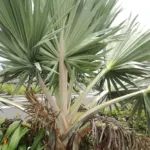
The palm has one stout, solitary trunk marked by conspicuous rings left by fallen leaf bases. Its enormous costapalmate leaves form a broad crown; long petioles carry fan blades with numerous pleated segments and toothed margins. Near flowering, the crown may decline before the giant terminal panicle emerges.
Flowering
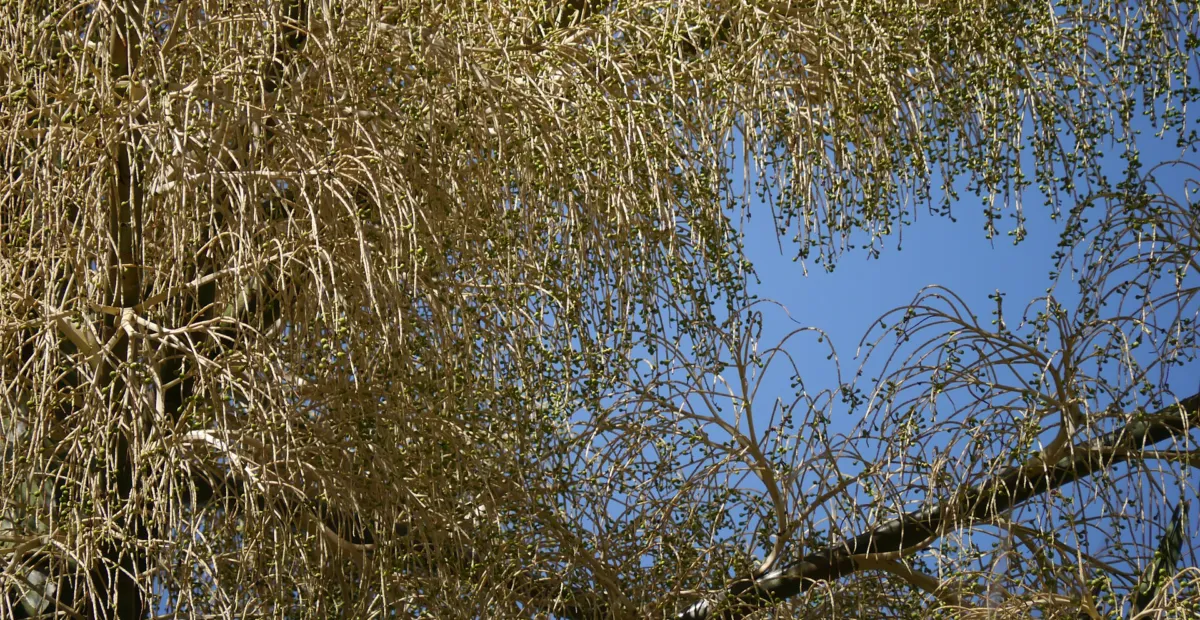
This monocarpic palm flowers only once, usually after decades of vegetative growth. A terminal, branched inflorescence rises above the crown and bears millions of tiny cream to yellowish-white bisexual flowers. Flowering is followed by fruiting and eventual death of the individual palm.
Pollination and visitors
The mass of small flowers is visited by insects, with bees and other insects documented or characteristic for palm inflorescences. The available evidence does not support assigning a single named pollinator species. Flower visitors should not be confused with airborne allergy risk.
Corypha umbraculifera photos
Click any photo for a larger view. Source, author and license are shown separately.
Diseases and pests
Diseases
Prevent problems by providing strong light, good air circulation, clean water, and well-drained soil. Watch for leaf-spot diseases, trunk or root rots, and decline associated with chronic overwatering. Remove badly damaged tissue with sterilized tools and correct drainage before considering treatment.
Pests
Inspect regularly for scale insects, mealybugs, mites, and caterpillars, especially on container plants or stressed specimens. Improve air movement, wash foliage when practical, and remove heavily infested material. Use horticultural oil or an approved insecticide only according to the product label and local regulations.
Toxicity and pollen
No authoritative species-specific toxicology record was located for Corypha umbraculifera in the sources reviewed. Do not treat that gap as proof of edibility or complete safety. Keep children and pets from chewing unfamiliar plant parts, and handle the sharply toothed leaf margins carefully.
- Typical season
- No reliable United States species-specific season documented
- Pollination / pollen
- Heavy, insect-associated pollen
This is an insect-pollinated palm, so its pollen is generally heavier and less readily dispersed through the air than wind-borne pollen. However, direct species-specific allergy studies were not located, so a low classification indicates limited documented airborne concern rather than zero risk.
Native habitat
Native to tropical parts of India and Sri Lanka, where it occurs in warm, humid landscapes including moist forest and lowland or foothill settings. It favors fertile, well-drained soils with dependable moisture and does not tolerate regular frost.
Interesting fact
The terminal inflorescence can rise about 20–26 feet above the crown.
A mature leaf may span roughly 16 feet across.
The palm may flower only once after 30–80 years of growth.
Its leaves were historically used for writing, thatching, mats, and umbrellas.
The species is monocarpic: fruiting is followed by death of the palm.
Frequently asked questions (FAQ)
The most relevant questions about this plant, with short and direct answers.
🌱Quick care
What is Corypha umbraculifera called in English?⌄
Corypha umbraculifera is commonly called the talipot palm. It is a solitary, tropical fan palm in the Arecaceae family.
How much sunlight does a talipot palm need?⌄
A talipot palm needs full sun for strong growth and a well-formed crown. Give it the brightest outdoor location available, especially in warm climates.
How often should you water Corypha umbraculifera?⌄
Water Corypha umbraculifera moderately, allowing the soil surface to dry slightly between waterings. Keep young palms consistently watered, but avoid continuously soggy soil.
Is the talipot palm cold hardy?⌄
The talipot palm is frost tender and is best suited to tropical or frost-free climates. Protect it from freezing temperatures and move container plants indoors before frost.
How big does Corypha umbraculifera get?⌄
Corypha umbraculifera can eventually reach roughly 65 to 90 feet tall, with an enormous crown of fan leaves. Its mature size makes it unsuitable for most small residential landscapes.
🌤️Environment and placement
What climate is best for a talipot palm?⌄
A talipot palm grows best in warm, humid tropical conditions with no regular frost. In the United States, outdoor cultivation is most realistic in frost-free parts of USDA Zones 10 and 11, with protection varying by local conditions.
Can Corypha umbraculifera grow in the United States?⌄
Corypha umbraculifera can grow outdoors in frost-free parts of the United States, particularly suitable areas of southern Florida and other tropical microclimates. Elsewhere, it is generally a specialty container or conservatory palm because of its eventual size and frost sensitivity.
What soil does a talipot palm need?⌄
The talipot palm prefers fertile, well-drained loam. Improve compact or poorly drained ground with organic matter and drainage amendments rather than planting it where water regularly stands.
How much space does a talipot palm need?⌄
A talipot palm needs an exceptionally large planting area because its trunk, crown, and flower cluster become enormous. Keep it well away from buildings, overhead utilities, paths, and other trees.
Can a talipot palm grow in a container?⌄
A young talipot palm can be grown temporarily in a large container, but it is not a practical long-term houseplant. Its rapid increase in scale, large leaves, and frost sensitivity eventually require a warm, spacious outdoor site.
💧Care and problems
How fast does Corypha umbraculifera grow?⌄
Corypha umbraculifera is generally slow growing, especially during its early years. Growth rate varies with heat, moisture, nutrition, root space, and whether the palm is grown in the ground.
Why are the leaves on my talipot palm turning brown?⌄
Brown talipot palm leaves can result from drought, low humidity, salt buildup, nutrient stress, cold injury, or natural aging. Check soil moisture and drainage first, then protect the palm from frost and harsh drying conditions.
Does Corypha umbraculifera need fertilizer?⌄
A talipot palm can benefit from a balanced palm fertilizer during active growth when the soil is poor or the foliage is pale. Follow the product label and avoid heavy feeding in cold weather or poorly drained soil.
What pests affect talipot palms?⌄
Talipot palms may be affected by general palm pests such as scale insects, mites, and caterpillars, although serious problems are not inevitable. Inspect the large fronds regularly and identify the pest before choosing a treatment.
🪴Planting and repotting
When is the best time to plant a talipot palm?⌄
Plant a talipot palm during the warmest part of the growing season, after cold weather has passed. Warm soil and a long frost-free period help the roots establish before the next winter.
How do you plant Corypha umbraculifera in the ground?⌄
Plant Corypha umbraculifera at the same depth it was growing, in fertile soil that drains freely, and water it thoroughly after planting. Leave generous room for the mature trunk, crown, spiny petioles, and eventual inflorescence.
Should a talipot palm be repotted?⌄
Repot a container-grown talipot palm only when roots have filled the pot or drainage has declined. Move it into a slightly larger, sturdy container during warm weather and avoid unnecessary root disturbance.
✂️Propagation and pruning
How do you propagate Corypha umbraculifera?⌄
Corypha umbraculifera is propagated from seed because it is a solitary palm and does not normally produce useful offsets. Sow fresh, fully mature seed in a warm, well-drained medium.
How long do talipot palm seeds take to germinate?⌄
Fresh talipot palm seeds commonly germinate in about two to four months, although timing can vary considerably. Warm conditions, consistent moisture, and seed freshness are more important than pretreatment.
Can you grow a talipot palm from a cutting?⌄
You generally cannot grow a talipot palm from a stem or leaf cutting. Propagation is normally by seed, and a solitary mature trunk does not provide a reliable vegetative propagation method.
Should you prune a talipot palm?⌄
Prune only dead, damaged, or hazardous fronds, using clean tools and avoiding cuts into the growing point. Do not remove healthy green fronds unnecessarily, because the palm has a single terminal growth point.
⚠️Toxicity and safety
Is Corypha umbraculifera toxic to people or pets?⌄
No species-specific toxicity is firmly established for Corypha umbraculifera. Nevertheless, its large, rough, and sometimes spiny leaf stalks can cause mechanical injuries, so keep people and pets away from hazardous access areas.
Does the talipot palm have sharp spines?⌄
Yes, the talipot palm can have toothed or spiny margins on its large leaf stalks. Wear protective clothing when handling it and avoid planting it beside walkways, play areas, or seating.
🌸Flowering and special interest
Does a talipot palm flower only once?⌄
Yes, the talipot palm is monocarpic, meaning it flowers and produces fruit once near the end of its life and then dies. The timing is highly variable, often requiring several decades of growth.
How long does it take a talipot palm to flower?⌄
A talipot palm may take roughly 30 to 80 years to flower, depending on growing conditions and the individual plant. Exact timing cannot be predicted reliably from the palm’s age alone.
What does a talipot palm flower look like?⌄
The talipot palm produces a huge, branched, terminal flower cluster rising above the crown. It carries millions of small cream to yellowish-white flowers and can become several yards tall and wide.
Does a talipot palm die after flowering?⌄
Yes, Corypha umbraculifera normally dies after flowering and fruiting because its single growing point is spent. Its seeds can continue the life cycle if they mature and germinate.
Does Corypha umbraculifera produce fruit and seeds?⌄
Yes, the talipot palm produces round, one-seeded fruits after flowering. The fruits mature over many months, and fresh mature seeds are the usual way to propagate the species.
Similar plants
 Round-leaved licuala palm (Licuala grandis) care guideLicuala grandis
 Baleares Island date palm (Phoenix canariensis) care guidePhoenix canariensis
 Palm (Oenocarpus bataua) care guideOenocarpus bataua
 Pelagodoxa henryana care guidePelagodoxa henryana
 Doum palm (Hyphaene thebaica) care guideHyphaene thebaica
 Latanier de l’Ile Ronde and latanier de Maurice (Latania loddigesii) care guideLatania loddigesii