
 Source:
Hillebrand’s Loulu (Pritchardia hillebrandii) short overview
Hillebrand's Loulu is a rare Hawaiian fan palm found naturally on Molokaʻi. Its single trunk supports broad, wavy, bluish-green leaves with striking silvery undersides, while pale flower clusters may develop small dark fruits. This slow-growing, evergreen palm prefers bright sun, excellent drainage, and warm conditions. In the United States, it is primarily a landscape or container specimen for frost-free regions, with indoor protection required where winter temperatures fall below its tolerance.
Taxonomic classification
Hillebrand’s Loulu (Pritchardia hillebrandii) care guide
Light and placement
Give full sun for strongest growth and crown form; partial shade is acceptable, especially for young plants or at hot, high-elevation sites. A bright east-, south-, or west-facing position is suitable in containers. Persistent deep shade can produce very slow growth and a weaker crown, while harsh reflected heat may scorch foliage if roots are allowed to dry severely.
Watering and humidity
Water deeply enough to moisten the root zone, then allow excess water to drain. Keep young palms consistently moist while establishing, particularly in hot lowland sites. Once established, the species tolerates some dryness, but prolonged drought can cause stress. Reduce irrigation during cool weather and never leave container roots standing in water.
Soil and growing medium
Use a sharply draining mineral or mineral-organic mix. Sandy, cindery, rocky, coral-derived, or well-structured loamy soils are suitable when excess water drains freely. Avoid persistently saturated ground. A neutral to slightly alkaline reaction is reasonable for its native volcanic and coastal settings, although the species can tolerate a broader range if drainage is excellent.
Feeding
Feed during active growth with a complete slow-release palm fertilizer that supplies potassium, magnesium, and micronutrients. Follow the product label and avoid heavy applications in dry soil or during cold, inactive weather. Container palms may need closer monitoring for potassium or magnesium deficiency, shown by yellowing or streaking foliage.
Growth and habit
This is a slow-growing, long-lived, single-trunk palm. It develops a broad fan crown and may take many years to reach landscape size. Good drainage, consistent establishment watering, and protection from browsing animals are more important than rapid fertilization. Avoid heavy shade, which can markedly slow growth.
Planting and repotting
Plant after danger of cold weather has passed, setting the palm at the same depth it occupied in its container. Keep the trunk base clear of mulch. Water regularly during establishment, then gradually reduce frequency as roots expand. Allow generous clearance for the crown and avoid sites where runoff collects.
Repot container plants only when roots have filled the pot or drainage has declined. Move up one pot size in warm weather, disturb the root ball as little as practical, and use a coarse palm mix with a strong drainage layer throughout the medium rather than relying on a shallow layer at the bottom.
Propagation and pruning
Propagation
Propagate from fresh seed. Clean and sow seed in a warm, airy, well-drained medium; maintain steady moisture without saturation. Germination and early growth may be slow, and fresh, legally sourced seed is important because the species has a restricted native distribution.
Pruning
The palm is largely self-pruning. Remove only fully dead leaves, spent flower stalks, or unwanted fruit stalks, using clean tools and avoiding cuts to the trunk. Do not remove green fronds merely to improve appearance, since premature pruning reduces vigor and can expose the crown to injury.
Overwintering
Move container plants indoors or into a heated greenhouse before frost. Give the brightest available light, reduce watering in cool conditions, and keep the crown dry enough to prevent rot. Outdoor plants in marginal climates need overhead frost protection and a warm, sheltered microclimate, but prolonged freezing is unsuitable.
Uses
A distinctive ornamental specimen for tropical and subtropical landscapes, botanical collections, conservatories, and large containers. It can provide shade and architectural structure. Traditional Hawaiian uses include leaves for thatching and weaving and young fruits for food; conservation, provenance, and local regulations should be considered when sourcing plants or seed.
Appearance
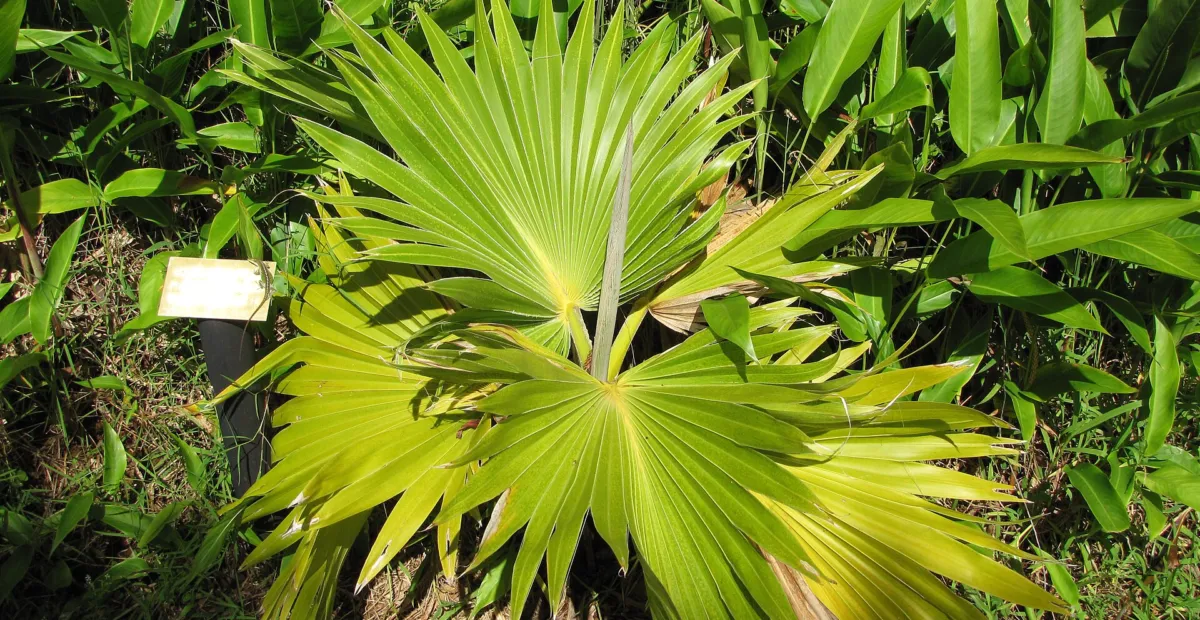
A single-trunk fan palm with coarse, wavy, costapalmate leaves. Mature blades may be emerald green to grayish or bluish green above and noticeably waxy or silvery underneath. The petioles can appear woolly, and long inflorescence stalks may carry small dark fruits. The combination of glaucous foliage and a compact palm crown is useful for identification.
Flowering
The inflorescences are produced among the leaves and are pale white to yellowish rather than showy. Flowering is reported as sporadic, and fruit follows on long stalks that can approach the length of the leaf stalks. A dependable month-by-month flowering schedule for the continental United States is not documented.
Pollination and visitors
The available sources confirm pale flowers but do not document a reliable species-specific animal pollinator or visitor list. Avoid assigning bee, butterfly, or other visitor codes without stronger evidence.
Pritchardia hillebrandii photos
Click any photo for a larger view. Source, author and license are shown separately.
Diseases and pests
Diseases
No species-specific disease profile was located in the reviewed authoritative horticultural sources. Reduce risk by providing strong drainage, avoiding trunk injury, removing badly damaged tissue with sterilized tools, and preventing chronic overwatering. Seek local diagnosis for unusual crown decline or persistent spotting.
Pests
Leaf rollers, red spider mites, sugarcane borers, and rats are reported problems. Inspect new leaves and leaf bases regularly, improve airflow, rinse foliage when practical, and use targeted controls only when pests are confirmed. Protect developing fruit from rats where necessary.
Toxicity and pollen
No reliable species-specific human, dog, cat, or child toxicity assessment was identified in the reviewed botanical and horticultural sources. Do not assume complete safety solely from missing data; prevent ingestion of seeds or plant material and contact a poison service or veterinarian if exposure causes symptoms.
- Pollination / pollen
- Pollen from insect-associated palm inflorescences; airborne relevance not established
This is a flowering palm and therefore produces pollen, but reliable species-specific airborne pollen counts and clinical allergy assessments were not located. The degree of allergy risk is unknown; people with pollen sensitivity should use ordinary precautions during flowering and avoid handling inflorescences unnecessarily.
Native habitat
The species is endemic to Molokaʻi, Hawaiʻi, historically associated with coastal cliffs and lowland habitats. Remaining wild plants are concentrated on rocky offshore islets where goats and rats are absent or reduced. It tolerates sun, wind, salt spray, and relatively dry conditions once established, but young plants need dependable moisture.
Interesting fact
The species is endemic to Molokaʻi and is now restricted mainly to small offshore islets. Its Hawaiian name loulu refers to the umbrella-like use of palm leaves. Young hāwane fruits were traditionally eaten, while leaves were used for thatching, weaving, hats, and fans.
Frequently asked questions (FAQ)
The most relevant questions about this plant, with short and direct answers.
🌱Quick care
What is Hillebrand's Loulu?⌄
Hillebrand's Loulu is the Hawaiian palm species Pritchardia hillebrandii in the family Arecaceae. It is a slow-growing, single-trunk fan palm native to Molokaʻi, Hawaii.
How big does Hillebrand's Loulu get?⌄
Hillebrand's Loulu typically reaches about 20 to 30 feet tall in cultivation, although some references report a potential height of 30 to 50 feet. Its crown is relatively compact compared with many larger palms.
Is Hillebrand's Loulu easy to grow?⌄
Yes, Hillebrand's Loulu is generally easy to grow when given warmth, good drainage, and adequate light. It becomes more drought tolerant after establishment but grows slowly.
How fast does Hillebrand's Loulu grow?⌄
Hillebrand's Loulu is a slow-growing palm that may gain roughly 1 foot per year under favorable conditions. Growth is slower in heavy shade, cold weather, poor soil, or containers.
🌤️Environment and placement
How much sun does Hillebrand's Loulu need?⌄
Hillebrand's Loulu grows best in full sun but tolerates partial shade. Young palms can handle some shade, while constant heavy shade may cause weak, very slow growth.
Can Hillebrand's Loulu grow indoors?⌄
Hillebrand's Loulu can be grown indoors temporarily as a young specimen if it receives very bright light and excellent drainage. It is ultimately better suited to a warm outdoor location because it becomes a substantial palm.
What USDA zones can grow Hillebrand's Loulu outdoors?⌄
Hillebrand's Loulu is best for frost-free parts of USDA Zones 10 and 11. In cooler areas, grow it in a container that can be protected during cold weather.
How cold hardy is Hillebrand's Loulu?⌄
Hillebrand's Loulu is frost tender and should be protected when temperatures approach about 25°F. Brief cold below that level can damage foliage or the growing point, especially on young palms.
Can Hillebrand's Loulu tolerate salt spray and wind?⌄
Yes, established Hillebrand's Loulu tolerates wind and some coastal salt spray. Even so, severe exposure and prolonged salt accumulation can cause leaf damage, so occasional rinsing may help in intensely salty sites.
💧Care and problems
How often should I water Hillebrand's Loulu?⌄
Water Hillebrand's Loulu regularly while it is establishing, keeping the root zone moderately moist but never waterlogged. After establishment, allow the surface to dry somewhat between deep waterings and reduce irrigation during cool or rainy periods.
What soil is best for Hillebrand's Loulu?⌄
Use well-drained mineral, loamy, cinder, sandy, or coral-based soil for Hillebrand's Loulu. Avoid compacted sites that stay wet because poor drainage can damage the roots.
What fertilizer does Hillebrand's Loulu need?⌄
Feed Hillebrand's Loulu with a complete slow-release palm fertilizer that includes magnesium, potassium, and minor nutrients. Follow the product label, especially for container-grown palms, which are more prone to nutrient deficiencies.
Why are Hillebrand's Loulu leaves turning yellow?⌄
Yellow leaves can result from overwatering, poor drainage, insufficient light, or magnesium and potassium deficiencies. Correct the growing conditions first, then use a balanced palm fertilizer if deficiency symptoms persist.
What pests attack Hillebrand's Loulu?⌄
Reported pests of Hillebrand's Loulu include leaf rollers, red spider mites, sugarcane borers, rats, and in Hawaii, coconut rhinoceros beetles. Inspect new growth and the crown regularly, and address serious infestations promptly.
Does Hillebrand's Loulu need pruning?⌄
Hillebrand's Loulu is largely self-pruning and needs little routine pruning. Remove only dead or damaged leaves and spent flower or fruit stalks, using clean tools and avoiding cuts to the trunk or growing point.
🪴Planting and repotting
When is the best time to plant Hillebrand's Loulu?⌄
Plant Hillebrand's Loulu during warm weather when the soil is workable and frost is no longer a risk. Warm-season planting gives the roots the best opportunity to establish before cooler conditions return.
How far apart should Hillebrand's Loulu palms be planted?⌄
For a small grove, Hillebrand's Loulu palms can be planted about 10 feet apart. For individual specimens with room to develop and display their crowns, spacing of roughly 20 to 40 feet is more appropriate.
Can Hillebrand's Loulu grow in a container?⌄
Yes, Hillebrand's Loulu can grow in a large container while young if the pot has drainage holes and a fast-draining mix. Container palms need careful watering, periodic repotting, and protection from cold.
✂️Propagation and pruning
How do you propagate Hillebrand's Loulu?⌄
Propagate Hillebrand's Loulu from mature seed, because cuttings and division are not practical for this solitary palm. Sow fresh, undamaged seed in a sterile, well-drained medium and keep it evenly moist.
How long do Hillebrand's Loulu seeds take to germinate?⌄
Hillebrand's Loulu seeds may germinate in a few months under warm, moist conditions. Germination can vary widely, so use fresh seed and do not discard the seed tray too early.
Can Hillebrand's Loulu be propagated by cuttings or division?⌄
No, Hillebrand's Loulu is not normally propagated by cuttings or division. As a solitary trunk palm, it is propagated primarily from seed.
⚠️Toxicity and safety
Is Hillebrand's Loulu toxic to dogs, cats, or people?⌄
There is no documented species-specific toxicity classification for Hillebrand's Loulu. Because palm fruits and seeds can be confused with those of other species, prevent pets and children from eating unknown plant material.
Is Hillebrand's Loulu invasive in the United States?⌄
Hillebrand's Loulu is a Hawaiian endemic rather than a broadly recognized invasive landscape palm in the United States. Avoid releasing cultivated plants or seeds into natural areas, and follow local rules for moving Hawaiian plant material.
🌸Flowering and special interest
Does Hillebrand's Loulu flower?⌄
Yes, Hillebrand's Loulu produces small pale white to yellow flowers on branched inflorescences. Flowering is not especially showy and may occur sporadically.
What fruit does Hillebrand's Loulu produce?⌄
After flowering, Hillebrand's Loulu produces round fruits that mature from green to brown or nearly black and can reach about 1 inch across. The fruits contain a single seed and may attract rats.
Can you eat Hillebrand's Loulu fruit?⌄
Hawaiian traditions describe the immature seeds of loulu palms as edible, but cultivated fruits should not be eaten unless their identity and preparation are certain. This species has no documented species-specific toxicity classification, but that is not the same as a food-safety guarantee.
Similar plants
 Nibong palm is an Asian species of palm tree in the family Arecaceae (Oncosperma tigillarium) care guideOncosperma tigillarium
 He Florida cherry palm or buccaneer palm (Pseudophoenix sargentii) care guidePseudophoenix sargentii
 Nipa Palm (Nypa fruticans) care guideNypa fruticans
 Mauritia flexuosa care guideMauritia flexuosa
 Miniature date palm (Phoenix roebelenii) care guidePhoenix roebelenii
 Ivory Cane Palm (Pinanga coronata) care guidePinanga coronata