
 Source:
Fishtail Palm (Caryota urens) short overview
Caryota urens, commonly called Fishtail Palm, is a tall, solitary tropical palm recognized by its ragged, fish-tail-shaped leaflets and graceful arching fronds. It prefers warmth, humidity, bright filtered light to partial sun, and consistently well-drained soil. Mature plants produce hanging flower clusters from the crown downward, then gradually die after flowering and fruiting. Its fruits contain irritating calcium oxalate crystals and should be handled carefully.
Taxonomic classification
Fishtail Palm (Caryota urens) care guide
Light and placement
Provide bright filtered light, morning sun, or gentle afternoon sun. In hot climates, protect from harsh reflected heat and intense late-afternoon exposure, which can scorch leaflets. Indoors, an east- or bright west-facing window is suitable; acclimate gradually to stronger sun. Weak, stretched growth and pale foliage suggest insufficient light, while bleached or brown leaflets suggest excess exposure or dry roots.
Watering and humidity
Water thoroughly when the upper 1–2 inches of mix begins to dry, then let excess drain fully. Keep the root zone evenly moist during warm active growth, but never leave the pot standing in water. Reduce frequency in cool, low-light winters while preventing complete drought. Humidity matters most indoors, where dry air can increase mite pressure and brown leaflet edges.
Soil and growing medium
Use a fertile, porous mix that drains freely but retains modest moisture. In containers, combine quality potting mix with bark, compost, and coarse perlite or pumice. Slightly acidic to neutral soil is suitable, though established palms tolerate a broader range when drainage is good. Avoid stagnant, waterlogged media.
Feeding
Feed during active growth with a complete palm fertilizer containing nitrogen, potassium, magnesium, and micronutrients. Apply at label strength or slightly weaker every 6–8 weeks outdoors, and less often indoors. Do not fertilize a recently repotted, drought-stressed, chilled, or declining palm until roots recover and active growth resumes.
Growth and habit
This is a solitary, upright palm rather than a clumping species. Growth is strongest with sustained warmth, moisture, nutrition, and humidity. The crown becomes increasingly imposing as the trunk elongates. Once reproductive growth begins, inflorescences develop sequentially downward; the trunk cannot be rejuvenated after its terminal flowering cycle.
Planting and repotting
Plant outdoors only after the danger of frost has passed, in a warm, sheltered site. Set the root flare level with the surrounding soil and do not bury the trunk. Water deeply during establishment and mulch over the root zone without touching the stem. Allow generous clearance from buildings because tall trunks and heavy crowns can be vulnerable to strong winds.
Repot container plants in spring when roots fill the pot or growth slows. Move up only one pot size, use a heavy container for stability, and disturb the root ball as little as possible. Large specimens are difficult to transplant successfully, so refresh the upper mix and improve drainage rather than repeatedly shifting them.
Propagation and pruning
Propagation
Propagate from fresh seed. Remove fruit pulp carefully, sow in a warm, sterile, well-drained medium, and maintain steady moisture and bottom warmth. Germination may be slow and irregular. Because the species is solitary and does not produce basal offsets, division is not a practical method.
Pruning
Remove only dead, damaged, or dangerously positioned fronds with clean tools. Do not cut the growing point or heavily strip the crown. Remove spent inflorescences or fallen fruit cautiously because sap and fruit tissues may irritate skin. A flowering trunk cannot be pruned back into vegetative growth.
Overwintering
Move container plants indoors before nights approach 45°F. Give the brightest available filtered light, reduce watering as growth slows, and keep the palm away from heating vents and cold drafts. Outdoor specimens in marginal climates need a warm microclimate and protection from frost, but prolonged freezing is not reliably tolerated.
Uses
A dramatic specimen for tropical landscapes, conservatories, large atriums, and warm-season patio containers. In its native range, sap is used for syrup, jaggery, and fermented beverages, and stem starch has traditional food uses. These uses require specialized harvesting and processing; do not consume material from ornamental plants or use the irritating fruits as food.
Appearance
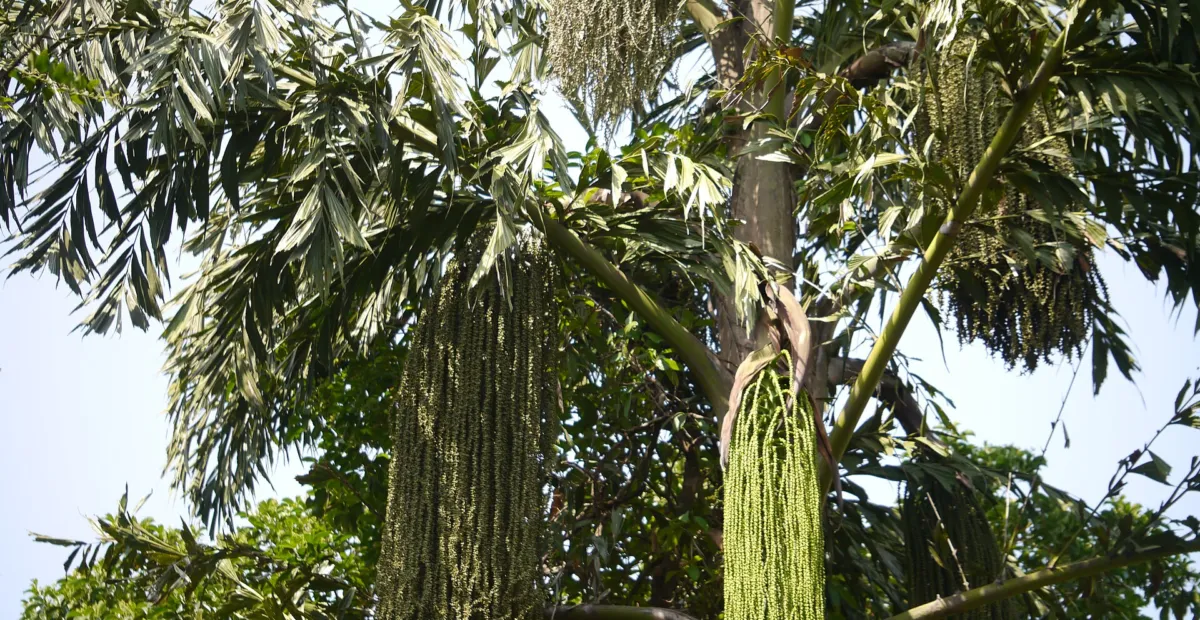
The smooth, pale-gray trunk supports large arching leaves divided into many irregularly wedge-shaped leaflets. The leaflet tips are jagged and resemble a fish tail, providing the key visual identification feature. Mature plants carry long, hanging flower and fruit clusters beneath the crown. Fruits mature red to purplish and contain irritating crystals.
Flowering
This monoecious palm bears inconspicuous male and female flowers in long, pendulous, branched inflorescences. Flowering progresses from the top of the trunk downward over several years. After completing flowering and fruiting, the individual palm declines and dies, a behavior known as monocarpic or hapaxanthic growth.
Pollination and visitors
Pendulous inflorescences produce pollen and attract insect visitors, especially bees and other small insects. Fruits may later be eaten and dispersed by birds, bats, or mammals in suitable native and tropical settings. Specific pollinator species are not consistently documented for this exact taxon.
Caryota urens photos
Click any photo for a larger view. Source, author and license are shown separately.
Diseases and pests
Diseases
Prevent crown and root problems by avoiding poorly drained soil, trunk injuries, and overhead irrigation. Watch for leaf-spot symptoms, basal rot, and decline associated with persistent wetness. Remove badly affected material with sterilized tools and correct drainage or irrigation before using fungicides.
Pests
Inspect for scale insects, mealybugs, spider mites, and palm-feeding caterpillars, especially indoors or under drought stress. Isolate infested containers, wash foliage, improve humidity and airflow, and use horticultural oil or insecticidal soap when appropriate. Avoid routine broad-spectrum insecticides that can disrupt beneficial insects.
Toxicity and pollen
The ripe fruit pulp contains needle-like calcium oxalate crystals that can cause intense irritation or burning of the skin, mouth, and digestive tract if handled or eaten. Sap and plant tissues should be treated cautiously. Wear gloves when removing fruit and keep fallen fruit away from children and animals. Evidence for species-specific systemic poisoning in pets is limited, so avoid ingestion rather than assuming safety.
- Typical season
- During flowering; outdoor exposure varies by climate
- Pollination / pollen
- Insect-carried pollen from male flowers
Caryota urens is an insect-pollinated palm, so airborne pollen exposure is likely lower than for strongly wind-pollinated plants, but a reliable species-specific clinical allergy profile is not established. During flowering, sensitive people should avoid handling inflorescences and observe personal symptoms rather than assuming zero risk.
Native habitat
Native from southern India and Sri Lanka through parts of Bhutan, southern China, and western and central Java. It is associated with wet tropical climates, moist evergreen forest, ravines, hills, and forest clearings. It favors warmth, humidity, dependable moisture, and soils that drain while remaining fertile.
Interesting fact
The species is monocarpic: one trunk flowers and fruits over a prolonged sequence, then dies. Its common name refers to the jagged, fish-tail-like leaflet tips. Traditional products include sweet syrup and fermented sap, but harvesting the growing point kills the palm. The fruits contain irritating calcium oxalate crystals.
Frequently asked questions (FAQ)
The most relevant questions about this plant, with short and direct answers.
🌱Quick care
What is Caryota urens commonly called in the United States?⌄
Caryota urens is commonly called Fishtail Palm. It is a solitary-trunked palm in the Arecaceae family and should not be confused with the clumping species Caryota mitis.
How much light does a Fishtail Palm need?⌄
Give Fishtail Palm bright filtered light to partial sun. Indoors, place it near a bright window with protection from intense afternoon sun, especially when the plant is young or recently moved.
How often should I water Caryota urens?⌄
Water Caryota urens regularly so the soil stays lightly and evenly moist, but never waterlogged. Allow only the surface to begin drying before watering again, and empty excess water from containers.
What soil is best for Fishtail Palm?⌄
Use fertile, well-drained loam outdoors or a porous container mix indoors. The soil should retain some moisture while allowing excess water to drain quickly.
How cold hardy is Caryota urens?⌄
Caryota urens is frost tender and should be protected when temperatures approach 32°F. In the United States, it is generally best suited to warm, frost-free areas or container culture that can be moved indoors.
🌤️Environment and placement
Can Fishtail Palm grow indoors?⌄
Yes, Fishtail Palm can grow indoors when it receives bright filtered light, regular watering, and adequate humidity. Give it plenty of vertical and horizontal space because mature leaves can become very large.
Can I grow Caryota urens outdoors in the United States?⌄
Caryota urens can be grown outdoors in warm parts of the United States where frost is uncommon. In colder regions, grow it in a container and move it indoors or into protected shelter before freezing weather.
Is Fishtail Palm suitable for full sun?⌄
Established Fishtail Palm can tolerate some direct sun, but bright filtered light to partial sun is safer for most plants. Acclimate container-grown or indoor palms gradually to stronger sunlight to reduce leaf scorch.
Does Caryota urens need high humidity?⌄
Caryota urens benefits from moderate to high humidity, particularly indoors during dry winter conditions. Brown leaf edges can worsen when dry air is combined with inadequate watering, salt buildup, or excessive direct sun.
How much space does a Fishtail Palm need?⌄
Give Fishtail Palm substantial vertical clearance and room for its broad, arching leaves. Caryota urens is a large solitary palm, so it is usually unsuitable for small rooms or confined planting beds at maturity.
💧Care and problems
Why are the leaves of my Fishtail Palm turning yellow?⌄
Yellow leaves commonly result from overwatering, poor drainage, inadequate light, or nutrient stress. Check the roots and soil moisture first, then correct drainage and light before applying fertilizer.
Why does my Caryota urens have brown leaf tips?⌄
Brown leaf tips can result from dry soil, low indoor humidity, fertilizer salts, root damage, or excessive direct sun. Keep the mix evenly moist, flush accumulated salts occasionally, and avoid letting the container remain waterlogged.
Why is my Fishtail Palm losing leaves?⌄
Fishtail Palm may lose leaves after sudden changes in light, temperature, watering, or humidity. Remove only fully dead fronds and stabilize the growing conditions rather than repeatedly relocating the plant.
How should I fertilize Caryota urens?⌄
Fertilize Caryota urens during active growth with a palm fertilizer used according to the label. Avoid heavy feeding in dry soil or during low-light winter conditions, because excess salts can damage the roots and leaf margins.
Does Fishtail Palm have common pest or disease problems?⌄
Fishtail Palm can develop problems when stressed, including scale, mites, fungal leaf spots, and root rot in poorly drained soil. Inspect leaves regularly and improve light, airflow, drainage, and watering consistency before using treatments.
🪴Planting and repotting
When should I plant Caryota urens outdoors?⌄
Plant Caryota urens outdoors during the warm growing season after the danger of frost has passed. Choose a site with fertile, well-drained soil and protection from freezing temperatures and harsh drying winds.
How do I repot a Fishtail Palm?⌄
Repot Fishtail Palm when roots fill the container or growth slows, moving it into a pot only one size larger. Use a porous mix, preserve as much of the root ball as possible, and water thoroughly after repotting.
Can Caryota urens grow in a container?⌄
Yes, Caryota urens can grow in a large container while young or where outdoor winters are too cold. Choose a heavy pot with drainage holes and expect to move the plant indoors as it grows or temperatures fall.
✂️Propagation and pruning
How is Caryota urens propagated?⌄
Caryota urens is propagated primarily from seed. Fresh, viable seed generally gives the best results, but germination can be slow and may take several months under warm, consistently moist conditions.
Can I propagate Fishtail Palm from cuttings?⌄
Fishtail Palm is not normally propagated from ordinary stem or leaf cuttings. Seed propagation is the dependable method for Caryota urens because it is a solitary-trunked palm without the basal offsets commonly used to divide clumping species.
Should I prune dead leaves from Caryota urens?⌄
Remove completely dead or badly damaged fronds with clean tools, cutting close to the base without injuring the trunk. Do not remove green fronds unnecessarily, because excessive pruning reduces the palm’s ability to produce energy.
⚠️Toxicity and safety
Is Fishtail Palm poisonous to people or pets?⌄
Fishtail Palm has a moderate irritation risk because its fruits and sap can irritate the skin, mouth, and eyes. Keep fruits and plant debris away from children and pets, and wear gloves when handling damaged or fruiting parts.
Can Fishtail Palm cause skin irritation?⌄
Yes, sap and fruit tissue from Caryota urens can cause irritation in sensitive people. Wear gloves and eye protection when pruning or cleaning the plant, and wash exposed skin promptly with soap and water.
Are Fishtail Palm fruits edible?⌄
Do not eat Fishtail Palm fruits or handle them casually because the fruit and sap may contain irritating compounds. Keep fruit away from children and pets and remove fallen fruit while wearing gloves.
🌸Flowering and special interest
Does Caryota urens flower?⌄
Yes, Caryota urens produces large hanging flower clusters as it matures. It is monocarpic, meaning the solitary trunk eventually flowers and fruits from the upper inflorescences downward before dying.
What happens to Caryota urens after it flowers?⌄
After Caryota urens completes flowering and fruiting, the single trunk gradually dies. This is a normal part of the species’ life cycle rather than a correctable disease or watering problem.
How long does it take Fishtail Palm to flower?⌄
Fishtail Palm usually requires many years to reach flowering size, and the timing varies with climate, light, nutrition, and growing conditions. Young container plants may remain vegetative for a long period.
Why are the leaves of Caryota urens shaped like fish tails?⌄
Caryota urens has distinctive twice-divided leaves with irregular wedge-shaped leaflets that resemble fish tails. This unusual foliage is the source of the common name Fishtail Palm.
Similar plants
 Ribbon Fan Palm (Livistona decora) care guideLivistona decora
 Coco-de-mer (Lodoicea maldivica) care guideLodoicea maldivica
 Mauritia flexuosa care guideMauritia flexuosa
 Nibong palm is an Asian species of palm tree in the family Arecaceae (Oncosperma tigillarium) care guideOncosperma tigillarium
 Round-leaved licuala palm (Licuala grandis) care guideLicuala grandis
 Normanbya normanbyi care guideNormanbya normanbyi