
 Source:
Copernicia baileyana short overview
Copernicia baileyana is a striking Cuban fan palm grown for its monumental form: a smooth, concrete-gray trunk supports a broad crown of stiff, deeply pleated blue-green leaves. Cream-colored branched inflorescences rise beyond the foliage and mature into dark fruits. This slow-growing, sun-loving palm tolerates dry periods once established but performs best in warm climates with fertile, sharply drained soil and plenty of room.
Taxonomic classification
Copernicia baileyana care guide
Light and placement
Provide unobstructed full sun, ideally in an open south- or west-facing position with room for the crown. Insufficient light can produce weak, stretched growth and a sparse crown; abrupt exposure after shade may scorch foliage, so acclimate container plants gradually. Avoid sites where buildings or trees will shade the palm for much of the day.
Watering and humidity
Water deeply and thoroughly when the upper soil begins to dry, allowing excess water to drain away. Keep young plants more evenly moist while roots establish; once established, the palm tolerates dry intervals but looks best with moderate moisture during active growth. Reduce irrigation in cool weather and never leave containers standing in water.
Soil and growing medium
Use a sharply drained sandy or loamy soil that does not remain waterlogged. The species tolerates poor and relatively dry soils, but growth and crown quality are better with moderate fertility and even moisture during establishment. Slightly acidic through slightly alkaline soils are acceptable; avoid compacted sites and persistently saturated clay.
Feeding
Feed during active warm-season growth with a complete palm fertilizer containing potassium, magnesium, and micronutrients, following the product label. Apply over the root zone rather than against the trunk and water afterward. Do not fertilize drought-stressed, recently frozen, or dormant plants.
Growth and habit
This is a solitary, slow-growing palm that eventually develops a massive trunk and broad crown. It is not suited to small residential beds. Young plants may remain modest for years, while established specimens require long-term space planning and careful protection of the crown and trunk.
Planting and repotting
Plant in spring or early summer after cold weather has passed, at the same depth as the root ball. Give the palm full sun and generous clearance from buildings, paths, and overhead utilities. Water deeply during establishment, then allow the surface to dry slightly between irrigations.
Young container plants can be shifted up when roots fill the pot, preferably in spring or early summer. Use a heavy, fast-draining palm mix and a stable container; mature specimens become difficult to move because of their size and sensitive root system.
Propagation and pruning
Propagation
Propagate from fresh seed. Clean the fruit, sow in a warm, well-drained medium, and maintain consistent moisture without saturation. Germination is commonly reported in roughly 4–12 weeks, though seed age and temperature affect results.
Pruning
Remove only completely dead or hazardous fronds, using clean tools and protective clothing. Do not cut green leaves unnecessarily, climb the trunk, or remove healthy crown material for cosmetic reasons. Petiole spines can cause injury during maintenance.
Overwintering
In the United States, grow outdoors only in frost-free or nearly frost-free areas. Protect young palms from brief cold snaps with breathable covers and root-zone mulch, but do not allow wet coverings to remain against the crown. Container specimens should be moved to a bright, warm, protected space before freezing weather.
Uses
Used primarily as a large ornamental specimen and architectural accent in tropical and subtropical landscapes, public gardens, and spacious courtyards. It is also maintained in specialist palm collections. Sharp petiole spines make it unsuitable beside narrow walkways or play areas.
Appearance
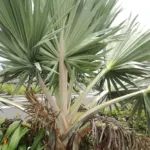
The palm forms one massive, smooth, slate-gray to concrete-gray trunk with a broad crown of circular to diamond-shaped, deeply pleated fan leaves. Leaves are rigid, waxy, and blue-green to gray-green beneath. Petioles are broad at the base and armed with backward-pointing spines, giving the plant a strongly architectural silhouette.
Flowering
Mature palms produce long, arching, branched inflorescences that extend beyond the crown. The flowers are cream-colored and occur in clustered branchlets. Flowering is associated with warm growing conditions, but a dependable flowering calendar for the United States is not well documented.
Pollination and visitors
The cream flowers are potentially visited by small insects, but a specific pollinator species or strong attraction record was not located. This palm should not be marketed as a heavily documented pollinator plant.
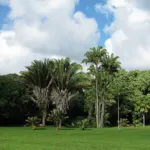
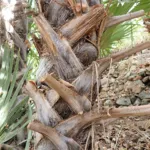
Copernicia baileyana photos
Click any photo for a larger view. Source, author and license are shown separately.
Diseases and pests
Diseases
Monitor for general palm problems such as nutrient disorders, lethal bronzing where present, and trunk or bud rots promoted by chronic wetness. Improve drainage, avoid mechanical trunk injury, remove severely diseased material with sterilized tools, and seek local extension diagnosis before using pesticides.
Pests
Inspect for scale insects, palm weevils, mites, and chewing pests, especially on stressed or container-grown plants. Maintain vigor with correct irrigation and nutrition, avoid trunk wounds, and use targeted treatment only after confirming the pest.
Toxicity and pollen
No reliable authoritative evidence establishing human or companion-animal toxicity was located for this exact species. Do not treat the absence of reports as proof of edibility or safety. The principal documented physical hazard is injury from sharp petiole spines; supervise children and pets around mature plants.
- Typical season
- Not reliably documented for U.S. conditions
- Pollination / pollen
- Airborne pollen; species-specific dispersal data limited
Reliable species-specific data on airborne pollen production and allergy importance were not located. As a flowering palm, it produces pollen, but its practical allergy significance in the United States remains uncertain. People with strong pollen sensitivity should avoid handling flowering material during peak bloom and rely on local clinical guidance.
Native habitat
The species is native to Cuba, where it occurs in warm terrestrial landscapes including savanna and woodland settings. It can tolerate dry periods and some poor soils, yet cultivated plants respond well to moisture-retentive but well-drained ground and high light.
Interesting fact
The species honors horticulturist and botanist Liberty Hyde Bailey. Its huge, rigid fan leaves can approach 5 feet across. The trunk is often described as having a concrete-like gray appearance. It is native to Cuba and is considered a slow-growing landscape palm.
Frequently asked questions (FAQ)
The most relevant questions about this plant, with short and direct answers.
🌱Quick care
What is Copernicia baileyana?⌄
Copernicia baileyana is a large, solitary fan palm native to Cuba and Hispaniola. It develops a smooth gray trunk and a broad crown of rigid, waxy green leaves.
How much sunlight does Copernicia baileyana need?⌄
Copernicia baileyana grows best in full sun. Young plants may tolerate some partial shade, but reduced light can slow growth and produce a less vigorous crown.
How often should I water Copernicia baileyana?⌄
Water Copernicia baileyana moderately, keeping the soil somewhat moist during active growth without leaving it saturated. Once established, it can tolerate periods of drought, but regular moisture supports faster growth.
Is Copernicia baileyana fast-growing?⌄
Copernicia baileyana is generally slow to moderate in growth, especially while young. Growth can vary considerably between plants and improves with full sun, adequate water, nutrition, and warm conditions.
🌤️Environment and placement
What USDA hardiness zone is suitable for Copernicia baileyana?⌄
Copernicia baileyana is best suited to warm USDA Zones 9b through 11, with the most dependable outdoor performance in frost-free areas. Zone ratings vary by source, so local winter exposure and protection are important.
Can Copernicia baileyana tolerate frost?⌄
Copernicia baileyana is frost-sensitive and should be protected from freezing temperatures. Brief cold near the upper 20s Fahrenheit may cause leaf damage, while prolonged or repeated freezes can be more serious.
Can Copernicia baileyana grow in a container?⌄
Copernicia baileyana can be grown in a large container while young, provided it receives full sun and has excellent drainage. Its eventual size and stiff, spiny leaves make long-term container culture demanding.
How much space does Copernicia baileyana need?⌄
Allow Copernicia baileyana substantial room for a broad crown and mature trunk. Its leaves can spread roughly 16 to 20 feet across, and the sharp petioles should be kept away from walkways and seating areas.
Is Copernicia baileyana drought-tolerant?⌄
Established Copernicia baileyana is drought-tolerant, although it grows better with periodic deep watering. Do not confuse drought tolerance with tolerance of constantly wet, poorly drained soil.
Can Copernicia baileyana tolerate salt or flooding?⌄
Copernicia baileyana has some tolerance of salt and short periods of inundation, but consistently wet sites are not ideal. In landscapes with heavy rain or poor drainage, planting on a raised mound can improve results.
💧Care and problems
What soil is best for Copernicia baileyana?⌄
Use well-drained sandy or loamy soil for Copernicia baileyana. It can tolerate relatively poor soil, but fertile soil with good drainage and a neutral to alkaline reaction generally supports stronger growth.
Why is my Copernicia baileyana growing slowly?⌄
Slow growth may result from insufficient sunlight, cool temperatures, poor nutrition, root stress, or natural variation between seedlings. A healthy plant may remain juvenile for years before developing a visible trunk.
How should I fertilize Copernicia baileyana?⌄
Feed Copernicia baileyana with a palm fertilizer that supplies potassium, magnesium, and micronutrients during warm active growth. Apply according to the product label, because excessive boron or other nutrients can damage or kill palms.
What causes yellow leaves on Copernicia baileyana?⌄
Yellowing can be caused by nutrient deficiencies, especially potassium or magnesium, as well as poor drainage or environmental stress. Older-frond spotting and yellowing should be evaluated together with soil conditions and the appearance of new growth.
Does Copernicia baileyana need pruning?⌄
Copernicia baileyana usually needs only the removal of dead or dangerous fronds. Avoid cutting green leaves unnecessarily, and use extreme care because the leaf stalks and margins can be sharply toothed.
🪴Planting and repotting
When is the best time to plant Copernicia baileyana?⌄
Plant Copernicia baileyana during the warm growing season, after the danger of frost has passed. Warm soil helps root establishment, while planting before winter can expose a newly transplanted palm to cold stress.
How do I plant Copernicia baileyana in the ground?⌄
Plant Copernicia baileyana at the same depth as it was growing in its container, in a sunny site with fast-draining soil. Water thoroughly after planting and keep the root zone evenly moist while it establishes.
Can Copernicia baileyana be transplanted?⌄
Copernicia baileyana can be transplanted, but large specimens are difficult and may recover slowly. Preserve as much of the root ball as possible, minimize root exposure, and provide careful watering after relocation.
✂️Propagation and pruning
How do you propagate Copernicia baileyana?⌄
Copernicia baileyana is propagated primarily from seed. Clean ripe seeds, sow them in a warm, well-drained medium, and keep the medium lightly and consistently moist.
How long do Copernicia baileyana seeds take to germinate?⌄
Copernicia baileyana seeds commonly germinate in about 4 to 12 weeks, although timing can vary with seed freshness and temperature. Warm conditions around 72 to 75 degrees Fahrenheit and steady moisture are helpful.
Can Copernicia baileyana be propagated from cuttings?⌄
No reliable cutting method is commonly used for Copernicia baileyana. Because it is a solitary palm without ordinary branching shoots, seed propagation is the practical method.
⚠️Toxicity and safety
Is Copernicia baileyana toxic to people or pets?⌄
The toxicity of Copernicia baileyana is not well documented, so it should not be considered proven safe to eat. The main documented hazard is physical injury from its sharp leaf margins and spiny petioles.
Are Copernicia baileyana leaves or stems dangerous?⌄
Yes, the leaf stalks and margins of Copernicia baileyana can have strong backward-pointing spines or sharp edges. Wear protective gloves and eye protection when planting, pruning, or handling the palm.
Is Copernicia baileyana suitable near walkways?⌄
Copernicia baileyana is not a good choice immediately beside walkways, patios, play areas, or driveways because its large leaves and spiny petioles can injure passersby. Give it an open location with clearance around the crown.
🌸Flowering and special interest
Does Copernicia baileyana flower?⌄
Yes, mature Copernicia baileyana produces branched cream to yellowish flower clusters that extend beyond the leaves. Flowering is more likely when the palm is mature, healthy, warm, and growing in strong light.
What does the fruit of Copernicia baileyana look like?⌄
The fruit of Copernicia baileyana is round to oval, dark brown to nearly black when ripe, and roughly three-quarters to 1 inch long. Each fruit generally contains a single rounded seed.
Does Copernicia baileyana produce seeds after flowering?⌄
Copernicia baileyana can produce viable seeds after flowering and fruit development. Allow the fruits to mature fully and remove the pulp before sowing the cleaned seeds.
Similar plants
 Carnarvon Fan Palm (Livistona nitida) care guideLivistona nitida
 Latanier de l’Ile Ronde and latanier de Maurice (Latania loddigesii) care guideLatania loddigesii
 Nibong palm is an Asian species of palm tree in the family Arecaceae (Oncosperma tigillarium) care guideOncosperma tigillarium
 Livistona chinensis care guideLivistona chinensis
 Doum palm (Hyphaene thebaica) care guideHyphaene thebaica
 Coco-de-mer (Lodoicea maldivica) care guideLodoicea maldivica