
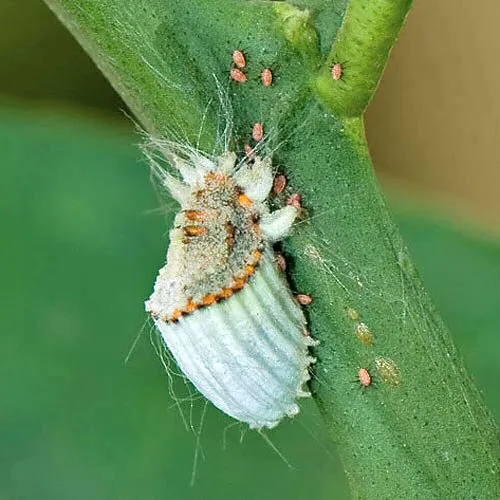
Cottony Cushion Scale
Icerya purchasiCottony Cushion Scale overview
Cottony cushion scale, Icerya purchasi, is a sap-sucking insect that attacks citrus and many woody ornamentals in the United States. Females are recognized by their elongated, fluted white egg sacs, while colonies produce honeydew and black sooty mold. Natural enemies often provide excellent control, but ants, dust and broad-spectrum insecticides can allow damaging outbreaks.
Typical conditions
Overview
Cottony cushion scale is most easily recognized by the mature female’s elongated, fluted, white cottony egg sac. The orange-brown female may be nearly 1/2 inch long when the egg sac is included. Younger stages are reddish and retain their legs, allowing them to crawl between leaves, twigs and branches.
The insect inserts piercing-sucking mouthparts into plant tissues and removes phloem sap. It is particularly important on citrus, Cocculus laurifolius, Nandina domestica and Pittosporum tobira in California landscapes, although many other woody plants can serve as hosts. Identification should be based on the characteristic egg sac and insect morphology because other cottony scale insects and mealybugs can look similar.
Symptoms and identification
- White, fluted, cotton-like egg sacs attached to orange-brown adult females.
- Reddish crawlers or young nymphs along leaf veins, petioles, twigs and branches.
- Sticky honeydew on leaves, fruit, bark or surfaces beneath the plant.
- Black sooty mold growing on honeydew-coated foliage.
- Reduced vigor, pale or distorted foliage, premature leaf or fruit drop, twig dieback and yield reduction during heavy infestations.
Light populations may cause little visible injury, particularly where vedalia beetles and parasitoid flies are present. Dense colonies in protected canopy areas are more likely to produce damaging symptoms.
Causes and spread
Spread occurs when mobile crawlers move to new leaves and shoots, when infested plant material is transported, and when scales are carried short distances by wind, animals, tools or contact between branches. Females can reproduce without mating, so a single surviving female may establish a new population.
Ants often protect cottony cushion scale because they collect honeydew. This interference reduces predation and parasitism. Broad-spectrum or persistent insecticides, dusty conditions and disruption of habitat can also remove the natural enemies that normally keep populations below damaging levels.
Life cycle and persistence
Females produce an elongated cottony egg sac containing commonly reported totals of about 600–800 red eggs. Eggs hatch in a few days during warm weather but may require up to two months in winter. First-instar crawlers are reddish with dark legs and antennae; they settle mainly on leaves and along veins.
Second instars occur on leaves and twigs, while third instars and adults are more common on branches and trunks. The scale molts between stages and leaves behind cottony wax. Development can be completed in roughly three months under warm conditions, with two to three generations per year reported in California. Males are uncommon, and females commonly reproduce parthenogenetically.
Treatment and control
Begin with confirmation of the pest and an assessment of natural enemies. Look for red-and-black vedalia beetles, their larvae or eggs near cottony egg sacs, and round parasitoid emergence holes in dead scale bodies. If biological control is active and plant injury is limited, treatment may be unnecessary.
For small infestations, prune and discard affected twigs or dislodge scales with a firm water spray where the host tolerates it. Manage ants before judging whether biological control has failed. If intervention is still justified, target exposed crawlers and young nymphs rather than mature females and their protected egg sacs. Horticultural oil may be useful on suitable hosts when applied according to the product label, with attention to heat, drought stress, plant sensitivity and spray coverage.
In commercial citrus, timing and treatment thresholds should follow the applicable state or university extension recommendations. Reinspect after treatment because protected adults and egg sacs may survive and new crawlers may emerge.
Low-impact and biological control
Conservation biological control is the primary organic and low-impact strategy where it is established. The vedalia beetle, Rodolia cardinalis, feeds on eggs, nymphs and adults. The parasitoid fly Cryptochaetum iceryae develops inside the scale and can be especially important in coastal California, while vedalia is often more important in inland and desert areas.
- Protect natural enemies by avoiding broad-spectrum residual insecticides.
- Control ants with physical trunk barriers and baiting strategies that do not contaminate foliage or harm beneficials.
- Reduce dust and provide flowering plants where appropriate to support adult parasitoids.
- Use hand removal, pruning and water sprays for localized infestations.
- Use only organically approved horticultural oils or other inputs that are legal for the specific crop and site, and follow the current label.
Prevention
- Inspect new citrus, ornamental and nursery plants before purchase and quarantine suspect plants when practical.
- Prune out heavily infested twigs when feasible, and dispose of removed material rather than composting active infestations.
- Control ants with trunk barriers or appropriately placed bait stations so they cannot tend scales; repair barriers as they collect debris.
- Avoid unnecessary broad-spectrum, persistent insecticides that kill vedalia beetles, parasitoid flies and other beneficial organisms.
- Reduce dust on foliage, maintain plant vigor through appropriate irrigation and nutrition, and avoid excessive nitrogen that promotes succulent growth.
- Monitor citrus and susceptible ornamentals by inspecting inner branches and leaf undersides during spring and summer.
Interesting facts
Cottony cushion scale was the subject of one of the earliest celebrated successes in classical biological control. Vedalia beetles imported from Australia helped rescue California’s citrus industry from severe infestations in the late nineteenth century.
The pest remains unusual among many scale insects because females retain mobility through much of their development. Its conspicuous cottony egg sac is not the insect’s body covering alone; it is a waxy structure produced by the female and used to protect the eggs.
Natural enemies can provide near-complete control in some regions, but the result is highly dependent on climate, host plant, ant activity and insecticide history. Cocculus laurifolius may be particularly susceptible where vedalia beetles avoid the plant.
Chemical control is rarely the first choice because mature females and egg sacs are difficult to penetrate and insecticides can destroy effective natural enemies. Use only products legally authorized and currently labeled for cottony cushion scale on the specific crop and site in the United States. Follow the current label exactly, including rates, timing, spray coverage, reentry and preharvest requirements; check state restrictions and avoid applications that are toxic to vedalia beetles, parasitoids, pollinators or other beneficial organisms.
Affected plants
The plants below are linked to this problem by structured host-plant data. The list updates automatically as new plant profiles are added.
 Cootamundra wattle (Acacia baileyana) care guideAcacia baileyana
 Knife-leaf Wattle (Acacia cultriformis) care guideAcacia cultriformis
 Silver Wattle (Acacia dealbata) care guideAcacia dealbata
 Longleaf Wattle (Acacia longifolia) care guideAcacia longifolia
 Pearl Wattle (Acacia podalyriifolia) care guideAcacia podalyriifolia
 Acacia pravissima care guideAcacia pravissima
 Prickly moses or western prickly moses (Acacia pulchella) care guideAcacia pulchella
 Field maple (Acer campestre) care guideAcer campestre
 Paperbark Maple (Acer griseum) care guideAcer griseum
 Downy Japanese Maple (Acer japonicum) care guideAcer japonicum
 Boxelder (Acer negundo) care guideAcer negundo
 Acer palmatum care guideAcer palmatum