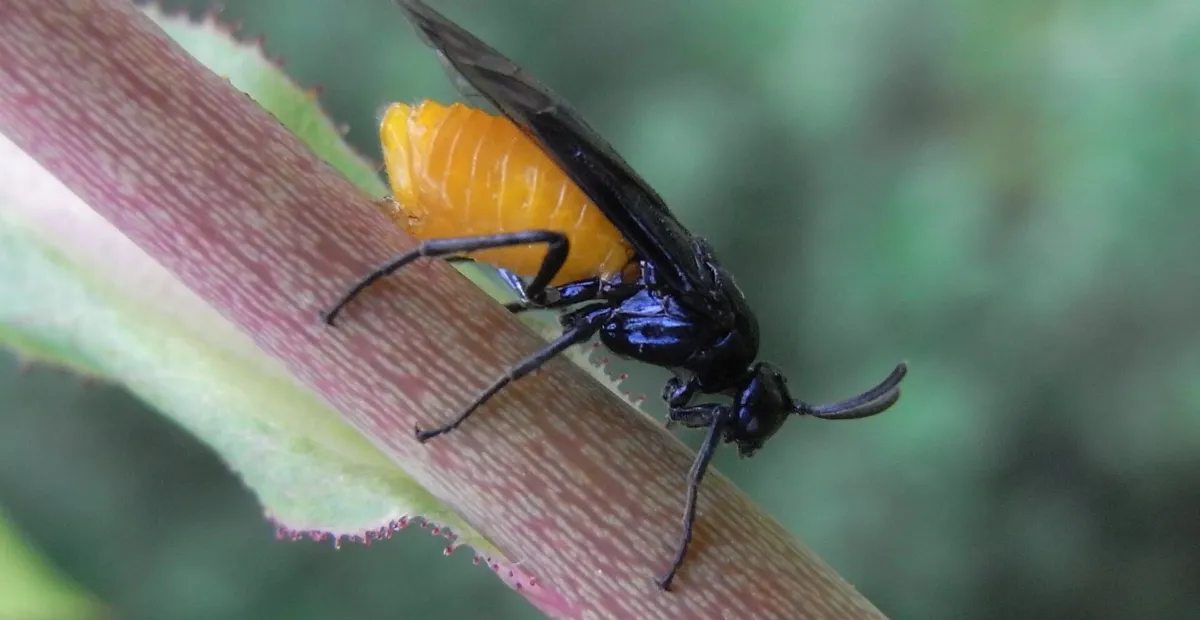
Large rose sawfly
Arge rosae (taxonomic name variably treated; often associated with Arge ochropus, while Arge pagana is also called large rose sawfly in some references)Large rose sawfly overview
Arge rosae is a taxonomic name associated in reference databases with rose-feeding sawflies, especially the large rose sawfly complex now treated under Arge ochropus or, in some sources, confused with Arge pagana. The larvae resemble small caterpillars but are sawfly larvae. They feed gregariously on rose foliage, causing window-pane damage, skeletonization, shoot scars and occasional defoliation.
Typical conditions
Overview
Arge rosae is a sawfly name associated with the rose sawfly group in the family Argidae. Sawflies are wasp relatives, not butterflies or moths, so their larvae are not true caterpillars. The documented host relationship is primarily with Rosa species, including cultivated garden roses and wild roses.
Modern databases and specialist references do not use the name consistently: Arge rosae may be listed as a synonym or historical name for Arge ochropus, while Arge pagana is a closely related rose-feeding species also called the large rose sawfly. Consequently, a reliable diagnosis should record the host, larval appearance, feeding pattern, egg-laying scars and, where needed, an adult specimen or expert confirmation.
In most home landscapes, the injury is primarily cosmetic and plants usually replace damaged foliage. Severe or repeated defoliation can reduce vigor, especially on newly planted, drought-stressed or heavily pruned roses.
Symptoms and identification
Damage is usually first noticed on young rose foliage in late spring or summer.
- Pale green, caterpillar-like larvae, often feeding in groups on leaf undersides.
- Transparent or browned “window-pane” patches where the green tissue has been scraped away.
- Progressive skeletonization, with veins and dry brown tissue remaining.
- Leaf curling, premature browning and leaf drop during heavy infestations.
- Elongate scars, splits or slight distortion on soft young shoots where females inserted eggs.
- Occasional localized shoot dieback or loss of flower-bud quality when egg-laying injuries are numerous.
Small larvae can be overlooked because they blend with the underside of the leaf. The injury can resemble caterpillar feeding, but sawfly larvae generally lack the distinctive crochets found on many moth caterpillars.
Causes and spread
Adult females cut into tender rose shoots with a saw-like ovipositor and insert eggs in the plant tissue. After hatching, larvae feed on rose leaves; older larvae may spread over the plant or move to nearby roses.
Spread within a garden occurs mainly through adult flight, movement of larvae between adjacent plants and survival of immature stages in soil or plant debris. Wild roses, unmanaged suckers and densely planted rose beds can act as local reservoirs. The name Arge rosae is taxonomically ambiguous, so not every rose sawfly reported under that name represents the same species.
Life cycle and persistence
Eggs are inserted into young rose shoots, often producing a visible linear scar. Larvae hatch after a short incubation period and initially feed gregariously. Mature larvae leave the plant and enter the soil or nearby sheltered material to form cocoons and pupate.
Depending on the species, climate and season, there may be one, two or occasionally three generations. The large rose sawfly described by the Royal Horticultural Society is active mainly from late May through October and may produce two, sometimes three, generations. Other members of the rose sawfly group may have only one generation, particularly in cooler regions. Adults emerge, mate and repeat the cycle; the exact overwintering stage varies by species.
Treatment and control
Begin control only when larvae are present and damage is increasing. For light infestations, hand-pick larvae and drop them into soapy water, or direct a firm spray of water at both the upper and lower leaf surfaces. Repeat inspections every few days because eggs or later generations may appear.
For larger infestations, a labeled contact product may be considered after confirming that the pest is a sawfly and not a moth caterpillar. Coverage of the leaf undersides is essential because larvae commonly feed there. Avoid treating open flowers or spraying when bees and other pollinators are actively foraging. In many established roses, allowing moderate injury is preferable to broad-spectrum treatment because plants commonly refoliate later in the season.
Low-impact and biological control
- Hand-remove larvae and prune out young shoots with conspicuous egg-laying scars.
- Use a strong water spray directed at larvae on both sides of the leaves.
- Insecticidal soap or horticultural oil can suppress exposed, soft-bodied larvae when direct contact is achieved; repeat only according to the product label.
- Neem-based products may be inconsistent and will not work well unless the larvae are directly contacted; do not apply automatically when no larvae are visible.
- Conserve lady beetles, lacewings, spiders, predatory bugs and parasitoids by avoiding unnecessary broad-spectrum insecticides.
- Do not rely on Bacillus thuringiensis products intended for moth caterpillars; sawfly larvae are not moth larvae and are generally not controlled by Bt kurstaki.
Prevention
- Inspect roses at least weekly from spring through midsummer, concentrating on leaf undersides and tender shoot tips.
- Remove and destroy leaves carrying young larvae before feeding becomes widespread.
- Prune out badly scarred or split shoot sections when practical, cutting back to healthy tissue.
- Keep roses adequately watered during drought and avoid excessive nitrogen that produces very soft, lush growth.
- Improve spacing and air movement so foliage can be inspected thoroughly.
- Remove heavily infested fallen foliage and obvious larval cocoons from the immediate planting area, without disturbing beneficial soil organisms unnecessarily.
- Monitor wild roses and unmanaged suckers near valuable plantings.
Interesting facts
The common name “rose slug” is often applied to several unrelated rose sawfly larvae because their smooth, soft bodies resemble tiny slugs. They are nevertheless larvae of wasp relatives in the order Hymenoptera.
Rose sawflies can create conspicuous skeletonized foliage without killing a healthy established rose. The double-row versus single-row arrangement of egg scars has been used to distinguish some closely related species, but reliable identification may require adult morphology or specialist examination.
Taxonomic names in older horticultural literature are not fully consistent: Arge rosae, Arge ochropus and Arge pagana have all been connected with common names such as rose sawfly or large rose sawfly. This is why host and symptom information should be interpreted alongside the identification source.
Use pesticides only when justified by confirmed active larvae and significant damage. Choose only products legally authorized and currently labeled for use on roses and this pest in the United States and in your state; follow the current label exactly, including rate, timing, protective equipment, re-entry, pollinator precautions and restrictions on flowering plants. Product registrations and labels can change, so consult the current label and your state Cooperative Extension or pesticide regulatory agency before application.
Affected plants
The plants below are linked to this problem by structured host-plant data. The list updates automatically as new plant profiles are added.