
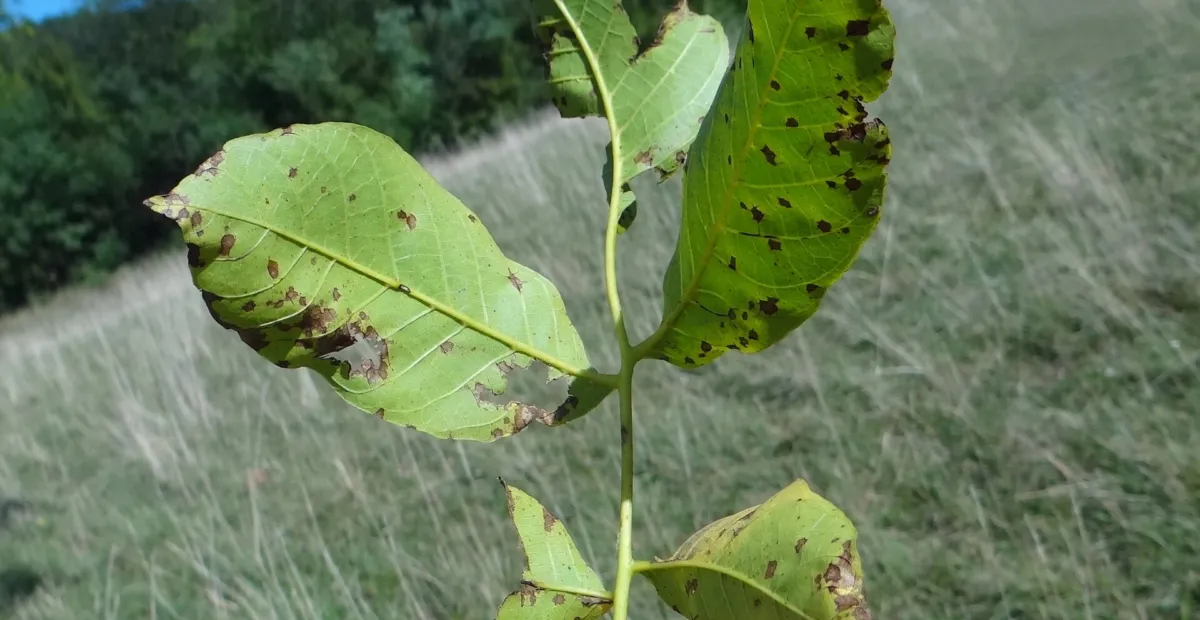
Walnut Anthracnose
Ophiognomonia leptostylaWalnut Anthracnose overview
Walnut anthracnose, also called walnut leaf blotch or walnut black spot, is a fungal disease caused by Ophiognomonia leptostyla and its asexual stage traditionally called Marssonina juglandis. It produces expanding brown to black leaf spots, lesions on rachises and shoots, premature leaflet drop, and sometimes damaged nut husks. Wet spring and early-summer weather favors severe outbreaks.
Typical conditions
Overview
Walnut anthracnose primarily affects leaves but may also colonize petioles, rachises, shoots, spurs and developing fruit or husks. Small necrotic specks enlarge into brown, gray-brown or black blotches, sometimes merging across the leaflet or midrib. Severe infection can cause early leaflet abscission and reduce nut development, especially when defoliation begins early or repeats over several seasons.
The disease is usually more damaging during persistently wet springs and early summers. It is not normally a lethal disease of established walnut trees, but young trees, heavily infected trees and trees repeatedly defoliated early in the season can lose vigor.
Symptoms and identification
- Small brown to black specks that enlarge into irregular necrotic blotches on leaflets.
- Lesions on the midrib, rachis or petiole that may cause leaflet breakage, tearing or premature abscission.
- Solitary dark acervuli, or spore-producing structures, may be visible within lesions under close inspection.
- Brown lesions can occur on shoots and nut husks; severe early defoliation may reduce nut filling or cause premature nut drop.
- Symptoms can resemble other walnut leaf spots, bacterial blight, scorch or insect injury, so laboratory confirmation may be needed for uncertain cases.
Causes and spread
The fungus survives primarily in infected fallen walnut leaves and sometimes in diseased fruit tissues. During wet spring weather, spores released from overwintered tissues are moved by rain splash and air currents to newly developing foliage. After lesions form, a second spore stage can drive repeated secondary infections through summer.
Several hours of continuous leaf wetness are generally needed for spore germination and infection. Dense canopies, poor air movement, frequent rainfall, overhead irrigation and prolonged cool-to-mild wet periods increase disease pressure.
Life cycle and persistence
- Infected walnut leaves and occasional fruit residues remain on or beneath the tree after leaf fall.
- Fruiting bodies mature in overwintered tissue and release primary spores during wet weather in spring.
- Rain splash and air movement carry spores to newly expanded walnut leaves and other susceptible tissues.
- Symptoms commonly become visible after an incubation period of several weeks, depending on temperature and wetness.
- Dark acervuli develop in lesions and release secondary spores, allowing repeated summer infection cycles.
- Diseased leaves fall and return the pathogen to the orchard floor for overwintering.
Treatment and control
Management is most effective when begun before repeated infection is established. Prioritize sanitation, canopy airflow and reduction of leaf wetness. On valuable young trees or walnut plantings with a history of severe early defoliation, consult local Cooperative Extension guidance for timing based on bud break, rainfall and disease risk.
Fungicides, where needed, are generally most useful as preventive applications directed at susceptible new growth; they are much less effective after extensive lesions and defoliation are visible. Mature trees with late-season symptoms often require no chemical treatment if overall vigor remains good.
Low-impact and biological control
Use nonchemical measures as the foundation: remove infected leaves and husks, improve canopy ventilation, reduce overhead irrigation and select less susceptible walnut material where available. Composting diseased debris should only be used where the process reliably reaches pathogen-inactivating temperatures; otherwise, follow local disposal rules. No biological control product should be assumed effective unless it is specifically registered and supported for this disease and crop.
Prevention
- Rake and remove fallen walnut leaves and diseased husks in autumn; dispose of them rather than leaving concentrated debris beneath the canopy.
- Prune selectively during the dormant season to improve airflow and light penetration, while avoiding unnecessary large wounds.
- Use drip or ground-level irrigation where practical and avoid wetting walnut foliage late in the day.
- Maintain balanced tree nutrition and water during drought, but avoid excessive nitrogen that promotes dense, prolonged succulent growth.
- When planting walnuts, favor cultivars or selections reported as less susceptible in the local region and provide adequate spacing.
- Monitor from bud break through early summer, especially after extended rainy periods.
Interesting facts
- Ophiognomonia leptostyla is the currently accepted name used for the pathogen, while older walnut references often use Gnomonia leptostyla or Marssonina juglandis.
- Walnut anthracnose severity can vary dramatically from year to year because disease development depends strongly on spring and early-summer rainfall.
- Severe late-summer leaf fall is often less damaging than early defoliation because walnut leaves have already supplied much of that season’s growth by then.
- Lesions on the midrib or rachis can weaken the tissue and contribute to torn leaflets and premature leaflet drop.
Use only fungicide products legally authorized for walnut anthracnose or the applicable walnut crop and site in the United States. Always follow the current EPA-approved label, including crop, disease, rate, interval, personal protective equipment, harvest restrictions and environmental precautions. Product registrations and labels vary by state, crop use and site; consult your state Cooperative Extension service or a licensed pesticide professional before treatment. Do not apply a pesticide solely from a diagnosis based on symptoms that could represent walnut blight or another disorder.
Affected plants
The plants below are linked to this problem by structured host-plant data. The list updates automatically as new plant profiles are added.
 Field maple (Acer campestre) care guideAcer campestre
 Boxelder (Acer negundo) care guideAcer negundo
 Acer palmatum care guideAcer palmatum
 He Norway maple (Acer platanoides) care guideAcer platanoides
 Sycamore maple (Acer pseudoplatanus) care guideAcer pseudoplatanus
 Silver maple (Acer saccharinum) care guideAcer saccharinum
 Sugar maple (Acer saccharum) care guideAcer saccharum
 Tatar Maple (Acer tataricum) care guideAcer tataricum
 Amur Maple (Acer tataricum ginnala) care guideAcer tataricum ginnala
 Thunberg’s Barberry (Berberis thunbergii) care guideBerberis thunbergii
 European Ivy (Hedera helix) care guideHedera helix
 Snap bean (Phaseolus coccineus) care guidePhaseolus coccineus