
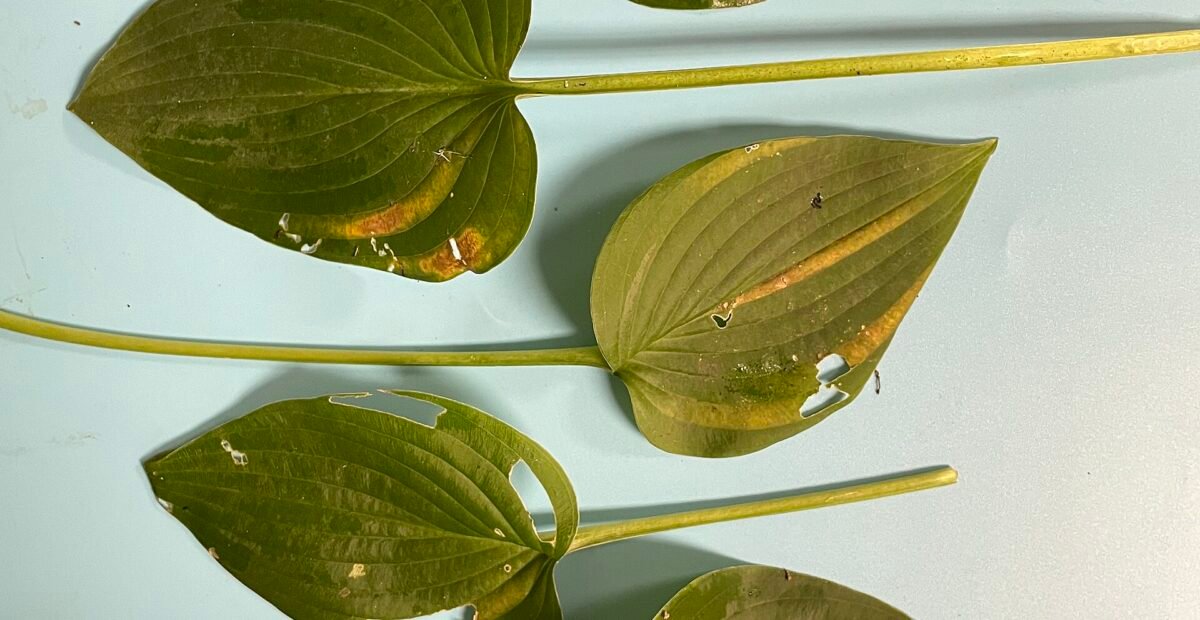
Strawberry foliar nematode
Aphelenchoides fragariaeStrawberry foliar nematode overview
The strawberry foliar nematode, Aphelenchoides fragariae, is a microscopic pest of strawberry foliage and crowns that also affects many ferns, herbaceous perennials and vegetatively propagated ornamentals. It moves through films of water on wet plant surfaces, so symptoms are most likely in humid, densely planted or frequently overhead-irrigated conditions. Confirmation requires microscopic laboratory examination because symptoms overlap with other stresses and foliar nematodes.
Typical conditions
Overview
Aphelenchoides fragariae is a foliar nematode associated particularly with cultivated strawberry and a broad, variable range of ornamental hosts. Unlike root-knot nematodes, it primarily occupies leaves, crowns, buds and stems. On strawberries it may produce crinkled or distorted new growth, stunting and reduced fruit development; on ornamentals, symptoms range from angular leaf lesions to localized browning, distortion and dieback.
Host records vary by nematode population, plant cultivar and diagnostic method. A confirmed record should therefore be interpreted for the particular host and production site rather than assumed from a broad host list.
Symptoms and identification
Symptoms are often strongest in new growth. Strawberry plants may show tightly crimped, curled, twisted or puckered young leaves, shortened petioles, a flattened or dwarfed crown, delayed growth and small or misshapen fruit. Older leaves may remain comparatively normal, especially early in an infestation.
On ornamental hosts, lesions may be angular or banded because veins restrict movement through the leaf. Fern pinnae can develop discrete brown lesions; monocot leaves may show stripes or rectangular panels. Severe infestations can cause premature leaf drop, bud injury, flower distortion or plant collapse. Symptoms alone cannot reliably distinguish A. fragariae from other foliar nematodes or non-nematode injury.
Causes and spread
Spread occurs primarily with infected transplants, cuttings, divisions, crowns and contaminated plant debris. On-site movement is favored by splashing water, overhead irrigation, rain-driven wetness, wet tools, workers' hands and contact between crowded plants. Nematodes can move in surface water films from stems into young leaves and neighboring plants.
Because they can survive in dry plant material and use fungi as food, infested debris, propagation areas and reused containers can maintain risk even when obvious symptoms disappear. Soil sampling alone may miss an infestation; symptomatic foliage and leaf bases are more useful for diagnosis.
Life cycle and persistence
Adults and juveniles feed on or within moist aboveground plant tissue, and eggs are laid in protected plant parts. Under favorable conditions, development from egg to adult can take roughly 8–14 days, allowing multiple generations during a growing season. Active movement requires a continuous or intermittent water film: nematodes travel up stems and across wet leaves, enter through natural openings or damaged tissue, and spread to adjacent plants.
When plant tissue dries gradually, individuals can enter a dormant, desiccation-tolerant state in dry foliage or other plant debris. They may also survive and feed on fungi, which helps explain why ordinary crop rotation does not reliably eliminate them.
Treatment and control
First confirm the diagnosis. Collect several symptomatic young leaves, leaf bases and crown tissue, keep them cool and moist—not submerged—and send them promptly to a state, university or qualified nematology diagnostic laboratory. A laboratory should distinguish A. fragariae from other foliar nematodes and from mites, thrips, fungal or bacterial lesions, nutrient disorders and herbicide injury.
- Remove and destroy severely affected plants and nearby symptomatic propagation material.
- For valuable plants with limited symptoms, remove affected leaves and improve irrigation, spacing and ventilation; this may reduce spread but may not eradicate the nematode.
- Do not propagate from an affected plant or move it to another bed, greenhouse or community garden.
- For commercial strawberry production, consult the state extension specialist, crop consultant and current state label database before selecting any intervention.
There is no dependable universal rescue treatment for an established infestation in garden plants. Replanting with clean material after thorough sanitation is often more reliable than trying to cure symptomatic crowns.
Low-impact and biological control
Use an exclusion-first approach. Buy nematode-free or certified strawberry transplants and nursery stock from reputable suppliers, and isolate new plants before placing them among established collections. Inspect young growth and discard plants with unexplained crimping or angular foliar lesions.
- Remove and bag heavily infested plants; do not compost suspect foliage unless the composting process is reliably managed.
- Keep foliage as dry as practical. Use drip or soaker irrigation, water early enough for leaves to dry, improve spacing and ventilation, and avoid working among plants while they are wet.
- Disinfect benches, trays, tools and hands after handling suspect plants; remove volunteer strawberries and weed hosts around production areas.
- Where appropriate, replace contaminated container media and sanitize pots and propagation equipment.
No biological or organically acceptable product should be assumed effective against this species without crop-specific evidence and legal registration. Biological products may support general plant health but do not replace exclusion and sanitation.
Prevention
Start with clean planting stock and keep incoming plants separate for observation. In commercial nurseries, maintain clean propagation zones, sanitize reusable equipment and avoid moving from suspect blocks to clean blocks. In home gardens, remove volunteer strawberry plants and promptly discard plants showing progressive distortion.
- Prefer drip irrigation and increase plant spacing where foliage remains wet after watering.
- Provide air movement and avoid excessive humidity in greenhouses and enclosed plant displays.
- Do not take cuttings or divisions from plants with unexplained leaf distortion or angular lesions.
- Mark suspect areas and obtain a laboratory diagnosis before distributing plant material.
- Use a documented sanitation and scouting schedule, checking young leaves, leaf axils and crowns during warm, wet periods.
Hot-water treatment has been described for strawberry planting material in phytosanitary protocols, but temperature, duration, plant condition and cultivar tolerance are critical. It should be undertaken only under an appropriate professional protocol; improvised treatment can kill the plants and is not a general home-garden remedy.
Interesting facts
The name can be misleading: A. fragariae is not restricted to strawberry and is documented from many ornamental plants, including ferns and herbaceous perennials. Conversely, crimped strawberry growth can also be caused by other foliar nematode species, so the common symptom name is not proof of species identity.
Foliar nematodes are unusual among plant-parasitic nematodes because many Aphelenchoides species primarily feed on fungi, while some populations can switch to living plant tissue. This biology makes sanitation and exclusion more dependable than relying on soil treatments alone.
Do not apply a pesticide solely from a visual diagnosis. In the United States, use only a product legally authorized and currently labeled for the specific crop, site and nematode problem in your state; follow the entire current label, including personal protective equipment, application limits, reentry and preharvest intervals. For home gardens and ornamentals, effective routine chemical control is generally limited, so sanitation and exclusion are the primary measures.
Affected plants
The plants below are linked to this problem by structured host-plant data. The list updates automatically as new plant profiles are added.
 Abelia ‘Edward Goucher’Abelia 'Edward Goucher'
 Abelia ‘Francis Mason’Abelia 'Francis Mason'
 Abelia chinensis care guideAbelia chinensis
 Abelia chinensis ionandra care guideAbelia chinensis ionandra
 Abelia macrotera schumannii care guideAbelia macrotera schumannii
 Large-flowered Abelia (Abelia uniflora) care guideAbelia uniflora
 Anemone ‘Whirlwind’Anemone 'Whirlwind'
 Winter windflower (Anemone blanda) care guideAnemone blanda
 Anemone alba Goaty & Pons (Anemone coronaria) care guideAnemone coronaria
 Wood Anemone (Anemone nemorosa) care guideAnemone nemorosa
 Anemone pamina care guideAnemone pamina
 Snowdrop Anemone (Anemone sylvestris) care guideAnemone sylvestris