
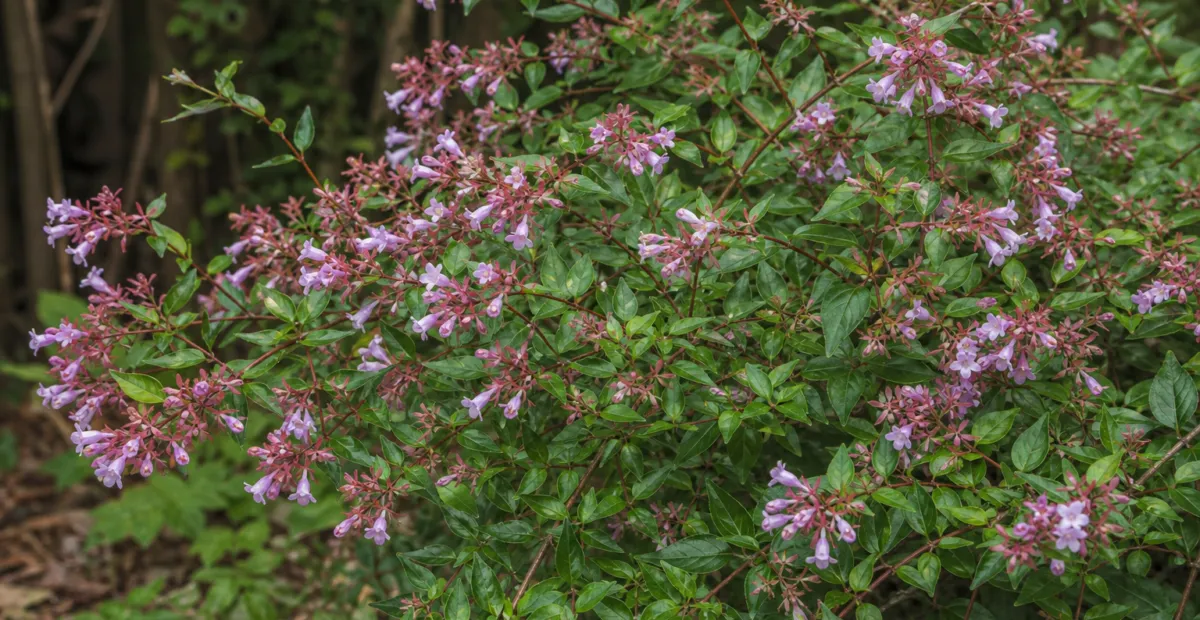
 AI-generated illustration
Abelia macrotera schumannii short overview
Abelia macrotera schumannii is a taxonomically uncertain name linked to a Chinese abelia complex that includes forms now treated in relation to Abelia schumannii and Abelia macrotera. The plant is best understood as a semi-evergreen to seasonally deciduous woody shrub with reddish stems, small ovate leaves, and tubular pink to lilac flowers backed by persistent reddish calyces. In the United States, it is best suited to a warm, sheltered site with sun and sharply drained soil.
Taxonomic classification
Abelia macrotera schumannii care guide
Light and placement
Give full sun for the best flowering, ideally in a south- or east-facing position protected from strong winter wind. Partial shade is tolerated, especially in hot climates, but deep shade can produce lanky growth and fewer flowers. Scorched leaf edges suggest excessive reflected heat or drought; long internodes and sparse bloom indicate insufficient light.
Watering and humidity
Water deeply when the upper few inches of soil begin to dry, especially during the first two growing seasons and during summer heat. Reduce frequency after leaf fall or in cool weather, but do not allow container roots to remain bone-dry for long periods. Drainage is more important than constant moisture; saturated soil can damage roots.
Soil and growing medium
Use fertile, well-drained loam or sandy loam with good air space around the roots. The broader Abelia group tolerates acidic, neutral, and mildly alkaline soils, but persistent waterlogging should be avoided. Incorporating organic matter is useful in poor soil, while heavy clay should be amended or raised for drainage.
Feeding
Feed in spring as growth begins with a balanced slow-release shrub fertilizer, or top-dress with finished compost. Use the label rate rather than heavy feeding, which can produce weak shoots and reduce winter resilience. Do not fertilize drought-stressed, newly transplanted, or dormant plants; water after applying granular products.
Growth and habit
This is a woody, multi-stemmed shrub with an erect to spreading or arching habit. It can become open and twiggy in insufficient light, while pruning after flowering or in late winter can maintain a denser outline. Plants may be semi-evergreen in mild winters and more deciduous in colder parts of the United States.
Planting and repotting
Plant in spring after severe freezes have passed, or in early fall where winters are mild enough for root establishment. Set the root flare level with the soil surface, water deeply, and mulch lightly without touching the stems. Allow roughly 5–8 feet between plants where a full mature shrub is intended; closer spacing creates a looser informal mass.
Repot container-grown plants in spring, moving only one pot size larger. Refresh the upper layer of mix annually if the root system is not crowded. Use a free-draining shrub mix rather than a water-retentive indoor-plant compost, and avoid burying the stem crown.
Propagation and pruning
Propagation
Use softwood cuttings in early summer or semi-hardwood cuttings in late summer. Take healthy non-flowering shoots, remove lower leaves, insert into a clean, sharply drained rooting medium, and maintain high humidity without saturation. Seed is possible but may be slow, variable, and difficult to source accurately for this taxon.
Pruning
Prune lightly after flowering to remove weak, crossing, or damaged stems and to shape the shrub. If rejuvenation is needed, remove a portion of the oldest stems at the base rather than shearing the whole plant. Avoid late-summer heavy pruning in cold climates because it can stimulate tender regrowth before winter.
Overwintering
In USDA Zone 7, plant in a sheltered microclimate and mulch the root zone after the ground cools. In colder zones, expect dieback or grow it in a container that can be moved into an unheated but protected space. Avoid warm indoor rooms, which can disrupt dormancy and encourage weak growth.
Uses
Primarily an ornamental shrub for warm borders, sheltered wall plantings, informal screens, specimen use, and large containers. Its late-season tubular flowers and persistent calyces provide ornamental interest. It has no established culinary or medicinal use in the evidence reviewed.
Appearance
Young shoots are often reddish or purplish and hairy, becoming reddish-brown with age and sometimes developing flaking bark. Leaves are opposite or occasionally arranged in threes on vigorous shoots, ovate to elliptic, small to medium-sized, and green with possible gray-green undersides. Flowers are tubular, with a conspicuous throat and persistent reddish sepals.
Flowering
The exact taxon is poorly represented in horticultural references, but associated Abelia schumannii material bears solitary or clustered, funnel-shaped tubular flowers on current-season growth. Flowers are generally white to pink or lilac-pink, often with orange or amber markings in the throat, and are set off by persistent reddish calyx lobes. Bloom is typically from summer into early autumn in temperate cultivation.
Pollination and visitors
Abelia flowers are generally associated with insect visitation, and related Abelias are often visited by butterflies and other insects. However, reliable visitor records for the exact taxon Abelia macrotera schumannii were not located, so no pollinator group is assigned with confidence.
Diseases and pests
Diseases
Generally low disease pressure when grown in well-drained soil. Honey fungus is reported as a possible problem in Abelia schumannii. Prevent stress with good drainage, avoid chronic overwatering, remove badly affected material, and improve air circulation rather than relying on routine fungicide use.
Pests
Usually relatively pest-free. Monitor new growth for aphids, scale, and sap-feeding insects, especially on stressed container plants. Use water spray or hand removal first; conserve beneficial insects and reserve labeled treatments for persistent infestations.
Related diseases and pests
Only Plant Doctor profiles whose host data indicate this plant may be affected are shown here.
Toxicity and pollen
No authoritative evidence located that identifies this exact taxon as poisonous to people or pets. That absence is not proof of complete safety, and plant material should not be intentionally eaten. Prevent children and animals from chewing ornamental shrubs, particularly when the plant identity is taxonomically uncertain; contact a poison service or veterinarian if significant ingestion causes symptoms.
- Typical season
- Late spring through early autumn during flowering, but exact exposure relevance is unknown.
- Pollination / pollen
- Insect-associated floral pollen; airborne importance not established
The flowers are not documented here as a major airborne-pollen source. Because the exact taxon is obscure and species-specific aerobiological data were not found, pollen allergy relevance is marked unknown rather than assumed negligible. People with strong pollen sensitivity should avoid handling flowering material if symptoms occur.
Native habitat
The associated taxa are native to mountainous regions of central and southwestern China, where they occur in temperate forest and deep-valley environments. These settings suggest fertile but well-drained soils, summer moisture, and protection from desiccating exposure. The exact infraspecific application of the supplied name remains uncertain.
Interesting fact
The name sits within one of the most taxonomically difficult groups of cultivated Abelias. Modern genetic work supports a close relationship between A. macrotera and A. schumannii, while field and cultivated specimens can be difficult to separate by appearance alone. Associated A. schumannii plants were introduced to the Arnold Arboretum by Ernest Wilson in 1910.
Frequently asked questions (FAQ)
The most relevant questions about this plant, with short and direct answers.
🌱Quick care
What is Abelia macrotera schumannii?⌄
Abelia macrotera schumannii is a cultivated botanical name associated with a Chinese abelia in the honeysuckle family, Caprifoliaceae. Its classification is treated inconsistently in modern references, so nursery labels may use related names such as Abelia schumannii or Abelia macrotera.
Is Abelia macrotera schumannii evergreen or deciduous?⌄
Abelia macrotera schumannii is best treated as semi-evergreen to deciduous, depending on winter temperatures. In mild climates it may retain foliage, while exposed or colder sites can cause substantial leaf drop.
How much sun does Abelia macrotera schumannii need?⌄
Grow Abelia macrotera schumannii in full sun to partial shade. A sheltered position with several hours of direct morning or afternoon sun generally supports denser growth and better flowering.
How often should you water Abelia macrotera schumannii?⌄
Water Abelia macrotera schumannii moderately, allowing the surface of the soil to dry slightly between thorough waterings. Increase watering during hot, dry weather and reduce it in cool seasons or consistently damp soil.
What soil is best for Abelia macrotera schumannii?⌄
Plant Abelia macrotera schumannii in well-drained loam or sandy loam. Avoid heavy, waterlogged ground because poor drainage can stress the roots and increase the risk of root problems.
🌤️Environment and placement
Where should Abelia macrotera schumannii be planted?⌄
Choose a sheltered, sunny or lightly shaded location for Abelia macrotera schumannii, such as a protected border or wall-side planting. Protection from strong wind and severe winter exposure is especially important in the United States.
Can Abelia macrotera schumannii grow in partial shade?⌄
Yes, Abelia macrotera schumannii can grow in partial shade, but flowering and overall density may be reduced if light levels are too low. Bright filtered light or morning sun is preferable to deep shade.
Is Abelia macrotera schumannii cold hardy?⌄
Abelia macrotera schumannii should be grown in a protected position because its reliable cold-hardiness is not well documented for United States conditions. Winter survival is likely to depend on the specific clone, local microclimate, and exposure.
Can Abelia macrotera schumannii be grown in containers?⌄
Abelia macrotera schumannii can be grown in a large container if the pot has excellent drainage and the plant is protected from hard freezes. Container roots are more vulnerable to winter cold than roots planted in the ground.
Is Abelia macrotera schumannii suitable for a small garden?⌄
It may suit a small garden when kept compact by selective pruning, but dependable mature size information for this exact taxon is limited. Allow enough room for a naturally bushy shrub rather than planting it tightly against paths or structures.
💧Care and problems
How do you fertilize Abelia macrotera schumannii?⌄
Feed Abelia macrotera schumannii lightly in spring with a balanced, slow-release fertilizer if growth is weak. Avoid excessive nitrogen, which can produce soft leafy growth at the expense of a compact form and flowers.
Why is Abelia macrotera schumannii losing leaves?⌄
Leaf loss can be normal in cold or stressful conditions because Abelia macrotera schumannii may behave as a deciduous or semi-evergreen shrub. Sudden extensive loss during the growing season can also indicate drought, waterlogged soil, transplant shock, or winter injury.
What pests affect Abelia macrotera schumannii?⌄
Abelia macrotera schumannii is not known for a distinctive pest problem, but common shrub pests such as aphids, scale, and spider mites may occasionally occur. Inspect new growth and treat only when damage is significant.
What diseases affect Abelia macrotera schumannii?⌄
The main preventable risk is stress from poor drainage, which can contribute to root or crown problems. Good airflow, well-drained soil, careful watering, and removal of damaged growth help reduce disease pressure.
🪴Planting and repotting
When is the best time to plant Abelia macrotera schumannii?⌄
Plant Abelia macrotera schumannii in spring after severe frost has passed or in early fall while the soil is still workable. Spring is the safer choice in regions with harsh winters or uncertain hardiness.
How do you plant Abelia macrotera schumannii in the ground?⌄
Set Abelia macrotera schumannii at the same depth it grew in its container, backfill with the native soil, and water deeply. Mulch lightly over the root zone, keeping mulch a few inches away from the stems.
Does Abelia macrotera schumannii need well-drained soil?⌄
Yes, well-drained soil is essential for Abelia macrotera schumannii. If the site stays wet, improve drainage with a raised bed or choose another location rather than relying on frequent soil amendments.
Should Abelia macrotera schumannii be repotted?⌄
Repot Abelia macrotera schumannii when roots circle the container, drainage slows, or the plant dries unusually fast. Move it into a pot only one size larger and use a free-draining potting mix.
✂️Propagation and pruning
How do you propagate Abelia macrotera schumannii?⌄
Softwood cuttings in early summer or semi-hardwood cuttings in late summer are the most practical propagation methods reported for closely related cultivated Abelias. Use clean tools, a sterile, well-drained medium, and consistently moist—not saturated—conditions.
Can Abelia macrotera schumannii be grown from seed?⌄
Seed propagation may be possible, but it is not the most predictable method for Abelia macrotera schumannii and may be difficult to source or authenticate. Cuttings are preferable when preserving the characteristics of a known plant.
When should Abelia macrotera schumannii be pruned?⌄
Prune Abelia macrotera schumannii after flowering or in late winter before new growth begins, depending on the local climate. Remove dead or damaged wood first, then thin selected older stems rather than shearing the whole shrub routinely.
How hard can you prune Abelia macrotera schumannii?⌄
Abelia macrotera schumannii can tolerate substantial rejuvenation pruning when necessary, but hard pruning should be occasional rather than annual. Remove up to about one-third of older stems at a time to encourage fresh growth while preserving the plant’s form.
⚠️Toxicity and safety
Is Abelia macrotera schumannii toxic to dogs or cats?⌄
No specific toxicity is documented for Abelia macrotera schumannii, but it should not be eaten by pets or people. Prevent ingestion of plant material and contact a veterinarian or poison-control service if a significant amount is consumed.
Is Abelia macrotera schumannii safe to plant around children?⌄
Abelia macrotera schumannii has no specific documented toxicity, but it is still best treated as an ornamental plant rather than an edible one. Teach children not to chew leaves, flowers, berries, or other unidentified plant parts.
🌸Flowering and special interest
When does Abelia macrotera schumannii bloom?⌄
Abelia macrotera schumannii is expected to flower in summer and may continue into early fall in suitable conditions. The exact bloom period can vary with the clone, spring temperatures, sunlight, and winter damage.
What do the flowers of Abelia macrotera schumannii look like?⌄
The flowers are tubular to funnel-shaped and typically arranged in small clusters, with a corolla that can widen toward the mouth. Color and flower shape may vary because the name has been applied inconsistently to related Abelia forms.
Why is Abelia macrotera schumannii not flowering?⌄
Insufficient light, excessive nitrogen, winter injury, drought, or heavy pruning at the wrong time can reduce flowering. Move or maintain the plant in brighter light and avoid cutting away new flowering wood shortly before bloom.
Similar plants
 Yellow lantern chili (Capsicum chinense) care guideCapsicum chinense
 Capsicum baccatum care guideCapsicum baccatum
 Serrano (Capsicum annuum ‘Serrano’)Capsicum annuum 'Serrano'
 Purple Beauty (Capsicum annuum ‘Purple Beauty’)Capsicum annuum 'Purple Beauty'
 Numex Twilight (Capsicum annuum ‘Numex Twilight’)Capsicum annuum 'Numex Twilight'
 Explosive Ember Chili Pepper (Capsicum annuum ‘Explosive Ember’)Capsicum annuum 'Explosive Ember'