
 Source:
 Snowdrop Anemone (Anemone sylvestris) short overview
Snowdrop Anemone is a hardy, rhizomatous perennial for spring gardens, with white, cup-shaped flowers held above divided green foliage. Native across temperate Eurasia, it performs best in fertile, well-drained soil with consistent moisture and sun to partial shade. Established plants can spread into attractive colonies, making them useful for beds, woodland edges, rock gardens, and informal groundcover. Fresh sap can irritate skin and should not be eaten.
Taxonomic classification
Snowdrop Anemone (Anemone sylvestris) care guide
Light and placement
Grow in full sun in cooler climates or partial shade where summers are hot. Morning sun and afternoon protection suit exposed sites, while woodland edges should remain bright rather than deeply shaded. Too little light produces weak, floppy growth and fewer flowers; intense heat combined with dry soil can scorch foliage and shorten bloom.
Watering and humidity
Water deeply when the upper inch of soil begins to dry during the growing season, keeping the root zone evenly moist but never saturated. Newly planted divisions need more frequent checking; established plants tolerate brief dry spells if mulched. Reduce watering after foliage dies back, but do not allow container rhizomes to remain bone-dry for long periods.
Soil and growing medium
Use fertile, well-drained loam that holds some moisture without becoming waterlogged. The species is associated with calcareous soils in parts of its native range and generally tolerates neutral to mildly alkaline conditions; avoid dense, stagnant clay unless it is amended with organic matter and drainage is improved.
Feeding
Top-dress with compost in early spring or apply a balanced, slow-release perennial fertilizer at label rate as growth begins. Avoid heavy nitrogen, which can produce lush foliage with weaker stems and may encourage disease. Do not feed drought-stressed, newly divided, or dormant plants; water first and resume feeding only after active growth is established.
Growth and habit
This perennial develops from short, branching rhizomes and gradually forms spreading colonies. The foliage emerges from the base, while flowering scapes rise separately above it. Give colonies room to expand, divide them when they become congested, and use edging if the plant begins moving beyond its intended area.
Planting and repotting
Plant nursery divisions or potted plants in spring or early fall while temperatures are moderate. Set the crown and rhizomes at the same depth as previously grown; do not bury the crown deeply. Space plants about 12–18 inches apart to allow colonies to develop while maintaining airflow. Water thoroughly after planting and keep evenly moist during establishment.
Repot container-grown plants in early spring or early fall, using a deep container with drainage holes and a loamy, humus-rich mix. Handle the rhizomes gently and replant at the same depth. Container plants may need division when the root mass becomes crowded or flowering declines.
Propagation and pruning
Propagation
Divide established rhizomatous clumps in early spring or early fall, replanting divisions promptly. Seed propagation is possible but may be slow and uneven; fresh seed generally benefits from a cool moist stratification period. Keep seed beds evenly moist and expect juvenile plants to require time before flowering.
Pruning
Remove spent flower stems after bloom if self-seeding or untidy seed heads are unwanted. Allow foliage to remain until it yellows naturally so the rhizomes can replenish reserves. Cut back dead foliage in late fall or early spring before new growth resumes. Avoid cutting into emerging crowns.
Overwintering
Plants in Zones 4–8 generally overwinter outdoors without special protection. In colder or exposed gardens, apply a loose 2–3 inch mulch after the ground begins to freeze, keeping material away from the crown. Container plants are more vulnerable to root freezing; group pots in a sheltered location and prevent repeated thawing and refreezing.
Uses
Primarily an ornamental perennial for spring borders, woodland edges, rock gardens, cottage gardens, and informal groundcover. Its spreading rhizomes can help fill open soil but may require edging in small beds. It is not recommended for culinary or home medicinal use because fresh tissues contain irritating compounds.
Appearance
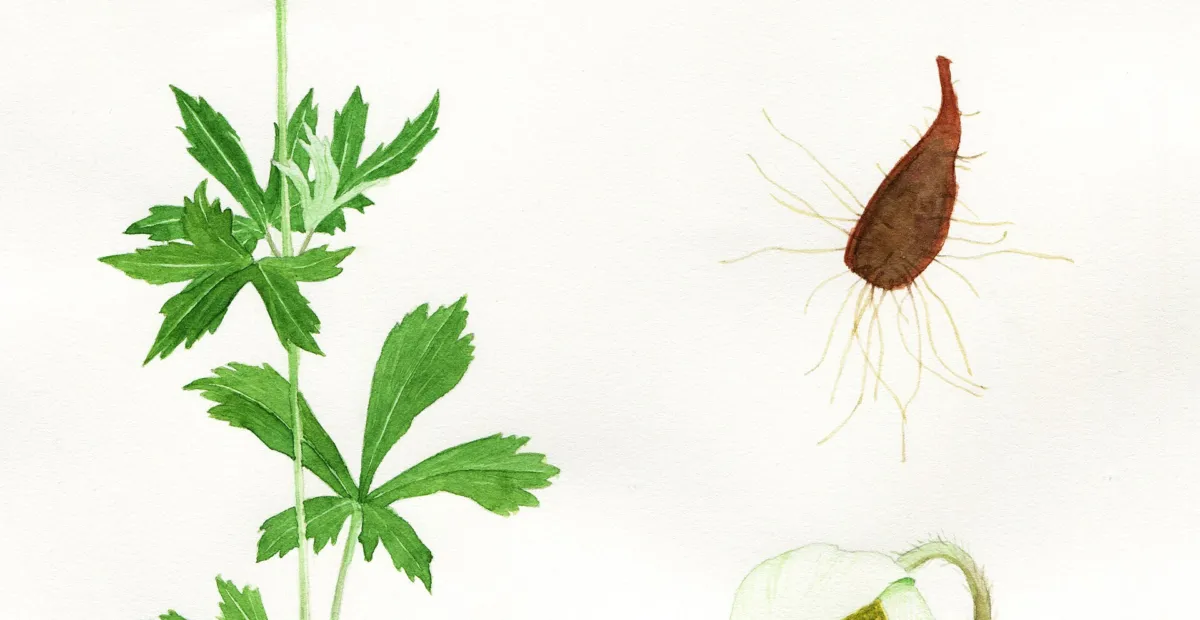
The plant forms a low colony of long-petioled, deeply divided basal leaves. Flowering scapes are upright and lightly hairy, with smaller divided bracts near the upper stem. Flowers are white and cup-shaped, with silky hairs on the outer surface of the sepals. After flowering, woolly achenes form rounded, textured seed heads.
Flowering
Flowers are usually produced singly or in small cymes on upright, lightly hairy scapes. The white, petal-like sepals open in late spring and may be followed by attractive woolly seed heads. Flowering is typically concentrated from April through June in much of the United States, with earlier or later bloom according to latitude and spring temperatures.
Pollination and visitors
The flowers are pollen-rich and lack nectaries, so they are visited primarily by pollen-collecting insects rather than nectar-seeking moths. Published work documents varied insect visitors, including bees, hoverflies and other flies, beetles, wasps, and other small insects. Exact visitor composition can vary by site and season.
Anemone sylvestris photos
Click any photo for a larger view. Source, author and license are shown separately.
Diseases and pests
Diseases
Watch for powdery mildew, leaf spots, and crown or root rot in crowded or poorly drained sites. Improve air circulation, water at the soil line, remove diseased foliage, and avoid working among wet plants. Reduce irrigation and improve drainage if crowns remain persistently saturated.
Pests
Slugs and snails may damage young foliage, especially in damp spring weather. Monitor new growth and reduce hiding places around the planting. Aphids can occasionally cluster on tender stems; use a strong water spray or an appropriate labeled treatment only when needed. Avoid broad-spectrum insecticides during bloom to reduce harm to flower visitors.
Related diseases and pests
Only Plant Doctor profiles whose host data indicate this plant may be affected are shown here.
 DiseaseAster yellows‘Candidatus Phytoplasma asteris’
 PestStrawberry foliar nematodeAphelenchoides fragariae
 DiseaseMaple powdery mildewSawadaea bicornis
 DiseaseCucurbit Powdery MildewPodosphaera xanthii (Castagne) U. Braun & Shishkoff
 DiseaseRose powdery mildewPodosphaera pannosa
 PestBrown planthopperNilaparvata lugens (Stål)
 PestRosy Apple AphidDysaphis plantaginea
 DiseaseApple Powdery MildewPodosphaera leucotricha
Toxicity and pollen
Fresh tissues of Anemone species contain ranunculin, which can convert to the irritating compound protoanemonin when plant material is bruised or chewed. Contact with sap may cause skin irritation, and ingestion can cause mouth or gastrointestinal irritation. Wear gloves when handling damaged foliage or roots and keep the plant away from children and pets that chew plants. Dried material is less irritating, but it is not an edible plant.
- Typical season
- April–June in much of the United States
- Pollination / pollen
- Insect-dispersed pollen, usually released within flowers
This is an insect-pollinated flowering plant with pollen presented to visitors, but reliable species-specific evidence for significant airborne allergy exposure in the United States is limited. The flowers are not generally treated as a major seasonal aeroallergen. People with strong pollen sensitivity should still avoid handling flowers closely if symptoms occur.
Native habitat
Across its Eurasian range, the species occurs in temperate regions including dry woodland margins, shrubland, meadows, meadow slopes, river-edge vegetation, and other open woodland mosaics. It is often associated with sunny or warm sites and, in parts of Europe, calcareous soils. Garden performance is best where drainage is reliable but summer drought is avoided.
Interesting fact
The flowers lack nectaries and offer pollen as the principal floral reward.
The species has more than 180 pistils in a typical flower.
Its rhizome is short, branched, and obliquely creeping.
The specific epithet sylvestris means growing in woodland.
White sepals are densely silky-haired on their outer surfaces.
Frequently asked questions (FAQ)
The most relevant questions about this plant, with short and direct answers.
🌱Quick care
How do you care for Snowdrop Anemone (Anemone sylvestris)?⌄
Grow Snowdrop Anemone in sun to partial shade, fertile well-drained soil, and consistently moderate moisture. It is a hardy perennial, but avoid waterlogged ground because saturated soil can cause root problems.
Is Snowdrop Anemone a perennial?⌄
Yes, Snowdrop Anemone is a herbaceous perennial that returns from its rhizomatous root system each year. It gradually forms spreading clumps rather than remaining as a single tight plant.
🌤️Environment and placement
How much sun does Snowdrop Anemone need?⌄
Snowdrop Anemone grows in full sun to partial shade, with partial shade often preferred in warmer climates. More sunlight can improve flowering when the soil remains evenly moist.
Can Snowdrop Anemone grow in full shade?⌄
Snowdrop Anemone can tolerate some shade, but full shade may reduce flowering and produce weaker growth. Bright woodland shade or filtered light is generally a better choice.
What USDA hardiness zones are suitable for Snowdrop Anemone?⌄
Snowdrop Anemone is suitable for cold climates and is hardy to about -22°F, roughly corresponding to USDA Zone 6 conditions or colder depending on local exposure and snow cover. Check the cultivar label because hardiness can vary slightly.
What type of soil is best for Snowdrop Anemone?⌄
Plant Snowdrop Anemone in fertile, well-drained loam that holds moderate moisture without staying soggy. Adding compost can improve poor or compacted soil, but drainage should remain a priority.
Does Snowdrop Anemone tolerate clay soil?⌄
Snowdrop Anemone can tolerate some clay soil, especially if it is improved with organic matter and does not remain waterlogged. Heavy, poorly drained clay increases the risk of root problems and may limit spreading.
💧Care and problems
How often should you water Snowdrop Anemone?⌄
Water Snowdrop Anemone when the soil surface begins to dry, keeping the root zone moderately and consistently moist. Increase watering during extended heat or drought, particularly for newly planted divisions.
Why is my Snowdrop Anemone not blooming?⌄
Poor flowering is commonly associated with insufficient light, drought stress, excessive nitrogen, or a recently divided plant that is still establishing. Move or divide it only during a suitable season and keep moisture consistent while it recovers.
Why are the leaves of my Snowdrop Anemone turning yellow?⌄
Yellow leaves can result from overwatering, poor drainage, natural seasonal dieback, or stress from drought. If the soil is wet, improve drainage and reduce watering; if flowering has finished, some yellowing may be normal.
What pests attack Snowdrop Anemone?⌄
Snowdrop Anemone generally has few serious pest problems, but slugs, caterpillars, and occasionally other foliage-feeding pests may cause damage. Inspect new growth and remove hiding places around plants when slug damage is present.
What diseases affect Snowdrop Anemone?⌄
Root rot is the main concern in persistently wet soil, while powdery mildew may occur in stressful or poorly ventilated conditions. Use well-drained soil, avoid overhead watering, and provide adequate spacing.
Are Snowdrop Anemones deer resistant?⌄
Snowdrop Anemone is generally considered resistant to deer and is often used in gardens with browsing pressure. No plant is completely deer-proof, especially when animals are hungry or young plants are newly installed.
Do rabbits eat Snowdrop Anemone?⌄
Snowdrop Anemone is commonly listed as rabbit resistant, although rabbits may still nibble it under heavy browsing pressure. Protect new plants with temporary mesh until they become established.
Does Snowdrop Anemone spread aggressively?⌄
Snowdrop Anemone can spread freely by rhizomes, especially in loose fertile soil, and may become too vigorous for a small border. Plant it where gradual naturalizing is welcome or divide it periodically to maintain boundaries.
🪴Planting and repotting
When should you plant Snowdrop Anemone?⌄
Plant Snowdrop Anemone in spring or fall when the soil is workable and temperatures are moderate. Spring planting is especially useful for divisions, while fall planting allows roots to establish before winter.
How far apart should Snowdrop Anemone be planted?⌄
Space Snowdrop Anemone about 12 to 18 inches apart for a connected planting while allowing room for its spreading habit. Use wider spacing if you want to slow the time needed for the plants to merge.
Can Snowdrop Anemone be grown in containers?⌄
Snowdrop Anemone can be grown in a large container with drainage holes, fertile potting mix, and regular watering. Containers restrict its rhizomatous spread, but the plant may need winter protection in exposed locations.
✂️Propagation and pruning
How do you stop Snowdrop Anemone from spreading?⌄
Limit spreading by dividing the clump regularly, removing unwanted rhizome sections, and avoiding especially loose soil where rapid expansion is a concern. A container or physical root barrier can also help confine the plant.
How do you propagate Snowdrop Anemone?⌄
The most practical method is division of the rhizomatous clump in early spring or fall. Replant healthy sections immediately at the same depth and keep them evenly moist while roots reestablish.
Can Snowdrop Anemone be grown from seed?⌄
Snowdrop Anemone can produce seed, but seed propagation is less predictable and slower than division. Freshly collected seed may require a cold period, and seedlings may take more than one season to reach flowering size.
When should Snowdrop Anemone be divided?⌄
Divide Snowdrop Anemone in early spring or fall, when temperatures are mild and the plant is not under heat stress. Spring division is specifically recommended by some horticultural references, while established clumps can also be divided after flowering.
Should Snowdrop Anemone be cut back after flowering?⌄
Cut back Snowdrop Anemone after flowering if the foliage becomes untidy or begins to die back naturally. Leave healthy foliage in place until it starts declining so the plant can replenish energy in its rhizomes.
⚠️Toxicity and safety
Is Snowdrop Anemone poisonous to people or pets?⌄
Snowdrop Anemone is an irritant and can be toxic if eaten in quantity. Sap may irritate skin, so wear gloves when handling it and keep plant material away from children and pets.
Can you touch Snowdrop Anemone?⌄
You can handle Snowdrop Anemone, but its sap may irritate skin. Wear gloves when planting, dividing, or cutting it back, and wash exposed skin afterward.
Is Snowdrop Anemone safe to eat?⌄
No, Snowdrop Anemone should not be eaten because ingestion can cause irritation and stomach upset and may be toxic in quantity. Seek medical or veterinary advice if a person or pet consumes it.
🌸Flowering and special interest
When does Snowdrop Anemone bloom?⌄
Snowdrop Anemone usually blooms in spring, commonly from April through June depending on climate. It may produce scattered additional flowers in early fall when growing conditions remain favorable.
What do Snowdrop Anemone flowers look like?⌄
Snowdrop Anemone produces white, cup-shaped, slightly nodding flowers with yellow stamens above divided green foliage. The blooms are often lightly fragrant and are followed by attractive fluffy seed heads.
Does Snowdrop Anemone rebloom in fall?⌄
Snowdrop Anemone may rebloom sporadically in fall, but a second flush is not guaranteed. Fall flowering is more likely when the plant has adequate moisture and avoids severe summer stress.
Is Snowdrop Anemone good for a woodland garden?⌄
Yes, Snowdrop Anemone is well suited to woodland gardens, informal borders, understory plantings, and naturalized areas with sun or filtered shade. Give it enough room because its rhizomes can spread into neighboring plants.
Is Snowdrop Anemone good for pollinators?⌄
Snowdrop Anemone attracts butterflies and other pollinators during its flowering period. Its white spring flowers also provide useful early-season garden interest.
Similar plants
 Azure Monkshood (Aconitum carmichaelii) care guideAconitum carmichaelii
 Monkshood (Aconitum ‘Stainless Steel’)Aconitum 'Stainless Steel'
 Monkshood (Aconitum ‘Bressingham Spire’)Aconitum 'Bressingham Spire'
 Golden full moon maple (Acer shirasawanum ‘Aureum’)Acer shirasawanum 'Aureum'
 Globosum (Acer platanoides ‘Globosum’)Acer platanoides 'Globosum'
 Striped maple (Acer pensylvanicum) care guideAcer pensylvanicum