
 Source:
 Large-flowered Abelia (Abelia uniflora) short overview
Large-flowered Abelia (Abelia uniflora) is a relatively uncommon Chinese shrub valued for its solitary, tubular flowers and neat, glossy foliage. In its native southeastern Chinese mountain forests, it grows as an upright woody perennial with hairy young branches and blooms from early summer into early fall. Give it sun or light shade, fertile well-drained soil, and shelter from severe winter cold; in colder parts of the United States, container culture may be the most reliable option.
Taxonomic classification
Large-flowered Abelia (Abelia uniflora) care guide
Light and placement
Grow in full sun for the strongest flowering, or partial shade in hot climates. A site with morning sun and protection from harsh afternoon heat or drying winter wind is suitable. Sparse, stretched growth and fewer flowers indicate insufficient light; scorched leaf margins suggest excessive heat, drought, or abrupt exposure.
Watering and humidity
Water deeply when the upper few inches of soil begin to dry, especially during the first two growing seasons. Keep the root zone evenly but not constantly wet. Reduce frequency in cool weather, while container plants may need more frequent checks during summer. Avoid standing water around the roots.
Soil and growing medium
Use fertile, humus-enriched soil that drains freely but does not dry excessively. A loamy woodland-style soil is suitable. The species appears adaptable across a moderately broad pH range, but avoid chronically waterlogged ground and highly compacted clay.
Feeding
Feed once in early spring as growth begins with a balanced, slow-release fertilizer at the label rate, or use a thin compost mulch. A second light application is optional in long growing seasons. Stop feeding by late summer so new shoots can harden before cold weather.
Growth and habit
This is an upright shrub that can develop several branches from the base and maintain a relatively neat form. Prune selectively after flowering or in early spring, removing weak or aging stems rather than shearing heavily. Young shoots may be hairy, helping distinguish the species from related taxa.
Planting and repotting
Plant in spring after the ground is workable, or in early fall where winters are moderate. Set the root ball level with the surrounding soil, water deeply during establishment, and mulch without touching the stems. Allow roughly 3–5 feet between plants where a naturally open shrub is desired.
Repot container plants in early spring before strong new growth begins. Move into a pot only one size larger, refresh the drainage-oriented mix, and avoid burying the crown or stem base.
Propagation and pruning
Propagation
Use semi-ripe or softwood cuttings in the growing season, or hardwood cuttings during dormancy where suitable material is available. Seed is possible but may be uncommon in cultivation and may require patience because the species is not widely propagated commercially.
Pruning
Prune lightly after flowering or in early spring. Remove dead, damaged, crossing, or weak stems at their base, and thin a few old branches when rejuvenation is needed. Avoid repeated hard shearing, which can reduce the natural arching character and remove developing flowering wood.
Overwintering
In Zones 6–7, mulch the root zone after the ground cools and place the shrub out of prevailing winter winds. Container plants are more vulnerable than plants in the ground; overwinter them in a cool, bright, protected space and water sparingly without allowing the mix to become bone-dry.
Uses
Use as an uncommon specimen shrub, sheltered border plant, woodland-edge accent, or container specimen. Its flowers and foliage can add seasonal interest, but it is not a documented culinary or medicinal plant and should not be marketed for those purposes.
Appearance
Leaves are opposite, short-petioled, ovate to occasionally elliptic, and usually glossy green. Margins are mostly entire but may have a few gland-tipped teeth. Young branches can be densely covered with short hairs. Solitary flowers in the leaf axils, persistent sepals, and yellow-marked hairy lower lips are useful identification features.
Flowering
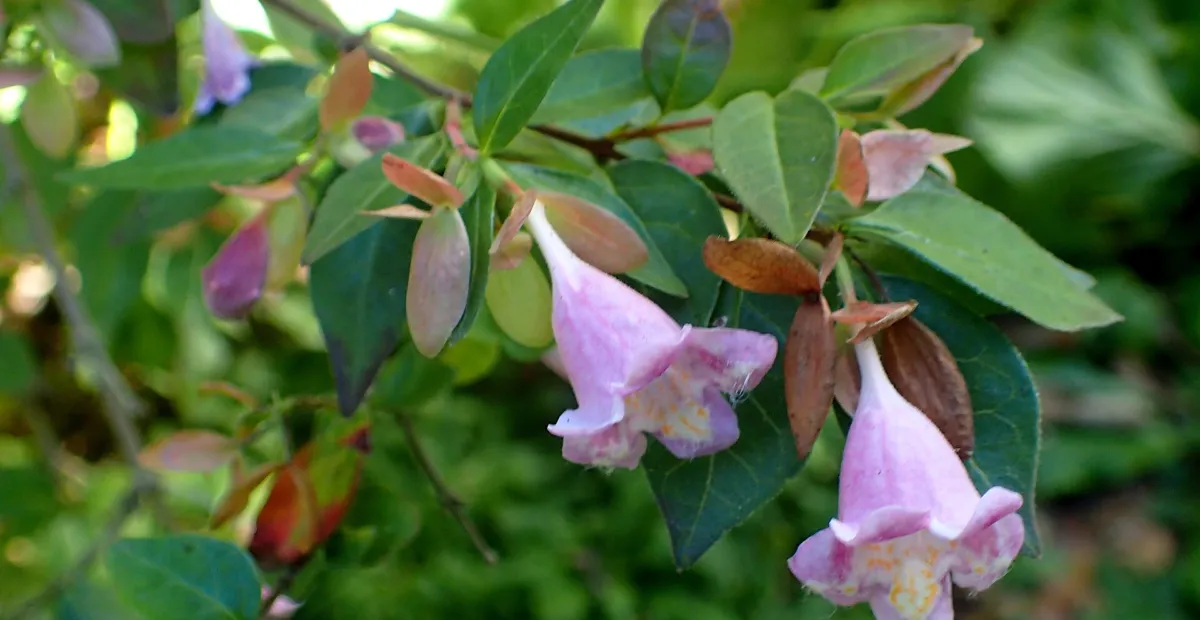
Flowers are borne singly in the leaf axils of new shoots. The corolla is funnel-shaped to slightly two-lipped, with a bulging base and a hairy lower lip. Flowers are white, sometimes pink-tinged, and may show yellow markings within the throat. Kew records flowering from June through September; Flora of China gives a broader April–June range for the variable species complex.
Pollination and visitors
The tubular, nectar-bearing flowers are consistent with visitation by bees, bumblebees, and butterflies. A specific pollinator species could not be reliably established for this exact taxon, and evidence from commonly grown Abelia hybrids should not be treated as species-specific proof.
Abelia uniflora photos
Click any photo for a larger view. Source, author and license are shown separately.
Diseases and pests
Diseases
No major species-specific disease profile is well documented. Reduce risk by providing good air circulation, avoiding persistent wet foliage, and planting in well-drained soil. Remove badly affected material and improve cultural conditions before using a pesticide.
Pests
Watch for spider mites, aphids, scale, and whiteflies, especially on stressed container plants. Inspect leaf undersides, rinse foliage when practical, improve watering consistency, and use horticultural oil or insecticidal soap only when pests are confirmed and the label permits.
Toxicity and pollen
No authoritative evidence was found establishing significant toxicity for Abelia uniflora in humans or domestic animals. Do not treat the absence of reports as proof of edibility; discourage chewing plant material and seek medical or veterinary advice after a substantial ingestion.
- Typical season
- During flowering, typically June–September in the United States when grown outdoors.
- Pollination / pollen
- Insect-dispersed pollen
Abelia flowers are insect-pollinated, so pollen is not typically released in large airborne clouds. Direct allergy evidence for pure Abelia uniflora is limited; sensitive people may still react to contact with flowers or pollen, especially during prolonged bloom.
Native habitat
The species is native to southeastern China, particularly mountain regions associated with Fujian, Jiangxi, Zhejiang, and southern Anhui. It occurs in mixed forests and thickets from roughly 2,000–3,900 feet, favoring temperate conditions and soils that retain some moisture while draining well.
Interesting fact
The species name uniflora refers to its solitary flowers, contrasting with related Abelias that commonly bear paired flowers. Its flowers have a distinctly bilabiate structure, a hairy lower lip, and yellow internal markings. It is native to southeastern China and is associated with mountain forests and thickets.
Frequently asked questions (FAQ)
The most relevant questions about this plant, with short and direct answers.
🌱Quick care
What is Large-flowered Abelia (Abelia uniflora)?⌄
Large-flowered Abelia is a deciduous to semi-evergreen flowering shrub in the honeysuckle family, Caprifoliaceae. It is a distinct species from the more commonly sold hybrid Abelia × grandiflora, although the two are often confused.
Is Abelia uniflora easy to grow?⌄
Abelia uniflora is generally manageable in a suitable site, but it is uncommon in United States cultivation and may be harder to source than hybrid abelias. Its main requirements are good drainage, moderate moisture, summer warmth, and protection from severe winter exposure.
How much sunlight does Abelia uniflora need?⌄
Plant Abelia uniflora in full sun to partial shade. More sun generally supports denser growth and better flowering, while too much shade can produce weaker, leggier growth.
How often should I water Abelia uniflora?⌄
Water Abelia uniflora moderately, keeping the soil evenly moist while it establishes. Once established, allow the surface to dry slightly between waterings, but provide supplemental water during prolonged heat or drought.
Is Abelia uniflora the same plant as glossy abelia?⌄
No. Glossy abelia usually refers to Abelia × grandiflora, a hybrid involving Abelia uniflora and Abelia chinensis, whereas Large-flowered Abelia is the separate species Abelia uniflora.
🌤️Environment and placement
What USDA hardiness zone is Abelia uniflora suitable for?⌄
Abelia uniflora is generally associated with USDA Hardiness Zone 6, although winter performance can vary with cultivar identity, local exposure, and establishment. In colder parts of Zone 6, place it in a sheltered site and protect the root zone with mulch.
Can Abelia uniflora survive winter in the United States?⌄
Abelia uniflora can survive winter in suitable parts of the United States, especially in protected Zone 6 and warmer locations. Cold winds, exposed sites, and abrupt temperature drops may cause stem dieback even when the roots survive.
Where should I plant Abelia uniflora?⌄
Choose a warm, sheltered location with full sun to partial shade and well-drained, humus-rich soil. Protection from prevailing winter winds is especially useful in borderline climates.
Can Abelia uniflora grow in a container?⌄
Abelia uniflora can be grown in a container if the pot has excellent drainage and the plant receives ample light. In colder regions, container plants need winter protection because their roots are more exposed to freezing temperatures.
What type of soil does Abelia uniflora prefer?⌄
Abelia uniflora prefers loamy, humus-rich, well-drained soil. Improve compact or poor soil with organic matter, but avoid planting it where water remains around the roots after rain.
Does Abelia uniflora tolerate drought?⌄
Abelia uniflora has some drought tolerance after establishment, but it performs best with moderate, consistent moisture. Drought stress is more likely during hot weather, in containers, or in sandy soil.
💧Care and problems
Why is my Abelia uniflora not flowering?⌄
Insufficient sunlight, excessive nitrogen, drought stress, or winter damage can reduce flowering in Abelia uniflora. It also needs adequate summer warmth, so a cool or heavily shaded site may produce foliage but few flowers.
Does Abelia uniflora lose its leaves in winter?⌄
Abelia uniflora may be deciduous or semi-evergreen depending on winter temperatures and exposure. In colder areas it can lose most or all of its leaves, while sheltered locations may retain some foliage.
What pests affect Abelia uniflora?⌄
No major pest problem is consistently documented for Abelia uniflora. Monitor plants for common shrub pests such as aphids or spider mites, particularly when the plant is drought-stressed or overwintered indoors.
What diseases affect Abelia uniflora?⌄
Serious diseases are not commonly associated with Abelia uniflora. Poor drainage and persistent wet soil are the main cultural risks because they can encourage root problems.
Should I fertilize Abelia uniflora?⌄
Fertilize Abelia uniflora only if growth is weak or a soil test indicates a nutrient deficiency. A thin spring layer of compost is usually preferable to heavy nitrogen fertilization, which can encourage leaves at the expense of flowers.
🪴Planting and repotting
When is the best time to plant Abelia uniflora?⌄
Plant Abelia uniflora in spring after severe frost has passed or in early fall while the soil is still workable. Spring planting is safer in colder regions because it gives the root system more time to establish before winter.
How do I plant Abelia uniflora in the ground?⌄
Dig a hole about twice as wide as the root ball and no deeper than the existing root flare, then backfill with the native soil and water thoroughly. Apply a 2- to 3-inch layer of mulch while keeping it away from the stems.
How far apart should Abelia uniflora plants be spaced?⌄
Space Abelia uniflora according to its mature size, which can be difficult to predict because the species is rarely grown and is often confused with hybrids. Leave enough room for its arching, multi-stemmed habit rather than planting it as a tightly clipped hedge.
✂️Propagation and pruning
How can I propagate Abelia uniflora?⌄
Abelia uniflora is most practically propagated from stem cuttings, with layering also possible. Seed propagation may work but is less predictable and may not reproduce desirable characteristics exactly.
When should I take Abelia uniflora cuttings?⌄
Take softwood or semi-ripe cuttings during active growth, using healthy nonflowering shoots. Keep the cuttings humid in a sterile, free-draining medium until roots form, because exact rooting performance for this uncommon species is not well documented.
Can Abelia uniflora be grown from seed?⌄
Abelia uniflora can produce one-seeded fruits, but seed availability and germination information are limited. Fresh, properly handled seed may require patience and controlled conditions, so cuttings are usually the more dependable option.
When should I prune Abelia uniflora?⌄
Prune Abelia uniflora in late winter or early spring, after the worst cold has passed and before vigorous new growth begins. Remove winter-damaged wood first, then thin crowded stems or shorten selected branches to maintain its natural shape.
Can I cut Abelia uniflora back hard?⌄
A mature Abelia uniflora may tolerate renovation pruning, but hard cutting can reduce flowering for that season and may stimulate vigorous shoots. In cold climates, wait until spring so you can distinguish living wood from winter-killed stems.
⚠️Toxicity and safety
Is Abelia uniflora poisonous to people or pets?⌄
No significant toxicity is documented for Abelia uniflora, but it is not established as an edible plant. Keep plant material away from children and pets and do not consume it without reliable species-specific safety information.
Is Abelia uniflora deer resistant?⌄
Reliable deer-resistance information for true Abelia uniflora is limited. Do not treat it as deer-proof; browsing pressure depends on local deer populations and available alternative food.
🌸Flowering and special interest
When does Abelia uniflora bloom?⌄
Abelia uniflora is reported to flower from early summer into early fall, roughly June through September under favorable conditions. Flowering can be shorter in cool summers, heavy shade, or after significant winter damage.
What do Abelia uniflora flowers look like?⌄
The flowers are solitary, tubular, and pink to purplish-pink, with a bearded throat and yellow markings. Persistent reddish sepals remain after flowering and add ornamental interest.
Are Abelia uniflora flowers fragrant?⌄
Abelia flowers are often described as scented, but the strength of fragrance in true Abelia uniflora is not consistently documented. Do not assume it will have the same fragrance or flowering display as a named Abelia hybrid.
Does Abelia uniflora attract pollinators?⌄
The tubular flowers of Abelia uniflora are likely useful to insect pollinators, especially bees and butterflies, but species-specific United States pollinator data are limited. Its flowers are most accessible and abundant when the shrub receives good sunlight.
Similar plants
 Fragrant Abelia (Zabelia tyaihyoni) care guideZabelia tyaihyoni
 Abelia ‘Francis Mason’Abelia 'Francis Mason'
 Abelia chinensis ionandra care guideAbelia chinensis ionandra
 Zabelia dielsii care guideZabelia dielsii
 Abelia ‘Edward Goucher’Abelia 'Edward Goucher'
 Abelia chinensis care guideAbelia chinensis