
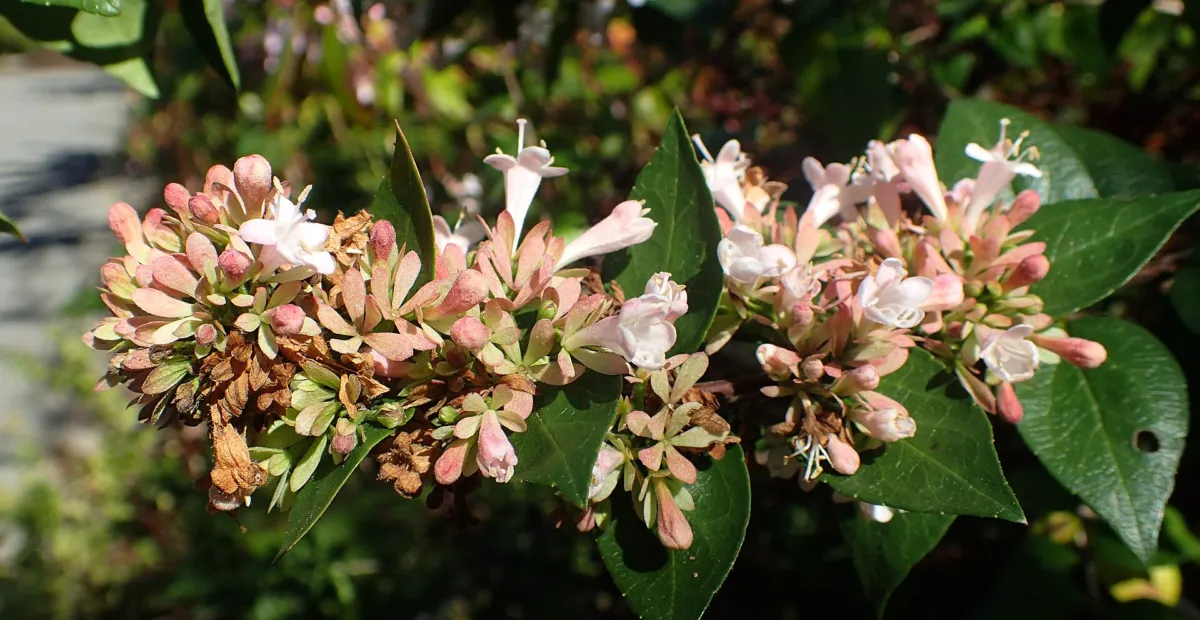
 Source:
 Abelia chinensis short overview
Abelia chinensis is a deciduous shrub from southern China, Taiwan, Vietnam, and the Nansei-shoto islands. It forms a gently arching, branching framework clothed in opposite green leaves and produces tubular, pale flowers in the warmer months. In U.S. gardens it is best suited to sheltered sites with sun or light afternoon shade, fertile soil, and reliable drainage. Its exact cold tolerance and pollinator value are less well documented than those of common hybrid abelias.
Taxonomic classification
Abelia chinensis care guide
Light and placement
Grow in full sun to partial shade, preferably with morning sun and protection from intense late-afternoon heat in hot climates. A bright, open site supports denser growth and better flowering. Too little light can produce sparse, weak branches and fewer flowers; excessive heat combined with drought may cause wilting, leaf scorch, or premature leaf drop.
Watering and humidity
Water deeply when the upper few inches of soil begin to dry, then allow excess water to drain away. Keep newly planted shrubs evenly moist during establishment; mature plants need less frequent irrigation but should not be left chronically dry during hot weather. Reduce watering in cool or dormant periods while preventing prolonged root-zone saturation.
Soil and growing medium
Use fertile, humus-enriched soil that drains freely but does not dry excessively. A loam-based soil is suitable; incorporate compost before planting if the ground is poor. Slightly acidic to neutral conditions are a reasonable target. Avoid persistently waterlogged sites, which can impair roots and increase disease risk.
Feeding
Apply a thin layer of compost in spring, or use a balanced slow-release fertilizer at the labeled rate as growth begins. Avoid heavy nitrogen feeding, which can produce soft, leafy growth at the expense of a balanced shrub form. Do not fertilize drought-stressed, newly transplanted, or dormant plants until they have resumed healthy growth.
Growth and habit
This is a woody shrub with slender branches and an arching to spreading habit. It can be maintained as an informal specimen or lightly shaped after flowering. Allow room for natural branching rather than forcing a tightly clipped hedge, and remove weak or crossing stems as needed.
Planting and repotting
Plant in spring after the soil can be worked, or in early fall where winters are moderate. Set the root flare level with the surrounding soil rather than burying the crown. Water deeply during the first growing season and mulch the root zone without touching the stems. Space plants according to the mature spread of the individual nursery selection.
Repot container plants in early spring, moving them only one pot size larger. Refresh part of the mix without heavily disturbing the root ball, and ensure the container has an open drainage hole. Because this is a woody shrub, long-term containers require occasional root pruning or replacement with a larger vessel.
Propagation and pruning
Propagation
Propagate from seed or semi-ripe cuttings. Sow fresh or properly stored seed in a clean, well-drained medium; germination requirements may vary. Take cuttings during active growth, keep them evenly moist under high humidity, and use a rooting medium with good aeration. Species-specific propagation protocols are not extensively standardized.
Pruning
Prune after flowering or in late winter before strong new growth begins. Remove dead, damaged, weak, or crossing stems first, then shorten overly long branches selectively. Avoid repeated shearing, which can spoil the naturally arching habit and reduce flowering wood.
Overwintering
In Zone 7, place the shrub in a protected site away from drying winter winds and apply a light organic mulch over the root zone after the ground cools. Container plants are more vulnerable than plants in the ground; move them to a sheltered, unheated location during severe freezes. Do not keep dormant plants warm and actively growing indoors.
Uses
Primarily an ornamental shrub for sheltered borders, informal screens, woodland-edge plantings, and large containers where winter conditions permit. Its arching habit and tubular flowers provide seasonal structure, but it is less commonly available in U.S. nurseries than hybrid abelias.
Appearance
The plant is a deciduous shrub with opposite, simple leaves and slender branches that tend to arch outward. Its inflorescences occur near the shoot tips or in the leaf axils. Persistent calyx lobes remain after flowering and crown the narrow, leathery fruits, helping distinguish the fruiting stage.
Flowering
The species bears axillary or terminal clusters of tubular, five-lobed flowers. Flowers are followed by narrow, leathery, one-seeded fruits with persistent calyx lobes. Exact peak bloom timing varies with climate and collection, and species-level U.S. flowering records are limited.
Pollination and visitors
The tubular flowers are compatible with insect visitation, but reliable species-specific U.S. records identifying the principal pollinator group were not located. Do not assign a documented visitor code without stronger evidence.
Abelia chinensis photos
Click any photo for a larger view. Source, author and license are shown separately.
Diseases and pests
Diseases
Watch for root problems in wet soil, including decline associated with poor drainage. Improve air circulation, avoid frequent overhead irrigation, remove badly affected tissue, and maintain moderate soil moisture. No disease profile specific to this species is sufficiently documented to justify a more detailed diagnosis list.
Pests
Inspect new growth for aphids, scale, and spider mites, especially on stressed container plants. Encourage natural enemies, rinse foliage when practical, and improve watering consistency. Use horticultural oil only according to the product label and when temperatures are appropriate; avoid unnecessary broad-spectrum insecticides during bloom.
Related diseases and pests
Only Plant Doctor profiles whose host data indicate this plant may be affected are shown here.
Toxicity and pollen
No reliable, species-specific evidence was found establishing significant toxicity to people or pets. This absence of evidence is not proof of edibility or complete safety. Do not ingest plant material, and supervise children and animals around unfamiliar ornamental shrubs.
- Typical season
- Late summer to fall when flowering
- Pollination / pollen
- Primarily insect-dispersed pollen
Abelia chinensis is an insect-pollinated flowering shrub, so its pollen is not typically released as a large wind-borne cloud. However, species-specific airborne pollen and clinical allergy data are insufficient for a confident low-risk classification. People with significant pollen sensitivity should avoid handling flowering material if symptoms occur.
Native habitat
In nature, the species occurs in temperate parts of southern China, Vietnam, Taiwan, and the Nansei-shoto region. It is associated with warm climates and shrub or woodland-edge conditions. Garden performance is likely best in fertile, well-drained soils with protection from severe winter exposure.
Interesting fact
Kew treats Abelia chinensis as an accepted species rather than merely a horticultural hybrid. Its native range extends from southern China and Vietnam through Taiwan and the Nansei-shoto islands. The species produces leathery, one-seeded fruits crowned by persistent calyx lobes.
Frequently asked questions (FAQ)
The most relevant questions about this plant, with short and direct answers.
🌱Quick care
What is Abelia chinensis?⌄
Abelia chinensis is a fragrant, multi-stemmed flowering shrub in the honeysuckle family, Caprifoliaceae. It is commonly grown for its arching habit, long summer-to-fall bloom period, white flowers, and persistent rosy sepals.
How much sun does Abelia chinensis need?⌄
Abelia chinensis grows best in full sun to partial shade. Full sun generally produces the heaviest flowering, while light afternoon shade can help in hot, dry climates.
How often should I water Abelia chinensis?⌄
Water Abelia chinensis moderately, keeping the soil evenly moist while the plant establishes. Once established, it tolerates some drought, but prolonged dryness can reduce growth and flowering.
What soil is best for Abelia chinensis?⌄
Plant Abelia chinensis in fertile, well-drained loam that retains some moisture without becoming waterlogged. It generally performs well in acidic to neutral soil.
How large does Abelia chinensis get?⌄
Abelia chinensis typically reaches about 5 to 8 feet tall and 3 to 5 feet wide. Its arching branches create a rounded, spreading form that needs several feet of growing space.
🌤️Environment and placement
What USDA hardiness zones are suitable for Abelia chinensis?⌄
Abelia chinensis is generally suited to USDA Zones 7 through 9. In colder areas, especially Zones 5 and 6, the top may die back during winter but can sometimes resprout from the roots in spring.
Can Abelia chinensis grow in partial shade?⌄
Yes, Abelia chinensis can grow in partial shade, particularly where it receives several hours of direct light. Flowering is usually stronger in a sunnier position.
Is Abelia chinensis tolerant of heat and humidity?⌄
Abelia chinensis is tolerant of heat and humidity once established. Provide good drainage and water during extended drought, especially for newly planted shrubs.
Where should I plant Abelia chinensis in the landscape?⌄
Plant Abelia chinensis near a patio, walkway, foundation, border, or pollinator garden where its fragrance can be enjoyed. Leave enough room for its mature arching branches rather than placing it tightly against structures.
Is Abelia chinensis evergreen or deciduous?⌄
Abelia chinensis is usually deciduous in colder climates and may be semi-evergreen in warmer regions. Winter leaf retention depends on local temperatures and exposure.
Is Abelia chinensis deer resistant?⌄
Abelia chinensis is generally considered tolerant of deer browsing. No shrub is completely deer-proof, so protection may still be needed where browsing pressure is high.
💧Care and problems
Does Abelia chinensis need regular fertilizer?⌄
Abelia chinensis usually needs little fertilizer when grown in fertile soil. If growth is weak, apply a balanced slow-release fertilizer in spring according to the product label rather than overfeeding.
What are common problems with Abelia chinensis?⌄
Abelia chinensis has no major pest or disease problems commonly reported in horticultural references. Poor drainage, severe drought, winter injury, or insufficient light are more likely to cause trouble than serious infestations.
Why is my Abelia chinensis not flowering?⌄
The most common causes of poor flowering are insufficient sunlight, winter damage, drought stress, or pruning at the wrong time. Because it flowers on new wood, avoid removing the season’s new growth before blooming.
Does Abelia chinensis tolerate drought?⌄
Established Abelia chinensis can tolerate periods of drought, but it performs best with moderate moisture. Water deeply during prolonged hot, dry weather and maintain a mulch layer without covering the stems.
🪴Planting and repotting
When is the best time to plant Abelia chinensis?⌄
Plant Abelia chinensis in spring or fall when temperatures are moderate and soil moisture is reliable. Spring planting is especially useful in areas where winter cold may damage young plants.
How do I plant Abelia chinensis?⌄
Set Abelia chinensis at the same depth it grew in its container, backfill with well-drained soil, and water thoroughly. Space plants about 3 to 5 feet apart for individual specimens, allowing more room if a broad hedge is desired.
Can Abelia chinensis be grown in a container?⌄
Abelia chinensis can be grown in a large container while young, provided the pot has drainage holes and the soil drains well. Container plants need more frequent watering and may require winter protection in cold climates.
✂️Propagation and pruning
How do you propagate Abelia chinensis from cuttings?⌄
Propagate Abelia chinensis with softwood cuttings in early summer or semi-hardwood cuttings in late summer. Use healthy, nonflowering shoots in a sterile, well-drained rooting medium and maintain consistent moisture and humidity.
Can Abelia chinensis be grown from seed?⌄
Seed propagation is possible in principle, but cuttings are the more practical method for reproducing selected plants. Seed-grown shrubs may vary in growth, flowering, and other characteristics.
When should Abelia chinensis be pruned?⌄
Prune Abelia chinensis in early spring before strong new growth begins. Remove winter-damaged or weak branches and shorten overlong stems as needed to maintain its shape.
Can Abelia chinensis be used as a hedge?⌄
Yes, Abelia chinensis can be shaped into an informal hedge because its arching branches respond to pruning. Avoid shearing too severely, since a naturally rounded form displays the flowers better.
⚠️Toxicity and safety
Is Abelia chinensis poisonous to people or pets?⌄
There is no confirmed species-specific toxicity classification for Abelia chinensis in the reviewed horticultural references. Do not eat any part of the plant, and contact a medical or veterinary professional if ingestion occurs.
🌸Flowering and special interest
When does Abelia chinensis bloom?⌄
Abelia chinensis usually blooms from early summer into fall, with the main display often occurring from July through September. The exact timing varies with climate, winter damage, and growing conditions.
What do Abelia chinensis flowers look and smell like?⌄
The flowers are small, white, tubular to bell-shaped blooms arranged in clusters and are strongly fragrant. Abelia chinensis is regarded as one of the more aromatic species in the genus.
Do the sepals remain attractive after Abelia chinensis flowers fade?⌄
Yes, the rosy mauve sepals often remain after the white flowers drop and provide color into fall. This persistent display is one of the plant’s notable ornamental features.
Does Abelia chinensis attract butterflies?⌄
Abelia chinensis provides nectar for butterflies and other visiting pollinators. Planting it in full sun and avoiding broad-spectrum insecticides during bloom can improve its value to pollinators.
Similar plants
 Fragrant Abelia (Zabelia tyaihyoni) care guideZabelia tyaihyoni
 Zabelia dielsii care guideZabelia dielsii
 Abelia ‘Edward Goucher’Abelia 'Edward Goucher'
 Abelia ‘Francis Mason’Abelia 'Francis Mason'
 Large-flowered Abelia (Abelia uniflora) care guideAbelia uniflora
 Abelia macrotera schumannii care guideAbelia macrotera schumannii