
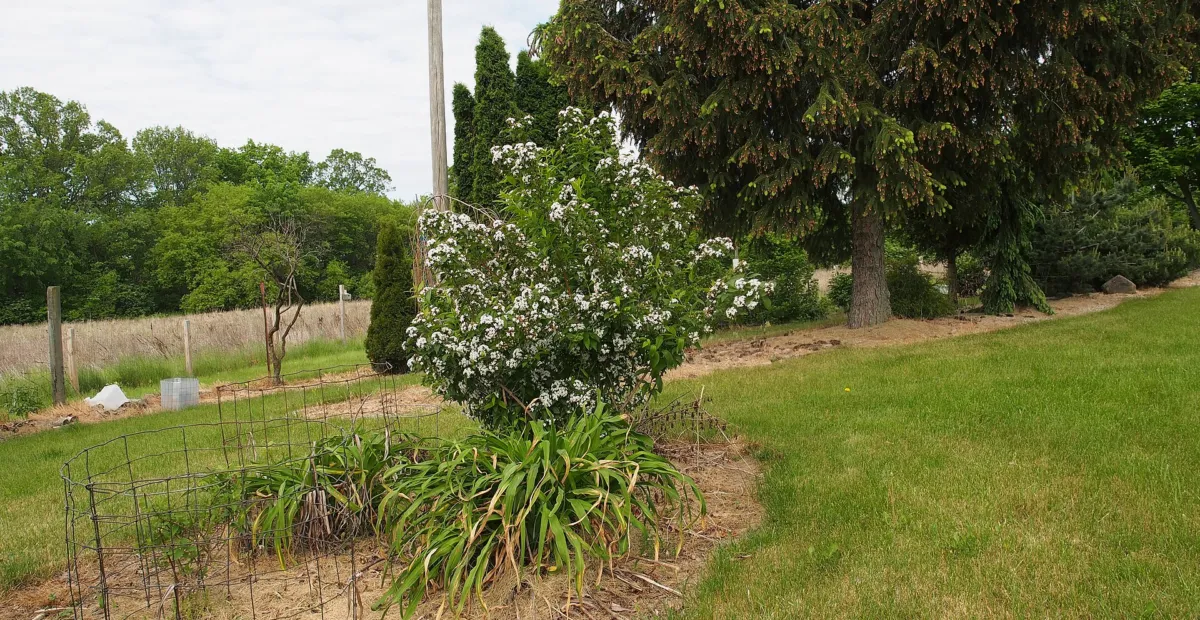
 Source:
 Fragrant Abelia (Zabelia tyaihyoni) short overview
Fragrant abelia is a hardy, deciduous Korean shrub valued for pink buds that open into intensely scented, tubular pinkish-white flowers in spring. Its glossy green leaves turn orange-red in fall, while loose, arching stems create a relaxed vase-shaped form. Plant it in sun or light partial shade with acidic, well-drained soil, and prune soon after flowering because the next season’s buds form on old wood.
Taxonomic classification
Fragrant Abelia (Zabelia tyaihyoni) care guide
Light and placement
Grow in a site receiving at least 6 hours of direct sun for the strongest flowering and best fall color. A spot with morning sun and afternoon protection can help in hot climates. Plants grown in too much shade may become open and flower sparsely; harsh reflected heat and drought can scorch foliage and reduce vigor.
Watering and humidity
Water deeply when the upper few inches of soil begin to dry, especially during the first two growing seasons. Maintain even moisture while the shrub establishes, but do not leave roots in saturated soil. Reduce supplemental watering after leaf fall, while continuing occasional winter watering during prolonged dry spells when the ground is not frozen.
Soil and growing medium
Use fertile, acidic to slightly acidic soil that drains freely but retains moderate moisture. Incorporate organic matter into poor soil, but avoid creating a sharply different planting pocket. Heavy clay should be improved with broad-area organic matter and drainage management rather than a narrow amended hole. A mulch layer helps moderate roots without touching the stems.
Feeding
Apply a thin layer of compost or a balanced slow-release shrub fertilizer in early spring as growth begins. Use only the label rate; excessive nitrogen can produce weak, leafy growth and reduce flowering. Do not fertilize drought-stressed, newly transplanted or late-season plants, because soft late growth may be more vulnerable to winter injury.
Growth and habit
This multi-stemmed shrub develops loose, upright-arching branches and may look somewhat rangy when young. Tip-pinch young plants during the growing season if a fuller framework is desired. Because flowering occurs on old wood, maintenance pruning should be timed immediately after bloom rather than late summer or fall.
Planting and repotting
Plant after the soil can be worked in spring, or in early fall with enough time for root establishment before hard freezes. Set the root flare level with the surrounding soil and water thoroughly to settle the root zone. Mulch 2–3 inches deep over the root area, leaving a small gap around the stems. Space plants according to their mature spread rather than their young nursery size.
Usually grown in the ground rather than as a long-term container shrub. If container-grown, transplant in early spring before strong growth or in early fall, moving to a pot only modestly larger than the root ball. Use a well-drained acidic mix, keep the root flare at the same level and water thoroughly after transplanting.
Propagation and pruning
Propagation
Propagation is generally by softwood or semi-ripe cuttings taken during active growth. Use clean material from healthy shoots, remove the lower leaves and root under humid, protected conditions in a free-draining medium. Rooting and subsequent establishment are moderate in difficulty; seed is less commonly used for garden production.
Pruning
Prune immediately after flowering, removing damaged, crossing or weak stems and shortening overly long shoots as needed. Avoid late-summer, fall and winter pruning because flower buds for the following spring are formed on old wood. For renewal, remove a limited number of oldest stems at the base rather than shearing the whole shrub.
Overwintering
In USDA Zones 4–5, site plants away from drying winter winds and apply a 2–3 inch mulch layer after the ground cools. Do not heavily prune before winter. Container plants have less root insulation than in-ground specimens and should be protected in an unheated sheltered location or planted out before severe winter weather.
Uses
Useful as a specimen, informal hedge, foundation planting, shrub border or mixed pollinator planting. Its spring fragrance and autumn foliage provide seasonal interest, while its arching habit suits relaxed, naturalistic designs. It is not primarily grown as a culinary or medicinal plant.
Appearance
Leaves are simple, opposite, ovate and glossy green with mostly entire margins. Stems are slender and arching, producing a rounded vase-like outline. Pink flower buds open to tubular pinkish-white blooms, and the foliage commonly develops orange to red-burgundy tones before leaf fall. The swollen leaf-stalk base and distinctive floral structure help separate Zabelia from true Abelia.
Flowering
Flower buds are pink and open into tubular, fused-petal blooms that are pinkish-white to white. The flowers appear in spring on older wood and are noted for a powerful sweet fragrance. The retained sepals can extend the ornamental display after the corollas fade.
Pollination and visitors
The fragrant tubular flowers are documented as attractive to butterflies. Other visitors may occur, but a more specific or broader visitor list is not consistently documented for this exact species in the sources reviewed.
Zabelia tyaihyoni photos
Click any photo for a larger view. Source, author and license are shown separately.
Diseases and pests
Diseases
No serious disease problems are consistently reported. Prevent stress by providing drainage, adequate spacing and good air movement. Remove badly affected foliage and avoid overhead irrigation if leaf spots appear. Do not use broad-spectrum fungicides unless the diagnosis is clear and the product is labeled for the crop and problem.
Pests
No major insect pests are consistently reported. Monitor new growth for aphids, scale or occasional chewing damage. Encourage natural enemies, wash small infestations from foliage and reserve targeted treatments for confirmed, persistent problems. Avoid unnecessary insecticides during flowering to reduce risk to visiting insects.
Toxicity and pollen
Authoritative species-specific toxicity information for humans and pets was not located in the sources reviewed. Do not treat the plant as edible or medicinal. Prevent children and animals from chewing unfamiliar plant material, and seek professional advice if ingestion causes symptoms or if a substantial amount was consumed.
- Typical season
- Spring flowering period
- Pollination / pollen
- Insect-dispersed pollen; airborne allergy relevance is not well documented.
This is an insect-pollinated flowering shrub, but reliable species-specific airborne-pollen and allergy data were not found. Fragrance should not be confused with pollen safety. People with significant seasonal allergies should observe their own response during bloom and avoid handling flowers if symptoms occur.
Native habitat
The species is native to Korea and occurs as a temperate woody shrub. In cultivation it performs best in well-drained, moderately moist acidic soil with sun or partial shade. Its cold tolerance is stronger than that of many commonly grown abelias, while hot, humid conditions can reduce performance.
Interesting fact
The species was long cultivated and sold under the name Abelia mosanensis. Its current placement in Zabelia reflects taxonomic differences from true Abelia, including distinctive floral and leaf-stalk characters. The specific epithet honors Korean botanist Tae-Hyun Chung.
Frequently asked questions (FAQ)
The most relevant questions about this plant, with short and direct answers.
🌱Quick care
What is Fragrant Abelia (Zabelia tyaihyoni)?⌄
Fragrant Abelia is a deciduous, arching shrub in the honeysuckle family, Caprifoliaceae. It is valued for intensely fragrant pink-budded, white tubular flowers and orange-red fall foliage.
How big does Fragrant Abelia get?⌄
Fragrant Abelia typically grows about 4–6 feet tall and 4–6 feet wide. Its arching, vase-shaped habit needs roughly 3–6 feet of planting space.
Is Fragrant Abelia actually an abelia?⌄
Its accepted botanical name is Zabelia tyaihyoni, although Fragrant Abelia is still widely sold under the synonym Abelia mosanensis. It is a close relative of true Abelias rather than a member of the genus Abelia.
🌤️Environment and placement
What USDA hardiness zones are suitable for Fragrant Abelia?⌄
Fragrant Abelia is generally suitable for USDA Zones 4–9 and is notably cold hardy for this group of shrubs. Performance can be weaker in hot, humid parts of the Deep South.
Does Fragrant Abelia need full sun or shade?⌄
Grow Fragrant Abelia in full sun to partial shade, with about 6 or more hours of direct sun producing the best flowering. Some afternoon shade can help in very hot climates.
Where should I plant Fragrant Abelia?⌄
Plant Fragrant Abelia in a sunny or lightly shaded location with good air circulation and well-drained soil. A spot near a walkway, patio, or window makes it easier to enjoy the strongly scented spring flowers.
What type of soil does Fragrant Abelia prefer?⌄
Fragrant Abelia prefers fertile, acidic, well-drained soil that remains moderately moist. It can tolerate a broader range of soil types when drainage is good, but avoid persistently waterlogged ground.
💧Care and problems
How often should I water Fragrant Abelia?⌄
Water Fragrant Abelia moderately, keeping the soil evenly moist while the plant establishes. Once established, it tolerates some dry periods, but water during prolonged heat or drought.
Does Fragrant Abelia tolerate heat and humidity?⌄
Fragrant Abelia tolerates ordinary summer heat but may perform poorly under prolonged heat combined with high humidity. In those regions, provide afternoon shade, good drainage, and consistent moisture.
Is Fragrant Abelia low maintenance?⌄
Yes, Fragrant Abelia is generally a low-maintenance shrub once established. Routine watering during drought and pruning immediately after flowering are usually the main tasks.
Why is my Fragrant Abelia not blooming?⌄
The most common reasons are insufficient sunlight, excessive late-season pruning, plant immaturity, or winter damage to flower-bearing wood. Fragrant Abelia blooms on old wood, so pruning after midspring or in late summer can remove next season’s buds.
What pests and diseases affect Fragrant Abelia?⌄
Fragrant Abelia is generally resistant to serious pest problems and is often avoided by deer. Poor drainage can contribute to root problems, and some references note possible susceptibility to honey fungus.
🪴Planting and repotting
When is the best time to plant Fragrant Abelia?⌄
Plant Fragrant Abelia in spring or fall when temperatures are moderate and the soil can be worked. Fall planting is useful in many parts of the United States because roots can establish before summer heat.
How far apart should Fragrant Abelia plants be spaced?⌄
Space Fragrant Abelia about 4–6 feet apart for a natural shrub border or informal hedge. Use the wider spacing for its mature width and better air circulation.
Can Fragrant Abelia be grown in a container?⌄
Fragrant Abelia can be grown temporarily in a large container, but it is primarily a medium-sized landscape shrub. Use a container with drainage holes and plan to protect the roots from extreme winter cold.
Should I mulch Fragrant Abelia?⌄
Apply a 2–3-inch layer of organic mulch over the root zone to conserve moisture and moderate soil temperature. Keep mulch several inches away from the stems to reduce rot problems.
✂️Propagation and pruning
When should Fragrant Abelia be pruned?⌄
Prune Fragrant Abelia immediately after flowering, usually in late spring or early summer. It flowers on old wood, so avoid late-summer, fall, or early-spring pruning if you want the fullest bloom display.
How do I prune Fragrant Abelia?⌄
Remove dead, damaged, or crossing stems first, then selectively thin older branches to maintain its arching shape. Young plants can be lightly pinched to encourage fuller branching, but severe shearing is usually unnecessary.
How can I propagate Fragrant Abelia?⌄
Propagate Fragrant Abelia from softwood cuttings in early summer or semi-hardwood cuttings in late summer. Rooting success depends on fresh material, consistent moisture, high humidity, and a sterile, well-drained medium.
⚠️Toxicity and safety
Is Fragrant Abelia toxic to dogs, cats, or people?⌄
The toxicity of Fragrant Abelia has not been firmly established. Do not allow children or pets to chew the plant, and contact a veterinarian or poison-control service if plant material is swallowed.
Is Fragrant Abelia safe to plant around children and pets?⌄
Because toxicity has not been established, use normal caution when planting Fragrant Abelia around children and pets. Keep fallen plant material away from animals that habitually chew ornamental plants.
🌸Flowering and special interest
When does Fragrant Abelia bloom?⌄
Fragrant Abelia blooms in spring, commonly from May into June in much of the United States. The exact timing varies with climate, winter conditions, and cultivar.
Are Fragrant Abelia flowers fragrant?⌄
Yes, the flowers are exceptionally fragrant, with a sweet scent often compared to jasmine. Pink buds open into clusters of pink-flushed white, tubular flowers.
What do Fragrant Abelia flowers look like?⌄
Fragrant Abelia produces clusters of tubular flowers that emerge from pink buds and open pale pink to white. The flowers are held on the previous season’s growth and are often attractive to butterflies.
Does Fragrant Abelia have good fall color?⌄
Yes, the glossy green leaves can turn orange, red, or burgundy in fall before they drop. The intensity depends on weather, sunlight, and the timing of the first frost.
Does Fragrant Abelia attract pollinators?⌄
Fragrant Abelia flowers can attract butterflies and other flower-visiting insects. Its spring bloom and strong fragrance make it a useful ornamental addition to a pollinator-friendly garden.
Similar plants
 Zabelia dielsii care guideZabelia dielsii
 Vesalea floribunda care guideVesalea floribunda
 Abelia ‘Edward Goucher’Abelia 'Edward Goucher'
 Glossy abelia (Vesalea mexicana grandifolia) care guideVesalea mexicana grandifolia
 Abelia chinensis ionandra care guideAbelia chinensis ionandra
 Abelia chinensis care guideAbelia chinensis