
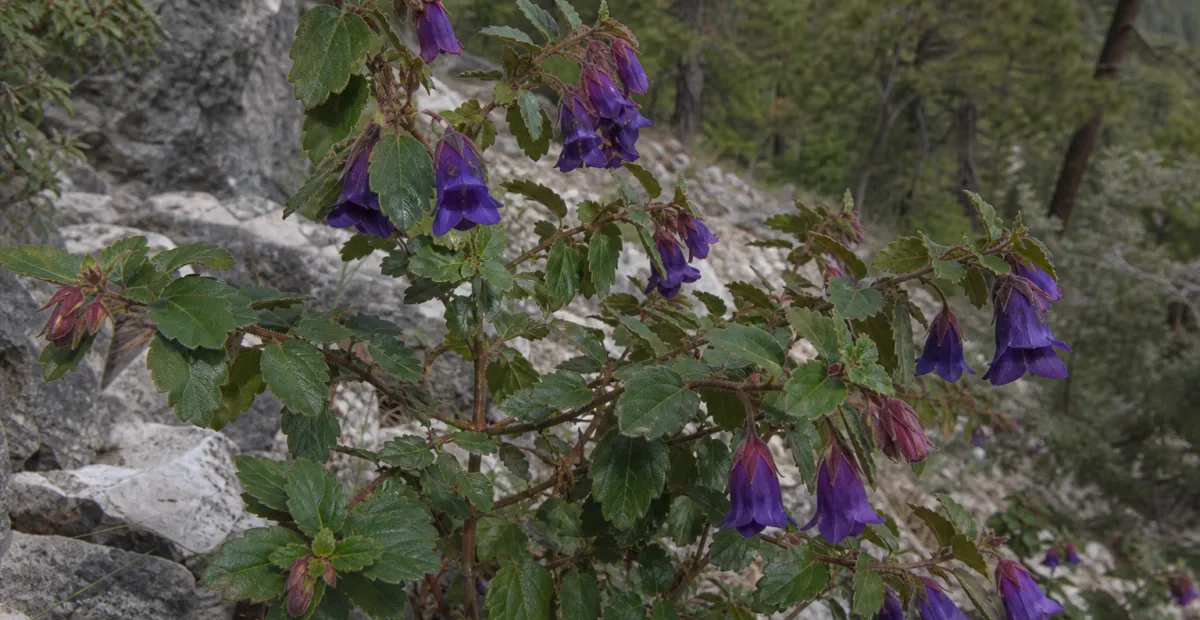
 AI-generated illustration
Glossy abelia (Vesalea mexicana grandifolia) short overview
Glossy abelia is the horticultural name supplied for Vesalea mexicana grandifolia, a taxon treated in current botanical literature as a highly localized Mexican mountain shrub. It forms erect to prostrate, hairy branches with leathery, crenate leaves and bears fragrant, hanging purple to indigo flowers. Native to limestone outcrops and pine-oak habitats at high elevation, it is rare in cultivation and valued chiefly for conservation, research and specialist collections.
Taxonomic classification
Glossy abelia (Vesalea mexicana grandifolia) care guide
Light and placement
Provide full sun to partial shade, ideally with morning or filtered afternoon light in hot climates. A south- or east-facing position with shelter from drying winter winds is preferable. Pale, stretched growth suggests insufficient light; scorched margins or bleached foliage indicate excessive heat or abrupt sun exposure. Acclimate container plants gradually.
Watering and humidity
Water thoroughly when the upper part of the substrate begins to dry, then allow excess water to drain completely. Keep newly planted specimens evenly but not constantly moist while roots establish; reduce frequency in cool weather and during dormancy. Avoid standing water around the crown. Humidity is less important than drainage and airflow.
Soil and growing medium
Use a sharply drained, mineral-rich substrate that resembles limestone or rocky woodland soil. A loam amended with coarse grit, pumice or fine gravel is preferable to dense clay. Calcareous conditions are indicated by the native habitat, but the exact cultivated pH range has not been established; avoid persistently waterlogged or strongly acidic media.
Feeding
Because the plant is rare and poorly documented in cultivation, feed conservatively. Apply a dilute, balanced fertilizer in spring only after active growth begins, or top-dress lightly with mature compost. Avoid high-nitrogen feeding, midsummer overfeeding and fertilizing dry or heat-stressed plants. Stop feeding by late summer to support firm, winter-ready growth.
Growth and habit
A variable shrub, described as erect to prostrate, with a potentially spreading or low-arching habit. It is adapted to cool, elevated Mexican mountain environments and calcareous rocky sites. In cultivation, prioritize drainage, provenance documentation and protection from severe winter cold rather than forcing rapid growth.
Planting and repotting
Plant in spring after the danger of hard frost, choosing a sunny, sheltered site with excellent drainage. Set the root crown at the same level as in the container. Space plants according to their expected shrub habit, allowing roughly 3–5 feet where enough cultivation data exists. Establish with regular but restrained watering, then reduce irrigation once rooted.
Repot only when the root system has filled the container, preferably in spring before active growth. Handle the roots carefully and use a free-draining mineral mix. Because the taxon is poorly represented in cultivation, avoid unnecessary disturbance and retain provenance records.
Propagation and pruning
Propagation
Propagation information specific to this taxon is sparse. Seed is the most defensible botanical method when legally collected from documented populations, but germination requirements are not well established. Semi-ripe cuttings may be worth trialing in a sterile, sharply drained medium under high humidity, though success is uncertain. Never collect wild material from protected populations.
Pruning
Prune sparingly after flowering or during dormant periods to remove dead, damaged or crossing stems and to preserve the natural arching habit. Avoid hard shearing, which may reduce flowering wood and stress a plant that is not well studied in cultivation.
Overwintering
Protect from temperatures below its provisional Zone 8 tolerance, especially while young or container-grown. Mulch the root zone after the ground cools, keep winter-wet soil away from the crown and shelter from desiccating winds. In colder regions, grow in a container and overwinter in a cool, bright, frost-protected space.
Uses
Best suited to conservation collections, botanical gardens, specialist nurseries and carefully managed rock or woodland gardens. Its rarity and restricted distribution make wild collection inappropriate. No reliably supported culinary, medicinal or household use was found.
Appearance
Branches are often reddish brown, ribbed, glandular and densely covered with stiff hairs. Leaves are ovate to elliptic, leathery and somewhat bullate above, with conspicuously raised veins and crenate margins. The underside of the midrib and branchlets are densely hairy, useful identification features.
Flowering
The taxon bears paired, hanging flowers that open consecutively, with occasional solitary flowers. The corolla is funnel-shaped, purple to indigo, fragrant and approximately 0.8–1.2 inches long. Documented flowering occurs mainly from June through October in its Mexican range.
Pollination and visitors
The fragrant, tubular-funnel-shaped flowers and exposed reproductive structures indicate animal visitation is plausible, but reliable taxon-specific visitor records were not located. Do not assign particular bee, butterfly or bird visitors without direct evidence.
Diseases and pests
Diseases
No disease profile specific to this taxon was located. Reduce risk by providing strong air circulation, avoiding overhead irrigation and keeping the root zone well drained. Inspect stressed plants for stem or leaf spotting and remove affected tissue with clean tools; do not use routine fungicides without a confirmed diagnosis.
Pests
No pest complex specific to this taxon was located. In cultivation, inspect new growth for aphids, scale insects and spider mites, especially during heat or drought stress. Improve airflow, correct watering and remove heavily infested tissue before considering a labeled treatment.
Related diseases and pests
Only Plant Doctor profiles whose host data indicate this plant may be affected are shown here.

Toxicity and pollen
No authoritative, taxon-specific human or veterinary toxicity assessment was located. Do not treat the absence of reports as proof of safety. Prevent ingestion of unidentified plant material, supervise children and pets around specimens, and seek professional advice after ingestion or a significant exposure.
- Typical season
- Unknown for the United States
- Pollination / pollen
- Unknown
Reliable airborne-pollen or allergy data for this exact taxon were not located. Its flowers are insect-associated in structure, but insect pollination does not establish zero allergy risk. People with strong pollen sensitivity should avoid handling flowering material closely until individual tolerance is known.
Native habitat
Native populations occur in northeastern Querétaro and southwestern San Luis Potosí, Mexico, in limestone outcrops and pine-oak woodland. Associated vegetation includes Agave, pine, oak, Arbutus, Cercocarpus, Cupressus and Rhus. Recorded elevations are approximately 6,900–8,700 feet, with a seasonal mountain climate.
Interesting fact
The taxon has been treated under several genera and ranks, including Abelia grandifolia, Linnaea grandifolia and Vesalea mexicana var. grandifolia. Its known populations are restricted to northeastern Querétaro and southwestern San Luis Potosí. The plant is associated with limestone outcrops and pine-oak forest at roughly 6,900–8,700 feet.
Frequently asked questions (FAQ)
The most relevant questions about this plant, with short and direct answers.
🌱Quick care
What is Vesalea mexicana grandifolia?⌄
Vesalea mexicana grandifolia, commonly called glossy abelia, is a rare Mexican shrub in the honeysuckle family, Caprifoliaceae. It is also treated in current botanical references as Vesalea grandifolia, while Vesalea mexicana var. grandifolia is an associated synonym.
How much light does glossy abelia need?⌄
Glossy abelia grows best in full sun to partial shade. In hotter U.S. climates, afternoon shade can help reduce heat and drought stress.
How often should you water glossy abelia?⌄
Water glossy abelia moderately, allowing the soil to dry slightly between waterings. Avoid constantly wet conditions because its native rocky habitat suggests a strong need for drainage.
What USDA hardiness zone is glossy abelia?⌄
Glossy abelia is generally considered suitable for about USDA Zone 8 when given protection. It may need shelter from freezing winds, exposed sites, and prolonged hard freezes.
Is glossy abelia evergreen?⌄
The available species-level research does not clearly establish a dependable evergreen habit for cultivated glossy abelia. Expect seasonal behavior to vary with temperature, exposure, and the individual plant.
🌤️Environment and placement
Where is Vesalea mexicana grandifolia native?⌄
Vesalea mexicana grandifolia is native to a very restricted area of northeastern Querétaro and southwestern San Luis Potosí, Mexico. It occurs in high-elevation mountain habitats rather than lowland tropical conditions.
What type of habitat does glossy abelia grow in naturally?⌄
Glossy abelia is associated with calcareous rock outcrops and pine-oak woodland at roughly 6,900–8,700 feet elevation. Its natural habitat is rocky, well drained, and seasonally cool.
Can glossy abelia grow in clay soil?⌄
Glossy abelia is unlikely to perform well in heavy, poorly drained clay unless the planting area is substantially amended or raised. Use a rocky, calcareous mix that drains sharply rather than retaining water around the roots.
Does glossy abelia tolerate drought?⌄
Glossy abelia may tolerate short dry periods once established, but reliable drought tolerance has not been well documented in cultivation. Water during extended heat or drought, especially while the plant is establishing.
Can glossy abelia grow in a container?⌄
Glossy abelia can be trialed in a container if the pot has excellent drainage and the root zone does not stay saturated. Because this taxon is rarely documented in cultivation, container performance is uncertain.
💧Care and problems
Why are the leaves of glossy abelia turning brown?⌄
Brown leaves can result from drought, hot exposure, winter injury, or roots staying too wet. Check soil moisture and drainage first, then protect the plant from extreme afternoon heat or freezing wind.
Why is my glossy abelia wilting even though the soil is wet?⌄
Wilting in wet soil commonly indicates root stress from poor drainage rather than a lack of water. Move or replant the shrub into a sharply drained, rocky mix if the problem persists.
Does glossy abelia need fertilizer?⌄
Glossy abelia should not need heavy fertilization in a suitable soil mix. If growth is weak, first correct light, drainage, and watering before applying a light, balanced fertilizer in spring.
What pests affect glossy abelia?⌄
No dependable, taxon-specific pest profile is available for Vesalea mexicana grandifolia. Inspect plants for aphids, scale, mites, and chewing damage, but confirm the cause before treating.
🪴Planting and repotting
When should you plant glossy abelia?⌄
Plant glossy abelia in spring after severe frost risk has passed, or in early fall where winters are mild. Spring planting is safer in marginal Zone 8 locations because it allows more time for root establishment.
How do you plant glossy abelia?⌄
Plant glossy abelia at the same depth it was growing in its container, in full sun to partial shade and sharply drained rocky soil. Keep the crown and main stems above any area that collects water.
How much space does glossy abelia need?⌄
A precise mature spread has not been well documented for this uncommon taxon. Allow enough room for a naturally spreading shrub and avoid crowding it against structures until its growth habit is known.
✂️Propagation and pruning
How do you propagate glossy abelia?⌄
Propagation methods for glossy abelia are poorly documented, but semi-ripe stem cuttings are a reasonable horticultural trial. Use clean cuttings, a sterile well-drained medium, bright filtered light, and consistent moisture without saturation.
Can you grow glossy abelia from seed?⌄
Seed propagation may be possible, but reliable germination guidance for Vesalea mexicana grandifolia is not readily available. Fresh seed, a well-drained medium, and experimentation with cool-moist stratification may be necessary.
When should you prune glossy abelia?⌄
Prune glossy abelia lightly after flowering or during the dormant season, removing damaged, weak, or crossing stems first. Avoid severe pruning until the plant’s mature form and flowering wood are better understood.
⚠️Toxicity and safety
Is glossy abelia poisonous to dogs or cats?⌄
The toxicity of Vesalea mexicana grandifolia is unknown because taxon-specific evidence is unavailable. Keep pets and children from chewing the plant, and contact a veterinarian or poison-control service if plant material is eaten.
Is glossy abelia safe to plant around children?⌄
Glossy abelia cannot be confirmed as child-safe because its toxicity has not been adequately documented. Place it where young children are unlikely to chew the leaves, flowers, or fruit.
🌸Flowering and special interest
When does glossy abelia bloom?⌄
Glossy abelia has been reported flowering from about June through October, with some broader species accounts extending into December. Bloom timing may shift with elevation, climate, and growing conditions.
What do glossy abelia flowers look like?⌄
The flowers are fragrant, hanging, funnel-shaped blooms that are typically purple to indigo and about 0.8–1.2 inches long. They are produced in pairs and may open successively.
Why is my glossy abelia not flowering?⌄
Insufficient light, excessive nitrogen, drought stress, root problems, or a young or recently transplanted plant can reduce flowering. Give it bright light, sharp drainage, even moisture, and time to establish.
Does glossy abelia produce fruit?⌄
Yes, glossy abelia has been reported to fruit from about October through December. However, fruiting details and seed availability in U.S. cultivation are poorly documented.
Is glossy abelia fragrant?⌄
Yes, the flowers of glossy abelia are described as fragrant. Fragrance is likely to be most noticeable during warm, still conditions when the flowers are open.
Similar plants
 Yellow lantern chili (Capsicum chinense) care guideCapsicum chinense
 Capsicum baccatum care guideCapsicum baccatum
 Serrano (Capsicum annuum ‘Serrano’)Capsicum annuum 'Serrano'
 Purple Beauty (Capsicum annuum ‘Purple Beauty’)Capsicum annuum 'Purple Beauty'
 Numex Twilight (Capsicum annuum ‘Numex Twilight’)Capsicum annuum 'Numex Twilight'
 Explosive Ember Chili Pepper (Capsicum annuum ‘Explosive Ember’)Capsicum annuum 'Explosive Ember'