
 Source:
 Zabelia dielsii short overview
Zabelia dielsii is a deciduous shrub from temperate China and a close relative of familiar garden abelias. It develops glossy bluish-green leaves, often with noticeable hairs on young shoots and veins, then produces paired, lightly fragrant flowers from spring into early summer. The corollas are white inside and may be pink or red outside. It is uncommon in American gardens, and its limits relative to Zabelia biflora remain taxonomically complex.
Taxonomic classification
Zabelia dielsii care guide
Light and placement
Give full sun to partial shade, ideally with morning sun and protection from intense late-afternoon heat in hotter regions. A bright woodland edge or east-facing border is suitable. Sparse, stretched growth and reduced flowering suggest insufficient light; scorched foliage or rapid wilting can indicate excessive heat combined with inadequate moisture.
Watering and humidity
Water deeply when the upper few inches of soil begin to dry, then allow excess water to drain. Keep newly planted shrubs evenly moist through their first growing season; established plants should receive supplemental irrigation during prolonged drought. Mulch the root zone, but keep mulch away from the stems. Humidity is not normally a separate requirement.
Soil and growing medium
Use a fertile, well-drained soil that still holds moderate moisture. Loam enriched with compost is suitable, while rocky or lightly calcareous ground can also work if it does not dry excessively. Avoid persistently waterlogged sites. A slightly acidic to neutral reaction is a reasonable target; precise pH limits for this species are not well documented.
Feeding
Apply a balanced, slow-release fertilizer or a thin compost mulch in early spring as growth begins. Avoid heavy nitrogen feeding, which can produce soft, leafy growth and reduce flower display. Do not fertilize drought-stressed, newly transplanted or dormant plants until roots are actively functioning.
Growth and habit
This is an upright, branching shrub that can become a substantial multi-stemmed specimen. Its mature form is best maintained by allowing a naturally open framework rather than shearing it tightly. Because plants in cultivation are uncommon, growth speed and ultimate garden performance may vary by provenance.
Planting and repotting
Plant in fall or early spring while the shrub is dormant, choosing a site with sun or light afternoon shade and good drainage. Set it at the same depth at which it was growing. Allow roughly 5–8 feet between plants where a full specimen is desired, with closer spacing only for an informal mass. Water regularly during the first growing season.
Container culture is not extensively documented for this species. If grown in a pot, use a loamy, free-draining shrub mix and move it into the next container size when roots fill the existing pot. Transplant while dormant or in early spring, disturbing the root ball as little as possible.
Propagation and pruning
Propagation
Propagation by seed or semi-ripe cuttings is plausible for this woody shrub, but detailed species-specific protocols are scarce. Sow fresh seed when available, or take semi-ripe cuttings in summer under humid, well-drained conditions. Expect variable rooting and use clean, labeled material because the taxonomic group is complex.
Pruning
Prune after flowering or during dormancy to remove damaged, crossing or weak stems and to maintain an open framework. Avoid routine hard shearing, which can remove next season’s structure and obscure the shrub’s natural form. Make selective cuts at the base or back to a healthy lateral branch.
Overwintering
Plants are reported hardy to about USDA Zone 6, but protection is sensible in colder or exposed sites. Apply a loose organic mulch over the root zone after the ground cools, avoid late nitrogen feeding and protect young plants from drying winter winds. Container plants are more vulnerable and should be overwintered in an unheated, sheltered location rather than a warm room.
Uses
Best treated as a botanical or specialty ornamental shrub for temperate borders, woodland edges and living collections. Its spring flowers and textured foliage provide ornamental interest, but commercial availability in the United States appears limited. No culinary or medicinal use is established here.
Appearance
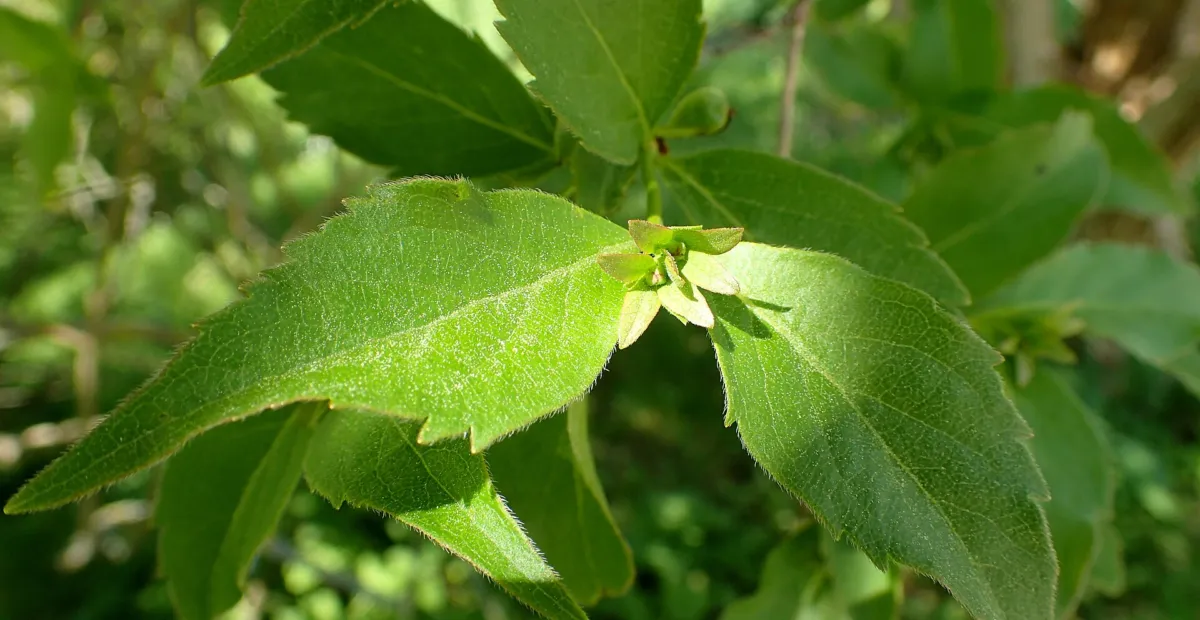
The shrub has ovate to obovate or lance-shaped leaves, sometimes irregularly lobed on vigorous shoots. Leaves are glossy bluish green above, with stiff hairs along the veins; young lower surfaces may also be hairy. Shoots can be densely covered with curved hairs. Paired flowers and later elongated achenes help distinguish it from unrelated ornamental shrubs.
Flowering
Flowers are borne in terminal pairs, with additional axillary flowers sometimes present. The corolla is four-lobed and white, while the outside may be pink to red. Bloom is reported from April through June in temperate cultivation, followed by elongated achenes that mature later in the season.
Pollination and visitors
The flowers are fragrant and structurally consistent with insect visitation, but reliable species-specific pollinator observations were not found. Avoid assigning a particular bee, butterfly or other visitor group without direct documentation.
Zabelia dielsii photos
Click any photo for a larger view. Source, author and license are shown separately.
Diseases and pests
Diseases
No species-specific disease profile was located. Reduce risk by providing good air circulation, avoiding saturated soil and watering at the base. Inspect stressed plants for leaf spots, dieback or root problems; remove affected material and correct drainage before using pesticides.
Pests
Specific pest records are limited. Monitor new growth for aphids and examine leaves for scale or chewing damage. Encourage good vigor with appropriate watering and spacing, remove small infestations by hand or with a strong water spray, and reserve labeled treatments for persistent problems.
Related diseases and pests
Only Plant Doctor profiles whose host data indicate this plant may be affected are shown here.

Toxicity and pollen
No authoritative species-specific toxicity assessment for humans, dogs, cats or children was located in the reviewed sources. Do not treat the absence of records as proof of safety. Prevent ingestion of unfamiliar plant material, supervise children and pets, and seek professional advice if plant parts are eaten or cause irritation.
- Typical season
- Spring during flowering
- Pollination / pollen
- Insect-dispersed pollen; detailed characteristics unavailable
This is an insect-pollinated flowering shrub, but species-specific airborne pollen and clinical allergy information were not located. Flowering plants can still release pollen, although exposure is often influenced by local abundance, weather and individual sensitivity. Use normal precautions during bloom if symptoms occur.
Native habitat
In its native Chinese range, it occurs in scrub, forests and grasslands, including mountainous habitats up to about 3,700 m elevation. The species occupies temperate environments and may encounter rocky or seasonally variable soils. Its broad Chinese distribution does not establish equivalent performance across all US climates.
Interesting fact
The species has been placed historically in Linnaea and Abelia.
Its accepted range spans several regions of China, including Tibet.
Young shoots and leaf veins may carry stiff, curved hairs.
The fruit is an elongated achene rather than a fleshy berry.
Frequently asked questions (FAQ)
The most relevant questions about this plant, with short and direct answers.
🌱Quick care
What is Zabelia dielsii?⌄
Zabelia dielsii is a deciduous flowering shrub in the honeysuckle family, Caprifoliaceae. It is native to temperate regions of China and is related to plants formerly classified in the genus Abelia.
Does Zabelia dielsii have a common name?⌄
No reliably documented English common name was located for Zabelia dielsii. In the United States, it is best identified by its scientific name rather than by an invented or translated common name.
Is Zabelia dielsii the same plant as Abelia dielsii?⌄
Yes, Abelia dielsii is a recognized synonym of Zabelia dielsii. Older nursery, herbarium, and gardening references may also use Abelia zanderi, Abelia brachystemon, or other historical names.
Is Zabelia dielsii the same as Zabelia biflora?⌄
The two names are closely related and have been confused, but they are treated as separate accepted species by some modern taxonomic references. Their identification can be difficult, so plants sold under either name should be checked against their source and botanical description.
How can I identify Zabelia dielsii?⌄
Look for a deciduous shrub with hairy young shoots and leaves, glossy bluish-green foliage, paired terminal flowers, and white to pink or reddish four-lobed corollas. Identification can be difficult because Zabelia dielsii overlaps morphologically with related taxa such as Z. biflora.
🌤️Environment and placement
How large does Zabelia dielsii get?⌄
Zabelia dielsii can grow into a shrub about 10 feet tall in suitable conditions. Its final size varies with climate, provenance, soil, and pruning.
Where does Zabelia dielsii grow naturally?⌄
Zabelia dielsii is native to several regions of China, including mountainous and temperate areas. It has been recorded in scrub, forests, grasslands, and habitats reaching roughly 12,000 feet in elevation.
What USDA hardiness zone is best for Zabelia dielsii?⌄
Zabelia dielsii is generally considered suitable for about USDA Zones 6 and warmer, although hardiness information is limited because the species is uncommon in cultivation. Protect it from severe winter extremes, especially when newly planted.
Does Zabelia dielsii need full sun?⌄
Zabelia dielsii grows in sun to partial shade. More sunlight usually supports denser growth and better flowering, while light afternoon shade can help in hot, dry climates.
What soil is best for Zabelia dielsii?⌄
Use fertile, well-drained loam for Zabelia dielsii. Improve compact or poorly drained soil with organic matter, but avoid sites that remain waterlogged after rain.
💧Care and problems
How often should I water Zabelia dielsii?⌄
Water Zabelia dielsii moderately, allowing the soil surface to begin drying between thorough waterings. Provide extra water during the first growing season and during prolonged summer drought, but do not keep the roots saturated.
Does Zabelia dielsii need fertilizer?⌄
Zabelia dielsii usually needs only modest fertilization when planted in fertile soil. Apply a balanced slow-release fertilizer in spring if growth is weak, and avoid excessive nitrogen because it can promote leafy growth at the expense of flowers.
Why is my Zabelia dielsii not flowering?⌄
Insufficient light, immature growth, excessive nitrogen, drought stress, or severe winter damage can reduce flowering. Place the shrub where it receives several hours of sun and avoid heavy pruning before its spring-to-early-summer bloom period.
What pests or diseases affect Zabelia dielsii?⌄
Reliable species-specific pest and disease information for Zabelia dielsii is limited. Monitor it like other woody Caprifoliaceae for common issues such as aphids, scale, leaf spots, and root problems caused by poor drainage.
🪴Planting and repotting
When should I plant Zabelia dielsii?⌄
Plant Zabelia dielsii in spring or early fall, when temperatures are moderate and the soil can be worked. Spring planting is preferable in colder parts of its range because it gives the roots more time to establish before winter.
How do I plant Zabelia dielsii in the ground?⌄
Set Zabelia dielsii at the same depth it grew in its container, then backfill with native soil and water thoroughly. Leave enough room for its mature shrub size and apply a light mulch layer without touching the stems.
Can Zabelia dielsii be grown in a container?⌄
Zabelia dielsii can potentially be grown in a large container while young, provided the pot has excellent drainage. Because it is a shrub that may reach about 10 feet, long-term container culture requires regular root-space management and winter protection.
✂️Propagation and pruning
How do I propagate Zabelia dielsii?⌄
Propagation is most plausibly done from cuttings, although detailed, species-specific propagation instructions are scarce. Take semi-ripe summer cuttings from healthy growth and use a sterile, freely draining rooting medium under humid conditions.
Can Zabelia dielsii be grown from seed?⌄
Zabelia dielsii produces dry, one-seeded fruits, but seed propagation may be uncommon and germination information is limited. Fresh, properly identified seed may require a period of cool, moist treatment before spring sowing.
When should I prune Zabelia dielsii?⌄
Prune Zabelia dielsii immediately after flowering or during dormancy to remove damaged, weak, or crossing branches. Avoid routine hard pruning in late spring if you want to preserve flowers produced on older growth.
⚠️Toxicity and safety
Is Zabelia dielsii toxic to people or pets?⌄
The toxicity of Zabelia dielsii is unknown because no reliable species-specific safety assessment was located. Do not allow people or pets to eat the plant, and seek professional advice if ingestion occurs.
Is Zabelia dielsii deer resistant?⌄
There is not enough reliable species-specific evidence to confirm deer resistance for Zabelia dielsii. If deer pressure is high, protect young plants until their browsing tolerance is known in your garden.
Is Zabelia dielsii invasive in the United States?⌄
No reliable evidence was located showing that Zabelia dielsii is invasive in the United States. It is uncommon in American cultivation, but gardeners should still prevent unwanted spread and follow local planting regulations.
🌸Flowering and special interest
Is Zabelia dielsii fragrant?⌄
Zabelia dielsii has moderately fragrant flowers. The paired flowers generally appear from spring into early summer, with fragrance varying according to the plant and growing conditions.
When does Zabelia dielsii bloom?⌄
Zabelia dielsii typically flowers from April through June in its native or comparable temperate climates. In the United States, the exact timing shifts with local spring temperatures and USDA zone.
What do Zabelia dielsii flowers look like?⌄
The flowers are usually white, sometimes pink to reddish on the outside, and arranged mainly in terminal pairs. They have a four-lobed corolla and are accompanied by four sepals.
Does Zabelia dielsii produce fruit?⌄
Yes, Zabelia dielsii produces dry, one-seeded fruits called achenes after flowering. Fruiting is generally reported from August through September in its native range.
Similar plants
 Yellow lantern chili (Capsicum chinense) care guideCapsicum chinense
 Capsicum baccatum care guideCapsicum baccatum
 Serrano (Capsicum annuum ‘Serrano’)Capsicum annuum 'Serrano'
 Purple Beauty (Capsicum annuum ‘Purple Beauty’)Capsicum annuum 'Purple Beauty'
 Numex Twilight (Capsicum annuum ‘Numex Twilight’)Capsicum annuum 'Numex Twilight'
 Explosive Ember Chili Pepper (Capsicum annuum ‘Explosive Ember’)Capsicum annuum 'Explosive Ember'