
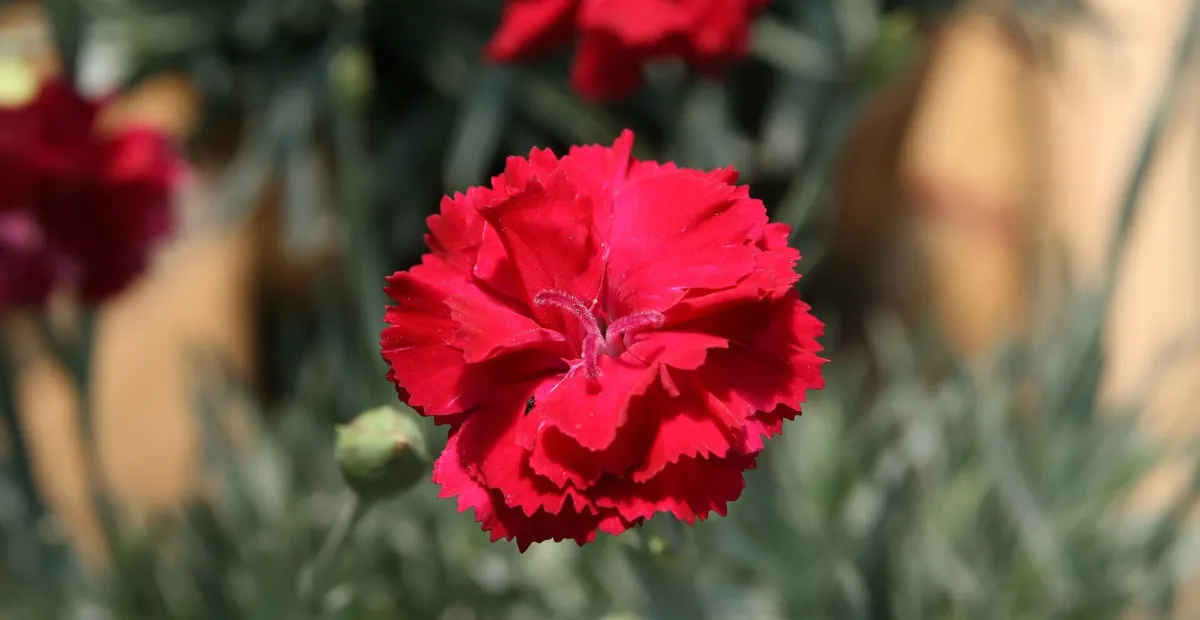
 Source:
 Dianthus ‘Frosty Fire’ short overview
Dianthus 'Frosty Fire' is a compact Allwood pink prized for its vivid double cherry-red flowers, narrow silvery blue-green evergreen foliage, and gentle clove-like fragrance. The low, spreading perennial performs best in full sun and sharply drained soil, making it useful for rock gardens, border edges, sunny slopes, and containers. It is hardy across much of the United States, with flowering typically beginning in late spring and sometimes continuing into summer or early fall after deadheading.
Taxonomic classification
Dianthus ‘Frosty Fire’ care guide
Light and placement
Give 'Frosty Fire' at least 6 hours of direct sun, ideally in an open south- or west-facing bed with excellent air movement. In hot-summer areas, light afternoon shade can prevent scorch without sacrificing flowering. Too little light produces lax growth and fewer blooms; excessive heat combined with drought can bleach foliage and shorten flower life.
Watering and humidity
Water deeply at the root zone when the upper inch of soil begins to dry during the first growing season. Once established, allow moderate drying between waterings and irrigate more during prolonged heat or container culture. Avoid frequent shallow watering and wet crowns. Morning irrigation is preferable in humid regions so foliage dries quickly.
Soil and growing medium
Use a lean to moderately fertile, sharply drained soil. Sandy loam, gravelly loam, or amended garden soil is suitable. Neutral to slightly alkaline conditions are preferred, although established plants tolerate a broader range when drainage is excellent. Avoid heavy, waterlogged clay; raised beds or rock-garden pockets improve winter survival and reduce crown-rot risk.
Feeding
Feed lightly in spring with a balanced, slow-release fertilizer or a thin layer of mature compost around the plant, keeping material away from the crown. Avoid high-nitrogen feeding, which can produce soft foliage and reduce flowering. Do not fertilize drought-stressed, newly divided, or dormant plants; water first and resume feeding only after active growth returns.
Growth and habit
Forms a low, dense, spreading cushion or compact clump rather than a tall upright plant. Flower stems rise just above the foliage and generally remain self-supporting. Deadheading improves appearance and may extend flowering. Divide or renew plants when the center becomes thin, but avoid prolonged wetness around the crown.
Planting and repotting
Plant in spring or early fall, setting the crown at soil level rather than burying it. Space plants about 9–12 inches apart for airflow and eventual coverage. Water regularly during the establishment period, then reduce irrigation once the root system is settled. In humid regions, leave extra space and avoid sites where foliage stays wet overnight.
Repot container plants in spring when roots fill the pot, moving them only one container size larger. Use a gritty, fast-draining potting mix and ensure the container has unobstructed drainage holes. Replant at the same depth, water once to settle the mix, and allow the surface to dry moderately between later waterings.
Propagation and pruning
Propagation
Propagate by softwood cuttings in late spring or summer, or divide established clumps in early spring or fall. Cuttings generally preserve the cultivar more reliably than seed. Division can be difficult if the crown is tight, so lift carefully and retain healthy rooted sections. Avoid sowing seed when an exact copy of 'Frosty Fire' is required.
Pruning
Shear or clip lightly after the main flush of flowering, removing spent stems while retaining the evergreen cushion. Deadheading can encourage later blooms. In late winter or early spring, remove winter-damaged foliage and tidy the clump, but do not cut deeply into old, leafless woody crown tissue.
Overwintering
Plants in the ground generally overwinter outdoors within the documented hardiness range if soil drains freely. Avoid winter mulch that stays wet against the crown; use a thin, airy layer only where needed for freeze-thaw protection. Containers are more exposed to cold than garden soil, so move them against a sheltered wall or overwinter in an unheated protected space.
Uses
Use 'Frosty Fire' for sunny edging, rock gardens, gravel beds, border fronts, walls, slopes, containers, and small-scale groundcover. Its fragrant flowers can be used as a short-stem cut flower. It is not recommended as an edible flower here because cultivar-specific food-use verification was not found, and Dianthus plant material may irritate pets.
Appearance
The plant forms a tight cushion of narrow, linear, grass-like leaves in a cool blue-green to silvery tone. Short, sturdy flowering stems carry vividly colored double blooms with fringed petal margins. The evergreen foliage provides structure outside the flowering period and helps distinguish the cultivar from greener, taller dianthus types.
Flowering
This cultivar produces short, sturdy stems bearing small, double, deeply fringed flowers. The blooms are described as bright red, cherry-red, magenta-red, or red with occasional pale markings. Flowering is concentrated from late spring into summer; regular removal of spent flowers can encourage additional flowering later in the season.
Pollination and visitors
The cultivar is specifically documented as attracting butterflies. Some nursery and garden sources also mention bees, but reliable cultivar-specific evidence is less consistent, so butterflies are the most defensible visitor group for the structured profile.
Dianthus 'Frosty Fire' photos
Click any photo for a larger view. Source, author and license are shown separately.
Diseases and pests
Diseases
Leaf spot is more likely in crowded, humid plantings, while crown rot develops in persistently wet soil. Improve air circulation, water at the base, remove affected foliage, and avoid overhead irrigation. Discard badly rotted plants and correct drainage rather than repeatedly treating symptoms. Good spacing and fast-draining soil are the main preventive measures.
Pests
Snails and slugs may damage young foliage and flowers, especially in damp conditions. Monitor plants after wet weather, remove hiding places, and use physical barriers or hand-picking first. Avoid keeping mulch against the crown. Stressed or overcrowded plants are more vulnerable to secondary damage.
Related diseases and pests
Only Plant Doctor profiles whose host data indicate this plant may be affected are shown here.
 PestMelon thripsThrips palmi Karny
 PestEuropean Grapevine MothLobesia botrana
 DiseaseImpatiens necrotic spot virus diseaseImpatiens necrotic spot orthotospovirus
 DiseaseFusarium wiltFusarium oxysporum species complex
 DiseaseGray MoldBotrytis cinerea
 DiseaseAlternaria leaf spot and fruit rotAlternaria alternata
 DiseasePhytophthora root and crown rotPhytophthora nicotianae
Toxicity and pollen
Dianthus species are listed by ASPCA as toxic to dogs and cats because of an unidentified irritant principle, with mild gastrointestinal upset and mild dermatitis reported for carnations. Direct evidence for this named hybrid is limited, so treat plant material as potentially irritating. Prevent chewing and wash hands after extensive handling; seek veterinary advice if a pet ingests a significant amount or develops symptoms.
- Typical season
- During flowering, generally late spring through summer
- Pollination / pollen
- Insect-dispersed pollen; limited airborne spread expected
The flowers are primarily insect-pollinated, so airborne pollen exposure is likely lower than for wind-pollinated plants. However, low airborne exposure does not mean zero allergy risk; sensitive people may still react to pollen, fragrance, or plant contact. No cultivar-specific pollen monitoring data was found.
Native habitat
This is a cultivated hybrid rather than a wild native species. Its parentage includes Dianthus plumarius and carnation-related Dianthus, reflecting plants adapted to open, sunny habitats with excellent drainage. In gardens it performs best in mineral, gravelly, or moderately fertile soils and struggles in hot, humid, poorly ventilated conditions.
Interesting fact
Dianthus × allwoodii hybrids originated from crosses involving cottage pink and carnation lines. 'Frosty Fire' is recognized for combining icy blue-green foliage with unusually vivid red double flowers. The cultivar can remain evergreen in mild climates and may rebloom after spent flowers are removed.
Frequently asked questions (FAQ)
The most relevant questions about this plant, with short and direct answers.
🌱Quick care
What is Dianthus 'Frosty Fire'?⌄
Dianthus 'Frosty Fire' is a compact, herbaceous perennial with silvery blue-green foliage and fragrant, double red flowers. It is commonly grown as a low border, edging, rock-garden, or container plant.
How much sun does Dianthus 'Frosty Fire' need?⌄
Dianthus 'Frosty Fire' performs best in full sun, receiving at least 6 hours of direct light daily. In hot climates, light afternoon shade can help reduce heat stress.
How often should I water Dianthus 'Frosty Fire'?⌄
Water Dianthus 'Frosty Fire' moderately while it is becoming established, then reduce watering once the roots are well developed. Allow the soil to dry somewhat between waterings and avoid keeping the crown wet.
Is Dianthus 'Frosty Fire' perennial?⌄
Yes, Dianthus 'Frosty Fire' is a cold-hardy perennial that can return for multiple years. Its longevity is best in sunny, well-drained soil rather than wet or heavily shaded conditions.
🌤️Environment and placement
What USDA hardiness zones are suitable for Dianthus 'Frosty Fire'?⌄
Dianthus 'Frosty Fire' is generally listed for USDA Zones 3 through 8, with some sources extending its range to Zone 9. Performance in the warmest, most humid areas may be less reliable.
Can Dianthus 'Frosty Fire' tolerate frost?⌄
Yes, Dianthus 'Frosty Fire' is hardy through severe frost when planted in well-drained soil. Good drainage is especially important during winter because cold, saturated soil can damage the crown.
What soil is best for Dianthus 'Frosty Fire'?⌄
Use well-drained sandy, gritty, or loamy soil with a neutral to slightly alkaline pH. Heavy clay or persistently wet soil should be amended or avoided because it can encourage crown rot.
Can Dianthus 'Frosty Fire' grow in containers?⌄
Yes, Dianthus 'Frosty Fire' grows well in containers with drainage holes and a sharply draining potting mix. Choose a container only slightly larger than the root ball and do not let excess water collect in a saucer.
Is Dianthus 'Frosty Fire' drought tolerant?⌄
Dianthus 'Frosty Fire' has good drought tolerance after establishment, but it still needs regular water during its first growing season. Drought tolerance is strongest in gritty, well-drained soil.
Does Dianthus 'Frosty Fire' tolerate heat and humidity?⌄
Dianthus 'Frosty Fire' can tolerate heat better than many dianthus selections, but prolonged hot, humid conditions may reduce performance. Provide excellent airflow, avoid wet foliage, and give some afternoon shade where summers are intense.
Where should I plant Dianthus 'Frosty Fire' in the garden?⌄
Plant Dianthus 'Frosty Fire' at the front of a sunny border, along a path, in a rock garden, on a slope, or in a raised bed. Its low mound is also useful for edging and small-space planting.
💧Care and problems
How tall and wide does Dianthus 'Frosty Fire' get?⌄
Dianthus 'Frosty Fire' usually grows about 6 to 9 inches tall and 9 to 15 inches wide. Mature size varies with soil, climate, and growing conditions.
How far apart should I plant Dianthus 'Frosty Fire'?⌄
Space Dianthus 'Frosty Fire' about 9 to 12 inches apart to allow each mound to develop while maintaining airflow. Wider spacing is helpful in humid regions or heavy soils.
Should I deadhead Dianthus 'Frosty Fire'?⌄
Yes, remove faded flowers from Dianthus 'Frosty Fire' to keep the plant neat and encourage additional blooming. Deadheading may support summer or fall rebloom, although the amount of rebloom varies by climate.
When should Dianthus 'Frosty Fire' be cut back?⌄
Lightly shear Dianthus 'Frosty Fire' after its main flowering period to remove spent stems and maintain a compact shape. Avoid severe late-fall cutting in cold areas because the foliage helps protect the crown.
Why is my Dianthus 'Frosty Fire' turning yellow or rotting?⌄
Yellowing, wilting, or crown collapse is often caused by excessive moisture or poor drainage rather than a lack of water. Move or replant the dianthus in porous soil, reduce irrigation, and keep mulch away from the crown.
What pests affect Dianthus 'Frosty Fire'?⌄
Snails and slugs may chew Dianthus 'Frosty Fire', while aphids can occasionally appear on tender growth. Good spacing, removal of hiding places, and routine inspection usually provide adequate control for light infestations.
What diseases can affect Dianthus 'Frosty Fire'?⌄
Leaf spots and crown rot are the main reported problems, especially where foliage stays wet or plants are crowded. Improve airflow, water at the soil line, and use well-drained soil to reduce disease pressure.
🪴Planting and repotting
When is the best time to plant Dianthus 'Frosty Fire'?⌄
Plant Dianthus 'Frosty Fire' in spring after the soil is workable or in early fall before the ground freezes. Fall planting allows root development, but spring is preferable in areas with very wet winters.
How do I plant Dianthus 'Frosty Fire' in the ground?⌄
Set the plant so the crown is level with or slightly above the surrounding soil, then backfill with well-drained soil and water thoroughly. Keep the crown uncovered and avoid burying the lower foliage.
Can Dianthus 'Frosty Fire' be grown in heavy clay soil?⌄
Dianthus 'Frosty Fire' can struggle in heavy clay because poor drainage increases the risk of crown rot. Grow it in a raised bed or amend the planting area to improve drainage rather than relying on frequent watering adjustments.
How do I overwinter Dianthus 'Frosty Fire' in a pot?⌄
In cold climates, overwinter potted Dianthus 'Frosty Fire' outdoors only if the container and roots are adequately protected from repeated freeze-thaw cycles. Keep the pot in a sheltered location, maintain barely moist soil, and never allow it to remain waterlogged.
✂️Propagation and pruning
Can Dianthus 'Frosty Fire' be propagated from cuttings?⌄
Yes, Dianthus 'Frosty Fire' can be propagated from nonflowering stem cuttings. Take healthy tip cuttings, remove the lower leaves, and root them in a clean, lightly moist, well-drained medium under bright indirect light.
Can I divide Dianthus 'Frosty Fire'?⌄
Division can be attempted with established Dianthus 'Frosty Fire', preferably in early spring or early fall. Because some plants have compact or woody crowns, stem cuttings may be more dependable for producing clones.
Will Dianthus 'Frosty Fire' grown from seed come true?⌄
Seed-grown Dianthus 'Frosty Fire' may not produce plants identical to the named cultivar because it is a hybrid selection. Use cuttings or division when preserving the original flower color, form, and growth habit is important.
⚠️Toxicity and safety
Is Dianthus 'Frosty Fire' toxic to dogs and cats?⌄
Dianthus 'Frosty Fire' should be treated as potentially irritating to pets because dianthus and carnations are associated with mild gastrointestinal upset or skin irritation. Keep it away from pets that chew plants and contact a veterinarian if ingestion causes symptoms.
🌸Flowering and special interest
When does Dianthus 'Frosty Fire' bloom?⌄
Dianthus 'Frosty Fire' typically blooms from late spring into early summer, with possible additional flowers later in the season. Deadheading and favorable growing conditions can improve the chance of rebloom.
What color are the flowers of Dianthus 'Frosty Fire'?⌄
The flowers are usually vivid red to cherry-red, with a double, fringed form and occasional lighter markings. Color intensity can vary somewhat with cultivar source and growing conditions.
Are Dianthus 'Frosty Fire' flowers fragrant?⌄
Yes, Dianthus 'Frosty Fire' is valued for fragrant flowers with a sweet, spicy, clove-like scent. Fragrance is usually strongest in warm, sunny conditions.
Does Dianthus 'Frosty Fire' attract pollinators?⌄
Dianthus 'Frosty Fire' can attract butterflies and other flower-visiting insects, particularly when grown in full sun. Its double flowers may provide less accessible pollen than single-flowered plants.
Is Dianthus 'Frosty Fire' evergreen?⌄
Dianthus 'Frosty Fire' often retains its blue-green foliage through winter in mild climates and may remain semi-evergreen in colder areas. Foliage quality can decline temporarily after severe cold or prolonged wet weather.
Similar plants
 Azure Monkshood (Aconitum carmichaelii) care guideAconitum carmichaelii
 Monkshood (Aconitum ‘Stainless Steel’)Aconitum 'Stainless Steel'
 Monkshood (Aconitum ‘Bressingham Spire’)Aconitum 'Bressingham Spire'
 Golden full moon maple (Acer shirasawanum ‘Aureum’)Acer shirasawanum 'Aureum'
 Globosum (Acer platanoides ‘Globosum’)Acer platanoides 'Globosum'
 Striped maple (Acer pensylvanicum) care guideAcer pensylvanicum