
Gray Mold
Botrytis cinereaGray Mold overview
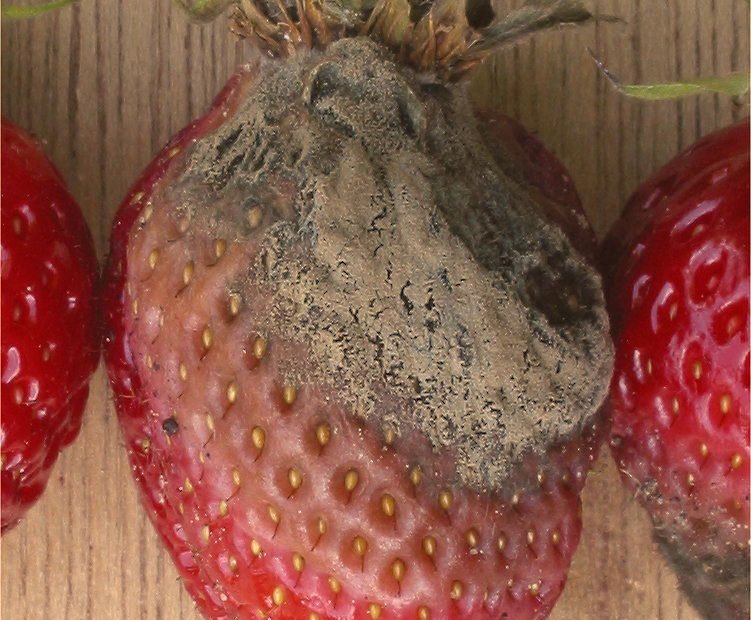
Gray mold is a widespread fungal disease caused by Botrytis cinerea. It most often develops on aging flowers, wounded tissue, ripening fruit, seedlings, and other succulent plant parts during cool, humid, or persistently wet conditions. Infected tissue becomes brown, soft, and water-soaked, then develops a characteristic gray, fuzzy layer of airborne spores.
Typical conditions
Overview
Gray mold, also called Botrytis blight or Botrytis fruit rot, is caused primarily by Botrytis cinerea. It has a very broad host range and is common in gardens, greenhouses, nurseries, vegetable fields, berry plantings, and postharvest storage.
The fungus usually colonizes dead, senescing, or wounded tissue first. From that base it may spread into adjacent living tissue. Flowers and ripening fruit are particularly vulnerable, while healthy, intact green leaves and stems are generally less readily infected unless wounds, dying tissue, or infected petals provide an entry point.
Symptoms and identification
Early symptoms may appear as small translucent, pale brown, or water-soaked spots. Lesions enlarge and become brown, tan, or gray, while infected tissue turns soft, collapses, wilts, and dies.
- Flowers may develop spotted or blighted petals, fail to open, or rot before and after bloom.
- Leaves can develop expanding brown lesions and may become covered with gray mold during wet conditions.
- Stems and petioles may develop brown lesions, cankers, girdling, or dieback, particularly around wounds.
- Fruit may develop pale, soft, watery rot, gray fuzzy growth, or pale rings and halos known as ghost spots on tomato.
- Under high humidity, masses of gray to brown conidia give infected tissue a fuzzy or woolly appearance.
Symptoms can be confused with other blossom blights, fruit rots, or opportunistic molds. Confirmation is more reliable when the characteristic gray sporulation is present and the site history includes prolonged moisture.
Causes and spread
Botrytis cinerea survives and sporulates on infected plant tissue, fallen flowers, dead leaves, crop residue, weeds, and sometimes hardened resting structures called sclerotia. The fungus produces very large numbers of airborne conidia.
Spores spread by air currents, rain splash, irrigation water, tools, workers, insects, and contact with contaminated plant debris. Infection commonly begins on aging flowers, senescent leaves, wounded stems, damaged fruit, or tissue weakened by poor nutrition, crowding, pruning injury, insects, or frost.
In greenhouses, condensation, dripping structures, dense canopies, poor ventilation, and wounds caused by clips, strings, or handling can create infection sites. In tomato, dying flowers are important infection courts, and fruit contacting wet soil or plant debris is at increased risk.
Life cycle and persistence
The fungus grows on moist dead or weakened tissue and produces gray masses of conidia. When spores land on a susceptible plant surface and adequate moisture persists, they germinate and penetrate tissue. Free water or very high humidity is usually required for infection; leaf wetness lasting roughly 5–8 hours can be sufficient under favorable conditions.
Disease development is commonly fastest at cool to moderate temperatures, approximately 60–77°F, with optimum growth often near 70–77°F. After colonizing a flower, dead leaf, or wound, the fungus can move into adjoining living tissue. New sporulation begins on diseased tissue and repeats the cycle as long as moisture and susceptible plant material remain available.
The pathogen can remain between seasons as mycelium, conidia, or sclerotia in plant debris and may persist on numerous cultivated and weed hosts. Infected fruit can continue decaying after harvest, particularly when storage sanitation and cooling are inadequate.
Treatment and control
Remove and destroy infected plant parts as soon as they are found, cutting well below active lesions when practical. Work only when foliage is dry, avoid shaking sporulating tissue, and sanitize tools between plants. Improve ventilation and reduce humidity immediately; fungicides cannot repair tissue that is already rotted.
For greenhouse, nursery, and commercial crops, disease management is most effective when preventive measures are combined with weather- or humidity-based scouting. Protective fungicides may be considered when disease pressure and crop value justify them, but product performance varies and resistance to multiple fungicide groups is common. Rotate effective modes of action according to current extension guidance and the product label rather than repeating one chemistry.
On many home-garden flowers, vegetables, and fruits, sanitation, moisture management, plant spacing, and removal of infected tissue are safer and more dependable than routine spraying.
Low-impact and biological control
For organically managed plantings, emphasize sanitation and environmental control: remove infected flowers, leaves, fruit, and debris; avoid overhead watering; improve spacing and air movement; and prevent condensation in protected culture.
Some biological control products based on beneficial fungi or bacteria are available for particular crops and production systems, but efficacy is crop-, strain-, timing-, and label-dependent. They work best preventively and should be used only when the product is approved for the crop and disease in the United States. No biological product should be assumed to cure established gray mold.
Clean propagation material, careful handling, prompt harvest, rapid cooling of produce, and clean packing or storage areas are important nonchemical controls.
Prevention
- Inspect transplants and discard plants with active lesions, dead petioles, or obvious gray sporulation before planting.
- Remove spent flowers, diseased leaves, rotting fruit, and infected stems promptly; place diseased material in sealed bags and remove it from the growing area.
- Avoid overhead irrigation when possible. Use drip irrigation or soaker hoses, and water early enough for foliage to dry.
- Increase spacing, prune appropriately, manage greenhouse ventilation, and use fans or heating strategies that reduce condensation without creating excessive plant stress.
- Handle plants carefully to prevent wounds and sanitize pruning tools between visibly diseased plants.
- Keep fruit, flowers, and stems away from wet soil and decomposing plant debris; clean crop residue at season’s end.
- Monitor greenhouse humidity, canopy wetness, old flowers, and wounded stems so sanitation occurs before extensive sporulation.
Interesting facts
- Botrytis cinerea is a necrotroph: it commonly exploits dead, aging, or wounded tissue rather than requiring direct penetration of healthy intact foliage.
- The gray appearance is produced by masses of airborne conidia formed on decaying tissue.
- The pathogen has a broad host range, including many ornamentals, berries, vegetables, and greenhouse crops, and can continue developing after harvest.
- Moisture duration is often more important than temperature alone. A dry canopy can interrupt disease development even when temperatures are favorable.
- Gray mold populations can evolve resistance to fungicides, making sanitation, ventilation, and mode-of-action rotation central to integrated management.
Use only fungicides legally authorized for gray mold on the specific crop and site in your state and country. Read and follow the current product label, including crop listing, application timing, personal protective equipment, reentry interval, preharvest interval, resistance-management instructions, and disposal requirements. Products differ in effectiveness, and resistant Botrytis populations are widespread; consult current state extension recommendations or a licensed crop adviser before selecting a treatment.