
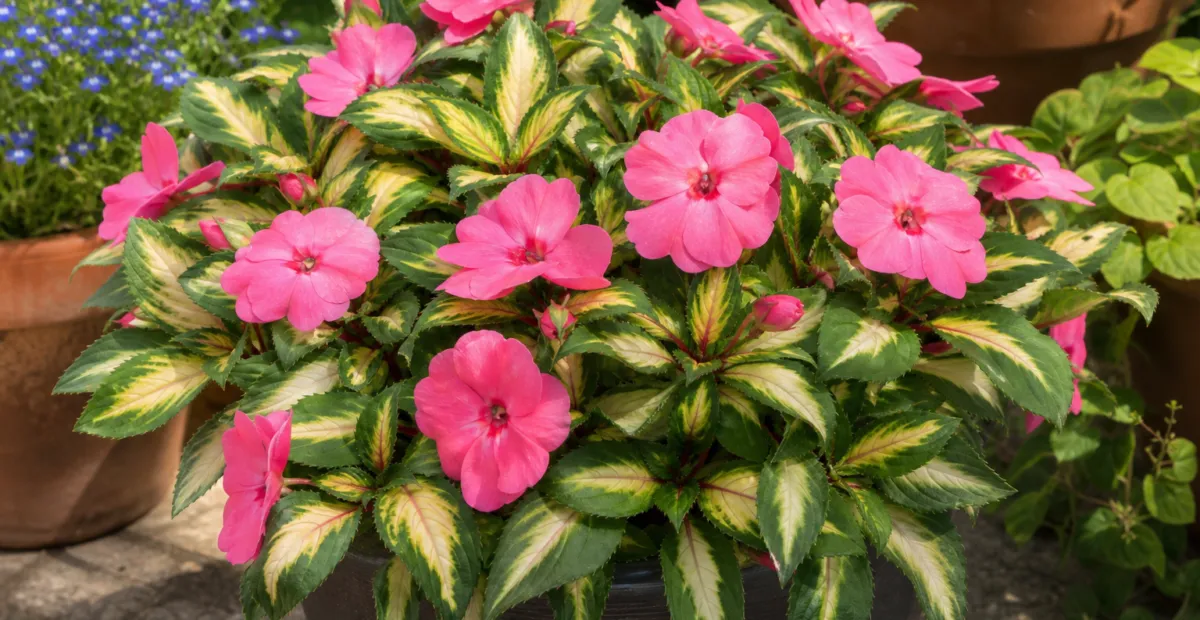
 AI-generated illustration
Compact Tropical (Impatiens sunpatiens ‘Compact Tropical’) short overview
Impatiens sunpatiens 'Compact Tropical' is a compact, bushy bedding impatiens valued for vivid pink flowers with red accents and unusual green foliage marked by a creamy-yellow central stripe. This heat-tolerant hybrid performs in full sun to partial shade, flowering from spring through fall and often until frost. Grow it in containers, borders, or mass plantings with evenly moist, well-drained soil.
Taxonomic classification
Compact Tropical (Impatiens sunpatiens ‘Compact Tropical’) care guide
Light and placement
Grow in full sun to partial shade, with roughly 4–6 or more hours of direct light where heat and water are adequate. Morning sun with light afternoon shade is useful in hot, dry regions. Too little light produces lanky growth and fewer flowers; intense reflected heat combined with dry soil can cause scorch, wilt, or bleached foliage.
Watering and humidity
Keep the root zone evenly moist but never saturated. Water deeply when the surface begins to dry, checking containers daily during hot weather; container plants may need frequent watering in summer. Reduce frequency in cool or cloudy weather, but do not allow repeated severe wilting. Water at the soil line when possible to limit leaf disease.
Soil and growing medium
Use fertile, moisture-retentive but well-drained potting mix or garden soil enriched with compost. A loamy structure helps prevent rapid drying while avoiding stagnant water around the roots. Slightly acidic to neutral soil is suitable; container mixes should include drainage material and never remain waterlogged.
Feeding
Feed after active growth begins with a balanced water-soluble fertilizer at half the label strength every two to three weeks, or use a controlled-release fertilizer according to its label. Water the plant before applying liquid fertilizer. Stop or reduce feeding in cool weather, after severe stress, or when the soil is dry to prevent root injury.
Growth and habit
Forms a dense, well-branched mounding plant with relatively short internodes. It fills containers and bedding spaces without normally requiring growth regulators in garden conditions. Plants may wilt dramatically when dry yet recover quickly after thorough watering; repeated drought reduces flowering and foliage quality.
Planting and repotting
Plant outdoors after the last expected frost when soil and nighttime temperatures have warmed. Set the root ball at the same depth as in its nursery container. Space plants about 20–24 inches apart for a continuous mass, allowing room for the compact mounding habit to fill in. Water thoroughly after planting and maintain even moisture during establishment.
Move into a container only slightly larger than the root ball when roots fill the existing pot. Transplant after the danger of frost has passed, disturbing the roots as little as practical. Containers must have open drainage holes because the plant needs consistent moisture but dislikes saturated roots.
Propagation and pruning
Propagation
Propagate commercially by licensed vegetative cuttings. Take healthy non-flowering shoot cuttings during active growth, root them in a clean, airy medium with steady moisture and high humidity, then gradually acclimate rooted cuttings. Seed propagation will not reliably reproduce this named cultivar.
Pruning
Little pruning is required. Remove broken, diseased, or badly stretched stems, and pinch lightly only if a young plant needs additional branching. Avoid severe cutting during hot, drought-stressed conditions; water first and allow recovery before reshaping.
Overwintering
In zones colder than 10a, treat the plant as an annual or bring containers indoors before frost. Indoor overwintering requires bright light, reduced watering, good airflow, and temperatures above about 55°F. Cut back lightly only if needed and check carefully for insects before bringing plants inside.
Uses
Primarily an ornamental annual for containers, patio displays, beds, borders, and high-density landscape color. Its heat tolerance and ability to flower in sun make it useful where traditional shade impatiens perform poorly. It has no established culinary or medicinal use in this cultivar and should not be treated as edible.
Appearance
The plant has succulent-looking green stems, dense branching, and pointed oval leaves with serrated margins. The most distinctive identification feature is the broad cream-to-yellow stripe running along the leaf midrib or center, contrasting with green leaf tissue. Flowers are bright pink with red accents and sit above the variegated foliage.
Flowering
The flowers are open, showy impatiens blooms produced continuously on branching stems. In the United States, flowering normally begins after spring planting and continues through summer and fall, often until the first hard frost. Deadheading is generally unnecessary because the plant is bred for continuous bloom and self-cleaning performance.
Pollination and visitors
Impatiens flowers commonly provide nectar and pollen for bees and bumblebees, with butterflies also recorded among visitors in the genus. Direct visitor records for this named cultivar are limited, so the attraction rating is cautious rather than a cultivar-specific pollinator trial result.
Diseases and pests
Diseases
SunPatiens selections are notably resistant to impatiens downy mildew, but poor drainage can encourage root and stem rots. Improve air circulation, avoid overhead watering late in the day, remove diseased material, and discard severely affected plants. Monitor for leaf spots, gray mold, and wilt when foliage stays wet for prolonged periods.
Pests
Watch for aphids, thrips, whiteflies, spider mites, and slugs. Inspect new growth and leaf undersides regularly. Use strong water sprays for light aphid infestations, remove badly damaged foliage, and favor insecticidal soap or horticultural oil when appropriate. Avoid routine broad-spectrum insecticides during bloom to reduce harm to visiting insects.
Related diseases and pests
Only Plant Doctor profiles whose host data indicate this plant may be affected are shown here.
 PestBroad mitePolyphagotarsonemus latus (Banks)
 PestCyclamen mitePhytonemus pallidus
 PestTwo-spotted spider miteTetranychus urticae
 PestCitrus mealybugPlanococcus citri
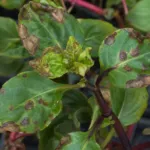 DiseaseImpatiens necrotic spot virus diseaseImpatiens necrotic spot orthotospovirus
 DiseaseCucumber mosaic virusCucumber mosaic virus
 DiseaseSouthern blightAthelia rolfsii
 DiseaseGray MoldBotrytis cinerea
Toxicity and pollen
ASPCA lists Impatiens species as non-toxic to dogs and cats. This cultivar is not documented as a food plant, so discourage intentional ingestion by children or pets and avoid using treated nursery plants as edible material. Sap or plant material may still cause minor irritation in sensitive individuals.
- Typical season
- Late spring through fall while flowers are open
- Pollination / pollen
- Primarily insect-dispersed pollen
This is an insect-pollinated flowering annual, so pollen is generally released within or around the flower during insect visits rather than carried in large airborne clouds. Airborne exposure is expected to be low, but sensitive people should avoid assuming zero allergy risk and should limit contact if symptoms occur.
Native habitat
This is a cultivated hybrid rather than a wild species with a single native habitat. Its Impatiens parentage is associated with warm, humid environments and fertile soils. In cultivation it performs best in warm summer conditions with reliable moisture, organic matter, and good drainage.
Interesting fact
The cultivar is marketed as SunPatiens Compact Tropical Rose and is protected under USPP 28,027. Its foliage has a distinctive central cream-to-yellow stripe. SunPatiens genetics were developed through breeding cooperation involving Indonesia. The compact series was bred for dense branching and container production.
Frequently asked questions (FAQ)
The most relevant questions about this plant, with short and direct answers.
🌱Quick care
How do you care for Impatiens sunpatiens 'Compact Tropical'?⌄
Grow it in full sun to partial shade, keep the soil consistently moist but well drained, and feed it periodically during active growth. It is frost tender, so protect it from cold or grow it as an annual.
Is Impatiens sunpatiens 'Compact Tropical' an annual or perennial?⌄
It is usually grown as a warm-season annual in the United States. It can persist as a perennial in frost-free areas roughly equivalent to USDA Zones 10–11, but freezing temperatures can kill it.
🌤️Environment and placement
Can Impatiens sunpatiens 'Compact Tropical' grow in full sun?⌄
Yes, this SunPatiens cultivar can grow in full sun, provided it receives regular moisture. In very hot climates, afternoon shade can reduce wilting and leaf scorch.
How much shade does Impatiens sunpatiens 'Compact Tropical' tolerate?⌄
It tolerates partial shade but generally performs best with bright light and some direct sun. Avoid dense, full shade because insufficient light can reduce flowering and produce weaker growth.
Is Impatiens sunpatiens 'Compact Tropical' good for containers?⌄
Yes, it performs well in containers, window boxes, and hanging baskets when planted in a quality, moisture-retentive potting mix. Containers dry out faster than garden soil, so monitor moisture frequently.
How large does Impatiens sunpatiens 'Compact Tropical' get?⌄
The Compact series generally forms a mounded plant about 14–24 inches tall and wide, although size varies with climate, nutrition, spacing, and growing conditions. Give plants enough room for airflow and outward growth.
What soil is best for Impatiens sunpatiens 'Compact Tropical'?⌄
Use fertile, moisture-retentive, well-drained loam or a high-quality container mix. Slightly acidic to neutral soil is suitable, but the planting medium should never remain waterlogged.
💧Care and problems
How often should you water Impatiens sunpatiens 'Compact Tropical'?⌄
Water whenever the soil surface begins to dry, keeping the root zone consistently moist rather than alternating between drought and saturation. Plants in full sun or containers may need water daily during hot weather.
Why is my Impatiens sunpatiens 'Compact Tropical' wilting?⌄
Wilting is most often caused by insufficient moisture, especially in full sun or a container, but waterlogged roots, extreme heat, or root disease can also be responsible. Check the soil before watering and ensure excess water drains freely.
Can Impatiens sunpatiens 'Compact Tropical' recover after wilting?⌄
Yes, it often recovers after thorough watering if the roots have not been damaged. Repeated severe wilting can cause leaf scorch, flower loss, and longer-term stress.
Should you deadhead Impatiens sunpatiens 'Compact Tropical'?⌄
Deadheading is usually unnecessary because the plant sheds spent flowers while continuing to bloom. Remove damaged flowers or foliage for appearance and better air circulation.
Does Impatiens sunpatiens 'Compact Tropical' need fertilizer?⌄
Yes, regular light feeding supports vigorous growth and flowering, especially in containers. Use a balanced flowering-plant fertilizer according to the label, avoiding excessive nitrogen that can promote foliage over flowers.
What problems affect Impatiens sunpatiens 'Compact Tropical'?⌄
Common problems include wilting from drought, root or stem rot from excess moisture, leaf scorch, aphids, thrips, whiteflies, spider mites, slugs, and fungal diseases. Good drainage, steady watering, airflow, and inspection of new plants help reduce risk.
Is Impatiens sunpatiens 'Compact Tropical' resistant to downy mildew?⌄
SunPatiens hybrids were developed for improved performance and resistance to impatiens downy mildew compared with traditional garden impatiens. However, no cultivar should be treated as immune to every disease or growing problem.
🪴Planting and repotting
When should you plant Impatiens sunpatiens 'Compact Tropical' outdoors?⌄
Plant it outdoors after the last expected frost, once nighttime temperatures are reliably mild and the soil has warmed. In much of the United States, this means spring, with timing adjusted to the local climate.
How far apart should you plant Impatiens sunpatiens 'Compact Tropical'?⌄
Space plants about 14–20 inches apart, depending on whether you want individual mounds or quicker coverage. Wider spacing improves airflow, while closer spacing fills a bed sooner.
Can Impatiens sunpatiens 'Compact Tropical' be grown indoors?⌄
It can be maintained indoors temporarily in a bright location, but it is primarily an outdoor bedding and container plant. Indoors, provide strong light, good drainage, steady moisture, and adequate airflow.
Can you overwinter Impatiens sunpatiens 'Compact Tropical'?⌄
You can try overwintering it indoors before frost by taking a healthy container plant or rooted cuttings and placing them in bright light. Success is most likely in a warm, bright environment, and the plant may become less compact during winter.
✂️Propagation and pruning
How do you propagate Impatiens sunpatiens 'Compact Tropical'?⌄
Propagation is commonly done from stem cuttings, which can root in a clean, moist medium under warm conditions. Because this is a named hybrid, seed may not reproduce the original plant reliably.
Can you prune Impatiens sunpatiens 'Compact Tropical'?⌄
Yes, light pruning can remove damaged growth and maintain a rounded shape, although routine pinching is usually unnecessary. Avoid heavy pruning during heat or drought stress.
⚠️Toxicity and safety
Is Impatiens sunpatiens 'Compact Tropical' toxic to dogs and cats?⌄
It is generally considered non-toxic to dogs and cats, but it is not an edible plant. Ingestion of any plant material can still cause mild stomach upset in some pets.
🌸Flowering and special interest
When does Impatiens sunpatiens 'Compact Tropical' bloom?⌄
It typically flowers from late spring through summer and can continue into early fall until frost. Consistent moisture, adequate light, and regular nutrition support continuous flowering.
What color are the flowers of Impatiens sunpatiens 'Compact Tropical'?⌄
The cultivar commonly sold as Compact Tropical Rose has bright pink flowers with red accents and yellow-green foliage edged in dark green. Color intensity can vary with light, temperature, and plant maturity.
Why is my Impatiens sunpatiens 'Compact Tropical' not flowering?⌄
Insufficient light, drought stress, excessive nitrogen, root problems, or cold temperatures can reduce flowering. Move it to brighter light if needed, keep moisture even, and avoid overfertilizing with a high-nitrogen product.
Similar plants
 He pickle pla (Delosperma echinatum) care guideDelosperma echinatum
 Impatiens ‘New Guinea’Impatiens 'New Guinea'
 Delosperma ‘Fire Spinner’Delosperma 'Fire Spinner'
 Delosperma nubigenum care guideDelosperma nubigenum
 Sheepfigs (Delosperma) care guideDelosperma
 Impatiens New Guinea Group (Impatiens hawkeri) care guideImpatiens hawkeri